Soft skills blog articles

Leadership and Training: A department head’s view

As a training provider, I have my opinions on how I think leadership and training should be connected.  Is this the same as what a German Dept Head thinks? I was recently fortunate to spend a few minutes with Arnhild Ott, Department Leader of Personnel Development in the Mail division of DPDHL. Here are four questions on leadership and training and her answers.

New Call-to-action


What do you wish line managers would understand about training?

Arnhild Ott: I wish that they would understand that training is only one possibility. The most interesting method is to learn on-the-job and that training is only 10% of the learning environment and it’s most valuable in your own business environment. A second point is that every training session needs to be centred on communication between the line manager and their employee. There is a need for a talk before and after the training. And this is very important for the training’s success: that the manager has an important role. A third point is that training is not an incentive; training is for when we have to close a gap between the current knowledge and the expected knowledge in the function of the role.

What will training look like in 10 years’ time?

Arnhild Ott: I expect that training will be more and more virtual, further away from classroom training with more webinars, more on-the-job, smaller pieces of content, or experience. It will be more creative, more integrated in your normal life and business life. It will be more difficult to see a distinction between training and a non-training session as it will be integrated in your business life. In short, small pieces, more virtual and more media-driven.

Can you give me your perspective on current trends in leadership culture?

Arnhild Ott: The world is rapidly changing. Main issues in the leadership culture context are that leadership practice is influenced by globalisation, by the uncertainty of the situation at the moment . You have to act in a more and more complex world. It’s more difficult for each manager to create the future. This is very strenuous for each manager because traditional methods and perspectives don’t help you in these increasingly complex situations. You always need more skills and more knowledge about methods, so as to be able to understand and (re)create complex situations with your employees.

The next point is that you see an increase in burnout; more and more people feeling limited in their competencies, their lives restricted by too much time at work. Everyone is searching for better work-life balance as they have to struggle against complexity. In fact, you see more and more issues of rationalisation. Mostly leaders have to handle more and more uncertainty and ambiguity. These are major challenges for people and especially leaders; everyone needs competencies to deal with uncertainty and unclear perspectives and also to enable them to decide on their own how to act.

Can you give some examples of these competencies?

Arnhild Ott: You need ambiguity. You need more systemic thinking rather than a linear perspective. You need to think from a network perspective- influence between several influences– not a single linear one. You have to combine rational thinking with more intuitive thinking and you have to recognise more and more your own gut-feeling.


A special thanks to Arnhild for taking the time to share her thoughts with us.  What do you think about what she said?  Do you agree?  Let us know in the comments area below.  Also, make sure to check out our methods and tools section to learn more about how companies are approaching their training.

Measuring Progress: What am I getting for my money?

Am I getting my money’s worth?

One key question for our seminar clients is, “Is paying for training experiences enough?”

Most often, the answer is clearly, “Yes”.  Despite all of the talk about ROI, buying an experience makes sense when we realize the benefits of training in general from an employee’s perspective. When organizations invest in training they get a lot from their employees even if they don’t change a thing based on what they learn. Employees appreciate the fact that the employer is willing to invest in their skills. They appreciate the break from the everyday. Employees value the opportunity to learn something that may help them to do their jobs better or more easily. Training is an additional benefit that can lead to higher morale.

As the 70-20-10 principle explains, formal training generally contributes to 10% of behavior changes at work. That’s it. 20% of work based behavior change comes from peer interaction and 70% from self learning. So back to the question, “What am I getting for my money?” In the best case, a training event offers a light at the end of the tunnel. It can point a way to lasting, improved skills and show participants a process for improving after the training event is done. On-sight, on-the-job training outside of the training room as well as coaching following the training event help training professionals to go beyond the training room 10%impact of most formal training.

Measuring Progress: Knowing what you want

Getting more for your money begins with knowing what you want to see after the training event is complete. Your outputs for the participants need to be verifiable and measurable. “I want them to work better together” doesn’t count. What will they do when they are working better together? The answer to that question is a good start of the process.

Is the training plan thinking based or doing based? If a training event is presentation heavy and practice light, it may lead to understanding without workplace application. Role plays, serious games and debriefing allow participants to see their needs in near workplace situations. When participants recognize their needs, they can practice and improve in the safe environment good training event should provide.

Is the trainer or the trainer’s company credible for the participants? A “who is this guy” approach by the participants will not make it easy for the trainer to give them the kinds of experiences that will lead to behavior change. Raising the credibility of the trainer will help participants to value the trainer and, most importantly, the training you are providing.

The bottom line is…

The bottom line answer to the question “What am I getting for my money?” is an experience that can serve as a catalyst for employee learning and workplace application. In combination with OTJ training and coaching you can extend the benefit of a trainer’s involvement. Ultimately, you are giving your employees another opportunity to improve themselves.

Let us know what you think about measuring progress in the comments area below.  Want to learn more about making the most of your training investment?  Download our short eBook here to read how.

Leadership: A practical exercise for managers

Do you ever stop and ask yourself the simple question: “What are my responsibilities as a manager?”

Sounds obvious, right? But how often do you really give yourself a chance to reflect on your performance as a leader?

eBook: The definitive checklist for qualifying training providers hbspt.cta.load(455190, ‘0377217d-6395-4d26-a5fc-d32a69e484a5’, {});

The John Adair Action-centered leadership model

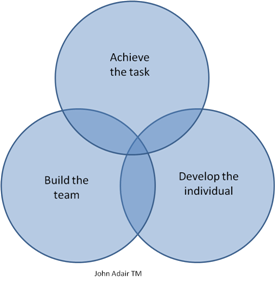
Over the years there have been countless models developed on this theme, and millions of books sold (and some of them even read! ).  Although it’s not the very latest of models, John Adair’s Action-Centred Leadership model is a simple and effective starting point when reflecting on your personal impact as a manager.  According to the model, the heart of your responsibilities as a manager are:

Leadership circles

  • to achieve the task
  • to develop your employees
  • to build an effective team

When you are performing at your best you are able to do all 3 of these things, and find the right balance. This balance means you and your team get the results you need and everyone benefits. This balance also makes your life easier, as synergies quickly build e.g. by achieving the task the team grows and individuals have a chance to develop. Likewise a strong team sharing ideas and supporting each other in difficult situations, naturally enables individuals to develop and therefore you achieve the task.

FREE DOWNLOAD

PUSH & PULL

Learn more about the two basic approaches to influencing others

influencing


A simple reflective exercise for managers

This is a simple and practical exercise to help you reflect on your performance and focus your actions.  You’ll need an uninterrupted 10 minutes, pen and paper.

Step 1

As a manager you are responsible for achieving your department’s task, building the team and developing individuals.

  • Take a moment and think about how well you are performing in these three areas.
  • Now take a pen and draw the three circles in proportion to how satisfied you are with your performance in each area. (and not how much time you spend on each area).  For example, if you feel that you are doing a good job of achieving the task, but your employees aren’t really developing and there’s very little team building then you might have something like the example below:

LeadershipStep 2

Now look at your circles and consider these 3 questions:

  1. How satisfied are you with your situation?
  2. Can you identify  3 concrete actions you can take to improve your performance?
  3. What has been preventing you from doing this and how are you going to overcome this?

Step 3

Identify one concrete step you can take in the next days – and do it.

More on action-centered leadership

This activity is used in our Practical Toolbox for Managers seminar, and something I try and do every few months myself. Clients and participants have consistently found this activity hugely useful.  A little focus and some “time out” from the hustle and bustle of your day-to-day challenges can go a long way. Take a look at these links for more information:


3 Questions for an HRD Leader on training

As trainers, we can offer our views on what we think is a good trainer, what is important for HRD, etc. Does that match what an experienced, German HRD Dept Head thinks? What is HRD’s view on training? I recently spent a few minutes with Jürgen Birkhölzer, Department Leader for Personnel Development in the Mail division of DPDHL. Here are three basic questions on training and his answers.

The big (free) eBook of negotiations language


What is a good trainer?

Jürgen Birkhölzer: A good trainer has a clear idea of what his targets are and that of his students. A good trainer has the right level of empathy so that he is able to walk in the shoes of his students. This is more the behavioral side. There is also a knowledge side. I think here a good trainer should be very qualified in their area of competence and the content of their training. A good trainer has to love the situation of dealing with people and has to be a good communicator: this is not only to lecture, like lessons in a university, it’s more building  sustainable levels of communication with the student and having a deep wish to exchange knowledge with the learner- it’s not just a one way process. If we look at a trainer whose job it is to work together with his learners to improve their behavior, like leadership or communication training, the being perfect aspect is not so important. It is more important that they are able to ask the right questions, that they are able to get students to realize their own ideas and have their own insights into the environment they want to focus on. Trainers are not able to change people, they are only able to change themselves; introducing self-reflection in the learners will help them work on their behavior. Overall, the communication or leadership trainer needs to be a very good psychologist.

What do training managers want from trainers?

Jürgen Birkhölzer: That’s a good question. The answer is connected to my daily work. We want our trainers to be available 24/7 as we have to meet our customer’s needs. That sounds easy but is very complex as we have a limited workforce in our internal training team and we very often have changing requirements. On the one hand, it’s our job to try to fulfill our business’s needs and on the other to steer the capacity of our trainer staff. We decided that for our trainers have to deliver 120-140 billable trainer hours per year. This gives us a clear perspective of what our capacity is, but we have to consider that we don’t have a stable request from our customer. In November and December and during the summer, we have no requests for training so we have to ask our trainers to go on vacation. In fact, I think the most important competence of a trainer manager is to find a balance between the necessary business idea to fill the customers’ requirements on the one hand, and on the other, to have the idea of resilience in mind that the capacity of your trainers is limited.

What is the most important thing in HRD in working with line managers?

Jürgen Birkhölzer: We have to look at this question from 2 sides: a line manager in an operational role and a line manager in a strategic role. Collaborating with strategic managers is the most important and relevant job HRD has to do. HRD has to provide services, training measures, processes and instruments and the whole world of HRD to fit business needs. HRD has to frequently clarify what is a business need with strategic managers. From my point of view, this is the most important relationship for HRD; the relationship to the business unit and the business in order to understand what is going on in the business now, and even more importantly, what will happen in the future. To support the strategic initiatives of the business with fitting HRD managers is a core measurement of HRD. So is the strength of the HRD relationship to the business and also how HRD manages to be intensively involved in what’s going on strategically.

The second point is the collaboration with the line managers. It is very important that line managers understand that HRD supports their daily business, that training and coaching supports them in being successful in their role. It’s not only the question that HRD costs money, it’s a question that in collaboration with the line manager, it is HRD’s job to explain what is the value-add of HRD and that the line manager has the opportunity to experience this value-add. HRD should not just be seen as a nice-to-have and that if you have cost-cutting in the department you must stop all HRD. In fact, it should be the opposite and that line managers say the last money we save is the money for the qualification for our people. This is the second most relevant task of HRD. They can provide as much high quality training as they want, but if strategic management doesn’t understand what the support of HRD means and the line managers don’t see the value added benefits, no-one will be successful.


A special thanks to Jürgen for taking the time to share his perspective with us.  What do you think about what he said?  Do you agree?  Let us know in the comments area below.  Also, make sure to check out our methods and tools section to learn more about how companies are approaching their training.

70-20-10 Model: 5 Implementation Tips

What is the 70-20-10 model?

As we mentioned last week in our blog post, the 70-20-10 model has been around for a few years now, and reflects the increasing awareness that learning is not just about “traditional” training (whether it be a seminar, classroom, or an e-learning program). Research has shown we actually acquire most of the knowledge, skills and behaviours we need to perform our jobs through actual experience and working alongside others.

The 70-20-10 model has its origins in the work of McCall, Eichinger and Lombardo from the Centre for Creative Leadership. Their book, “The Career Architect” (1996), is based on empirical research and concluded that successful managers learned in 3 different ways:

  • 70 percent of learning comes from real life on-the-job experiences, tasks and problem solving
  • 20 percent of learning comes from feedback, working with and observing role models
  • 10 percent from “traditional” training

In our last post we talked about why you should think about implementing the 70-20-10 model.  Now, let’s take a look at how you can implement it at your company.

5 Practical tips for implementing the 70-20-10 model in your company

1.  Enable experiential learning – this is key when we consider that 70% of learning comes from “doing”. Giving employees the opportunity to learn through challenging yet achievable experiences is one the most powerful and practical tools in a manager’s toolbox.

Experiential learning can come through new roles and equally occur within existing roles. Three approaches we’ve seen clients benefit from are:

  • extending the scope of responsibility and control
  • enabling and increasing decision-making power
  • expecting staff to build new relationships (e.g. other business units, senior managers, virtual teams , suppliers, partners, clients…)

2.  Be prepared to accept a compromise between optimal efficiency and developmental opportunities.   You can expect to see specific requests upwards, where an employee is keen to get involved in a challenging project specifically to build their skills. Naturally they won’t be as effective or efficient as somebody who can already perform this role – so look at it as a learning and development initiative rather than just a question of resources.

3.  Engage with internal and external trainers and training providers early on to discuss how to connect the dots between on-the-job, social and formal learning. The goal is to identify critical skills and behaviors and then look at building and reinforcing these using all options.

4.  Coaching and mentoring – Both coaching and mentoring are great ways of integrating social learning into a traditional program. Although the two terms are often used interchangeably, and both draw on a similar skill set I’d argue there are differences. For me mentoring is deliberately connecting an experienced person (the mentor) with a less experienced one (the mentee). The mentor could be a colleague, a manager, or the line manager. The mentor then tutors, shares experiences, models, counsels and offers feedback.  Coaching does not necessarily imply directly related experience, tends to be less directive, and is aimed at improving performance in specific areas.  Regardless of how you define them, both approaches have a lot to offer.

5.  When it comes to traditional training the key is early and explicit management involvement. The single most powerful step a manager can take is to clearly explain to their staff  why the training is relevant to the business and that there are clear expectations. This simple step drives motivation, participation and transfer. This transfer is crucial and I’d suggest that any traditional formal training has to integrate a transfer plan. In this simple document the employees are challenged to consider how they will actually transfer the learning into their workplace, when they’ll do this, who else needs to be involved and how will they know when they have achieved this.

The 70-20-10 model has proven to positively impact organisations in enhancing their learning and development programs. Now that you know what it is, and some tips on implementing it, let us know if you have any experience with the 70-20-10 model in the comments area below. Want to learn more on how else you can help employees retain what they learn from training? Click here for more information.

70-20-10 Model: Getting Started

What is the 70-20-10 model?

The 70-20-10 model has been around for a few years now, and reflects the increasing awareness that learning is not just about “traditional” training (whether it be a seminar, classroom, or an e-learning program). Research has shown we actually acquire most of the knowledge, skills and behaviours we need to perform our jobs through actual experience and working alongside others.

The 70-20-10 model has its origins in the work of McCall, Eichinger and Lombardo from the Centre for Creative Leadership. Their book, “The Career Architect” (1996), is based on empirical research and concluded that successful managers learned in 3 different ways:

  • 70 percent of learning comes from real life on-the-job experiences, tasks and problem solving
  • 20 percent of learning comes from feedback, working with and observing role models
  • 10 percent from “traditional” training

Initially focussing on management and leadership development, this conclusion has since been extended to other types of professional learning and development. Today the 70-20-10 model is being used by Learning & Development departments in a wide-range of multinationals operating across a broad range of businesses. (e.g. PriceWaterhouseCoopers, Nike, Dell, Goldman Sachs, Maersk, L’Oréal, and Caterpillar)

Why implement the 70-20-10 model?

The model has an attractive simplicity, although the exact ratios are contended. As a trainer and manager of a training company my feeling is that the most important step is to see the model as a philosophy and not a rigid recipe.  The key is understanding and accepting that the majority of learning actually happens outside of the classroom, and that any learning and development program should take this into account and proactively support this.  It doesn’t mean that traditional training is no longer relevant in the 21st century, but rather that this traditional training is just a part of learning and development strategies.

Whether you are a learning & development specialist, a line manager, a trainer or training provider, or an employee, you should take time to reconsider and refocus your efforts. By doing this you can:

  • shift the focus and expectations towards more efficient and effective types of learning and development
  • ensure that time and money invested in learning and development makes a greater impact
  • support your business by keeping people in the workplace while they are learning

“Almost without exception, in my experience, organisations that have adopted 70-20-10 have achieved greater impact on performance at organisational and individual level at lower cost than was being achieved beforehand.” – Charles Jennings

Moving forward starts with simple conversations

Based on what we’ve seen our clients do, and what we’ve tried ourselves, here are some concrete and practical ways to begin implementing the 70-20-10 model in your organization.

The first step is to raise awareness and build commitment through simple conversations.  Everyone involved needs to be brought on board with the idea that leaning and development is not just about going on a course.  My own experience as a manager is that this is a relatively easy process in that many managers see 70-20-10 as “common sense”.

These conversations are essential as the 70-20-10 model depends on L&D working closely with line managers, and on line managers communicating with their staff. Managers need to be aware of the pivotal hands-on role they play in developing their staff, and employees need to appreciate the context for new decisions.

During these conversations it’s worth being clear that this is not a cost-cutting exercise, replacing “training” by a loose learning-by-doing approach. It’s actually a quality driven initiative, aiming to make sure that the company is developing to meet future challenges.

If, like Target Training, you’re a medium sized company, these conversations are reasonably manageable. If, like many of our clients, you’re part of a larger organization then start small. Find a business unit where managers are comfortable and confident wearing the “developing people” hat. Speaking with our clients, many of whom are multinationals, the general consensus has been that introducing the 70-20-10 model step by step has proved to be the most effective approach. By connecting with managers who have a genuine interest in developing their teams and the employees within them, the model organically spreads to other areas.

The 70-20-10 model has proven to positively impact organisations in enhancing their learning and development programs. Now that you know what it is, next week we will get into some practical tips on how to implement it in your company. Let us know if you have any experience with the 70-20-10 model in the comments area below. Want to learn more on how else you can help employees retain what they learn from training? Click here for more information.

Prioritizing Work: 4 Categories to Help

4 Simple categories to help in prioritizing work

Prioritizing work can be a challenge for anyone, especially managers. I have just returned to work after being on holiday for two weeks. After reading all of my emails and speaking to my colleagues, I now have a huge to-do list. In the past, I wouldn’t have known where to start but I recently learned a very simple method for prioritizing. Based on The Eisenhower Matrix, I label each task on my to-do list with a letter, A, B, C or D.

Prioritizing work with A, B, C, or D


1.  ‘A’ tasks: Do it

These tasks are:

  • urgent, very important and should be done straight away
  • directly affect the work of others and they are waiting on you to continue their own tasks

2.  ‘B’ tasks: Plan it

These tasks are:

  • important but not urgent, so you can take the time to plan when you will do them
  • ones that require extra thought and consideration and should not be rushed

3.  ‘C’ tasks: Delegate it

These tasks are:

  • ones that aren’t overly important but need doing quickly
  • easily done by others who have more time to do them

4.  ‘D’ tasks: Drop it

These tasks are:

  • not urgent, nor are they necessarily important
  • ones that could be skipped, forgotten about, or done only if you have extra time at the end of the day


The A tasks are the most important, so I start with them, then the B and so on. One challenge I face is to find the time for the C tasks. Normally, at the end of the day, I find it useful to make my to-do list for the next day, along with the priorities; that way I know exactly what to do when I arrive at the office and I can get straight to work. It also stops me from brainstorming tasks for the next day when I should be listening to my bedtime story!

What methods do you use for prioritizing work? Let us know in the comments area below.  Are you interested in improving your time management?  Click here for information on how.


Head, Hand & Heart: 3 elements all presentations need

Every presentation is different. Or is it? In this short video, Chris Slattery, Managing Director and training enthusiast, outlines the three elements all presenters need to keep in mind to make sure their presentations runs well. By keeping the key elements of head, hand and heart in mind even the most inexperienced presenter can deliver a clear and memorable message.

Discover more about how we integrate the Head, Hand and Heart model into our seminars here.

Meeting Rules: Mobile Phones and Laptops

Does your company have clear meeting rules?

While some organizations have clear policies about whether laptops and mobile phones can be used during meetings, in other companies the rules were never established or have been allowed to grow relaxed. Ask a group of professionals what they think about this issue and you’re bound to get a mixed response. Some people will say these devices should be banned from every meeting with no exceptions; some will say they don’t see any problem with using them in meetings; others will say that remaining in touch is an absolute business necessity. We’re not here to tell you how to run your meetings. We are here, however, to bring your attention to the fact that you need to have clear meeting rules on this issue, regardless of how you decide to handle it.

3 Dangers of not having clear meeting rules for mobile phones/laptops

  1. There’s not a unified approach to the meeting – In previous posts, we’ve discussed the importance of setting ground rules for your meeting. Mobile phones and laptops should definitely be addressed when you set the ground rules along with your team.
  2. There’s a chance some colleagues might be unhappy – If a member of your team is strongly against the use of laptops and mobiles in meetings, they should have a chance to discuss the issue with their colleagues. In the end, a conversation about the situation might highlight key issues. What if, for example, one colleague has responsibilities that force him or her to be in contact with another group of people at the same time as your meeting?
  3. You’re not as efficient as you could be – While we’ve stated that it may be necessary for some people to be in contact all the time, the fact is that when someone’s attention is divided between the meeting they’re in and their laptop screen, they’re not completely focused on the matter at hand.

3 Ways for your team to deal with the issue

  1. Establish a total ban – This might not be a popular approach, but it solves the problem permanently. This means all mobile phones and laptops are switched off and put away, out of sight.
  2. Ask colleagues who absolutely must take a call or send an email to leave the room – This is probably a healthy compromise, but the risk is that attendees will still spend the entire meeting checking their phone or laptop, even if they don’t make any calls or send any emails.
  3. Put an “email break” on the agenda of longer meetings – This doesn’t take care of urgent phone calls or emails, but can probably satisfy even the most hardcore smartphone and email addicts.

3 Outcomes of establishing meeting rules

  1. You display leadership – Setting ground rules and then sticking to them is key to running meetings that really work. When you take charge effectively and suggest solutions, the members of the group will feel more committed to working together with you as the leader of the meeting.
  2. You save time – A few minutes spent discussing this issue now can potentially save a lot of time (and problems) later.
  3. You ensure everyone is on the same page – Without the chance to discuss opinions, small disagreements about issues like these can turn into bigger problems. A unified team will ultimately work better together over time.

Having clear meeting rules will help everyone focused on the topic and not distracted by calls and emails. Let us know what has worked for you in the comments area below.  Click here for more information on how to make your meetings run more smoothly.

Presentation slides: 4 Keys to Keeping Attention

4 Keys to good presentation slides

Creating presentation slides that summarize your points but still keep your audience’s attention isn’t easy. Ever try talking to someone who is busy reading a book? It’s not easy to get and hold their attention, is it? This is what happens when you stand up to make a presentation and your presentation slides are full of text. The audience will be splitting their attention between trying to read and trying to listen. You should keep your text to a minimum, and never just read from your presentation slides. So, to ensure that your slides support your message rather than distracting from it, here are a few tips.

1.bmp3 main points per slide, one sentence per point. If there is too much information on the slides, your audience will not be able to concentrate on what you are saying as they will be trying to read the slides.


2Slides should NEVER include paragraphs.  You are the presenter; the slides support you, not the other way around.  If you need a lot of text, you should be sending a report or email. They should not contain information that the speaker or audience needs to spend time reading.  This information can be included in the handouts.

387% of the information we process is through what we see, 9% is through what we hear and 4% is from other senses1.  If you want people to listen to what you are saying and to understand it, don’t ask them to read at the same time.  If you want them to read, perhaps you should email them a report instead.

4When you want to talk, try adding a blank slide into your presentation – they will have nothing else to look at so they’ll concentrate on you.


Remember

Your presentation slides support your message, they don’t tell the whole story for you! Let us know what has worked for you in the comments area below.

Normal
0

false
false
false

EN-US
X-NONE
X-NONE

/* Style Definitions */
table.MsoNormalTable
{mso-style-name:”Table Normal”;
mso-tstyle-rowband-size:0;
mso-tstyle-colband-size:0;
mso-style-noshow:yes;
mso-style-priority:99;
mso-style-qformat:yes;
mso-style-parent:””;
mso-padding-alt:0in 5.4pt 0in 5.4pt;
mso-para-margin-top:0in;
mso-para-margin-right:0in;
mso-para-margin-bottom:10.0pt;
mso-para-margin-left:0in;
line-height:115%;
mso-pagination:widow-orphan;
font-size:11.0pt;
font-family:”Calibri”,”sans-serif”;
mso-ascii-font-family:Calibri;
mso-ascii-theme-font:minor-latin;
mso-hansi-font-family:Calibri;
mso-hansi-theme-font:minor-latin;
mso-bidi-font-family:”Times New Roman”;
mso-bidi-theme-font:minor-bidi;}
[1] Sheldon Press; Pease, Alan; “Body Language, How to read others thoughts by their gestures”

4 Ds of Presentations

Do you know the 4 Ds?

You are a good presenter — you are engaging, funny and energetic. You like the challenge of speaking in public and you are good at it. Yet you have the feeling sometimes that you could be doing more or doing things differently.  There are some situations in which you connect better to the audience than others and you feel you can do better.  You can do this by paying attention to the 4 Ds:

Contact us now hbspt.cta.load(455190, ‘7813087e-b095-4d57-a251-222b117a6cc4’, {});

Development – Design – Delivery – Debriefing

The 4 Ds of presentations

Development

There is no “one size fits all” solution for what to do to make a good presentation. Success depends on the audience and the situation as to what techniques are more likely to work and what aren’t.  That’s where the first D comes in, Development. In this sense, development means developing your understanding of the context of your presentation before moving on to designing the content. The more special the situation or presentation is for you, the more time you should invest in understanding what may happen before it does. Are key decision makers warm to the idea you are presenting or not? Does the audience have mixed opinions? What goals unite you and the audience in ways they can appreciate? Is the audience expecting a lot of data? How formal or informal do they expect you to be? Knowing the answers to these and other questions can lead to a refined message and different design and delivery behaviors than you may be used to.

Design

You know the importance of a good looking presentation. Many companies recognize the importance of presentation design so much that they hire professional designers to produce them. That means sometimes presenters are asked to present presentations they didn’t personally create. Often they are produced to fill a function, like introducing your company, not meet the needs of a specific audience. Generic presentations mean the presenter needs to work harder to make the material relevant to their audience.  The key in design is, if the information shared is important to the audience, they will pay attention to it. The best format helps but the relevance of the information makes the difference.

Delivery

Certain delivery techniques can help us deal with the prepackaged design situation effectively. We can draw our audience’s attention to a special part of a slide by using a pointer and the phrase “Let me draw your attention to…” if there is too much information on the slide. You can tell stories to bring meaning to data and you can relate charts and graphs to the experiences of your audience without changing a slide. The results of your development work will point you in the best direction. If you need to do something for the audience that is outside of your comfort zone: practice, practice, practice. The more you practice a different style the more comfortable you will become.

Debriefing

Getting feedback from your audience about your presentation is important to continual process improvement. This means getting feedback solely about the presentation itself and not its outcome. This can be difficult to do yet there are some ideas worth considering. Have a third party write down the audiences’ questions for review after the presentation. Ask audience members about specific delivery behaviors you are working on, like eye contact, controlling your movements and how you use your hands rather than simply asking them what they thought of the presentation.

Increase your chance of success

The 4 Ds of presentations; Development, Design, Delivery and Debriefing, can help you tailor your presentations to specific audiences and make the appropriate adjustments in your style to increase your chances of success. Let us know some of your experiences in the comments area below.

FOR MORE INFORMATION

Here are just a few posts for you to explore if you want to learn more on this topic.

Setting Goals: 8 Ideas to Ensure Effectiveness

8 Ideas to ensure you are setting goals that are effective

Setting goals is a large part of any manager’s job. If you are going to spend the time setting goals, make sure that they are going to be effective. We all know about SMART goals, but what about effective goals?

1.  Linked to business priorities

Your goals should:

  • be linked to the bigger goals of your organization or to key elements of your business strategy
  • solve a particular short-term problem which is “urgent but not important”
2.  Linked to results, not activities

Also expressed as “should be related to the job’s outputs, not inputs”, or “concerned with ends and not means”.

  • An activity: “conduct six training sessions for First Aiders on site”
  • A result: “train six First Aiders so that they pass the basic examinations by June 6th”
3.  Measurable and specific

Objectives should state clearly “how much”, “by what date”, “how well”, “at what cost”, “with what degree of accuracy”, “compared to what”. This is obviously easier for some jobs than for others. Even for service-orientated jobs, (always difficult to quantify) it is often possible to identify some valid performance indicators on which objectives can be based.

4.  Challenging – but attainable

Objectives should certainly be stretching, challenging and “developmental”. However, unattainable objectives will prove very de-motivating – even if you were the individual who originally proposed them. Keep an eye out for self-imposed objectives which are over-ambitious!

5.  Matching experience and capability

Objectives should not only be based on business goals, but should also be tailor-made for each individual. These should take into account their personal experience, skills, knowledge, planned development, etc.

6.  Updated

If changes outside the job-holder’s control occur which make the objectives significantly more or less achievable, the objectives should be reviewed and updated. Failing to do so leads to total cynicism about the whole principle of objective-setting and recognizing good or bad performance.

7.  Number of objectives

It is easy to set too many objectives. This could lead to priorities that aren’t clear for either party, as well as attention and focus that is diluted. There is no universally “correct” number – this will vary from job to job. When in doubt, aim for fewer rather than more.

8.  Compatible upwards/downwards/sideways

Check that each individual’s set of objectives is compatible with others. These should aligned with the manager’s own objectives, those of the job-holder’s colleagues and their subordinates.

Remember

The more effective you are at setting goals, the more chance you have of achieving what your business really needs to achieve! Want to know more about setting goals as well as working more efficiently and effectively?  Click here.


Asking Good Questions in Presentations

3 Quick tips on asking good questions in presentations

Asking good questions during a presentation can be difficult. If you haven’t understood a point in the presentation, it is likely that other people in the audience will be thinking the same as you. You don’t want to leave the presentation with a question mark in your head so it is important to ask your question. Other people in the audience will likely be pleased that you have asked.  Here are 3 quick tips on asking good questions in presentations.

1.  Prepare

Write your question down before you ask it. This will allow you to reflect on your question before you ask it, as well as giving you time to check to see if it is understandable.  Also, some questions sound good at first, but you may reconsider asking them after a minute of thought.

2.  Provide context

Some presentations are long and your question may be related to a topic covered 10 minutes ago. Provide some context of what the topic was or what point you are addressing. This will help both the person who is answering the question and the rest of the audience understand what you are talking about.  It also shows that you have been paying attention and are following the presentation.Contact us now

3.  One question

Try to ask just one question instead of clustering your questions. If you ask a lot of questions all at the same time, it can confuse the presenter and you probably won’t get the detailed response you are looking for.  If you have a two or three part question, wait until the presenter answers the first question and then ask your next question.  They may answer your second question in their first answer.

If you have any more tips on asking good questions in presentations, please let us know in the comments section below.

Presentation Introductions for Beginners: The 3 Ps

Presentation introductions for beginners

Do the thoughts of presentation introductions make you nervous? Does the idea of speaking in front of people make your mouth go dry? Well keep reading …
If you are nervous about presenting in English, making effective presentation introductions is especially important.  Effective presentation introductions will help your audience know what to expect and it will help you feel confident. Once you’ve started well it is easier to keep going – and don’t forget that your audience is there to listen to what you have to say and not your English.

The 3Ps

A colleague shared this simple technique with me, and it always works. When you are presenting in English (or in any language) your introduction needs to answer three questions:Contact us now

  1. Why are you standing there presenting? What is the purpose of your presentation?
  2. What are the steps in your presentation? What is the process you will follow?
  3. Why should your audience listen to you?  What is their payoff?

It doesn’t matter if you are introducing your team, presenting a process or giving an update on a project – the structure is the same. The 3Ps help you remember this structure, and if it helps you when you are nervous, why not use the three keywords?

An example of the 3Ps in action

“Good afternoon and thank you for coming.  The purpose of my presentation today is to update you on the factory acceptance test.  The process I will follow is to first review the agreed schedule, then talk about the tools we are using and finally we will look at two problems we have found and how we will solve them.  This will take me 10 minutes. Why should you listen?  Well, your payoff is that you will be confident that we can complete the FAT on schedule and that everything is under control.”

If you follow this structure your presentation introductions will be simple, clear and effective.  Most importantly you can concentrate on what you want to say, and stop worrying about the English.
Good luck, and let me know how it works for you in the comments area below.


Storytelling in Business – Why Not? Part 2

The power of storytelling in business

Storytelling is again a topic of interest in the business communications world.  Conferences and speakers around the world are praising the power of storytelling and attracting audiences. My question is, why? Humans have told stories since our earliest beginnings. We all tell stories.

“Storytelling comes naturally to humans, but since we live in an unnatural world, we sometimes need a little help doing what we’d naturally do.” ― Dan Harmon

It was part of our survival and development. Stories are all around us, from campfires to multimillion dollar movies, so why do we have to make a case for it in a business environment?

This second part of a two-part blog post (part 1) covers the two remaining things we learned when preparing a seminar about storytelling in business. This seminar gives participants the skills and determination to tell more stories and better stories in the workplace.

Courage to connect

Lesson 4

If work for you is simply an exchange of power, storytelling and other enhanced communication tools are not important.  Others will translate what you say into orders if you are in a power position just as you may interpret orders from your superiors.
If you want your workplace to be a place where people build something together instead of following the orders of the few, storytelling is an active strategy to humanize the workplace for you and your co-workers. It provides opportunities for meaningful connections that inspire trust.

From stories to action

Lesson 5

A good story can set the stage in a business environment and yet we often need to make the purpose clear once it is complete.  We can achieve that socratically through a debriefing method or by simply telling the listeners what we had in mind directly.

Why this works

A clear explanation of the purpose of the story provides a natural, logical connection to the observation of what the teller and the listeners need to accomplish in a business environment. Getting things done on an individual level is a function of:

  • understanding clearly what to do
  • having the ability to do it
  • being motivated to get it done

Address the why

Stories can clearly address the “why” of an action leading to an increase in commitment to doing it. When listeners can connect the story to their current situation, they become involved in the process of identifying what to do and why it needs to be done—without having to be told.

More

See how Target Training provides skill development seminars about Storytelling in business and many other communication skills to increase your effectiveness in the workplace. Let us know if you have anything to add in the comments box below.


Storytelling in Business – Why Not? Part 1

The power of storytelling in business

Storytelling is again a topic of interest in the business communications world.  Conferences and speakers around the world are praising the power of storytelling and attracting audiences. My question is, why? Humans have told stories since our earliest beginnings. We all tell stories.

“Storytelling comes naturally to humans, but since we live in an unnatural world, we sometimes need a little help doing what we’d naturally do.” ― Dan Harmon

It was part of our survival and development. Stories are all around us, from campfires to multimillion dollar movies, so why do we have to make a case for it in a business environment?

Generally, I think the answer is fear. We are afraid to “lay an egg”, reveal too much of ourselves, show too much emotion or not be taken seriously at work. After all, work is the activity in which most of us invest most of our waking hours so there’s a lot at stake.

This two-part blog post covers five things we learned when preparing a seminar about storytelling in business. Our storytelling seminar gives participants the skills and determination to tell more stories and better stories in the workplace.

5 Lessons about storytelling in business: Lessons 1-3

What does your listener want?

Lesson 1

What attracts audiences to the telling of a story?  It comes down to three things:

  1. emotion
  2. energy
  3. authenticity

Telling bedtime stories to children is a practical example of the standards adults have for stories as well, though many may not say it. Children will demand expressions of the energy of the characters, the emotion of the plot and telling the story “like you mean it”. Adults need these things too to be engaged.

What makes a good story good?

Lesson 2

As Aristotle observed, a good story starts with a character in trouble. The character is one the audience can identify with–not too good to be in trouble and not too bad to deserve the trouble to come.  The story progresses with the development and deepening of the trouble to create a sense of fear in the audience so the resolution of the problems leaves the audience with a sense of relief.
Aristotle referred to the stages as pity, fear, and catharsis. Stories from Greek tragedy to Toy Story follow this model in one way or another.
In the workplace we can tell stories about problems, consequences and solutions to reflect Aristotle’s model.

Crafting stories that fit

Lesson 3

The STAR Model is a basic and effective format for telling stories in a business environment. The model fits the needs of business audiences as it sets the scene, describes the action in it and talks about what happened to resolve the situation. This model is very effective in behavioral interviewing, answering questions about past performance and offering a status update.

Situation – clearly explain the facts and assumptions that make up the context of the action.

Task – detail the task to be completed or the goal to be reached.

Actions taken – describe all relevant actions taken to complete the task.

Results achieved – describe the immediate outputs and eventual outcomes of the actions taken.

Make sure to check our site for part 2 next Wednesday. See how Target Training provides skill development seminars about Storytelling and many other communication skills to increase your effectiveness in the workplace.

Let us know if you have any comments on the first three lessons below.

Presentation Mistakes: 3 Ways to Handle Yours

We all make mistakes

We all make presentation mistakes. Sometimes we don’t realize we’ve made them until it’s too late. Sometimes the presentation mistakes don’t get noticed by others, and sometimes they do. You may have experienced the following: you are in the middle of a presentation when you realize the information on your next slide is wrong. What do you do? Continue presenting the information as though nothing is out of the ordinary? Admit that there is a mistake? Use a little humor and turn it into a test to see if anyone can spot the mistake?

3 reasons to prevent the audience from pointing out presentation mistakes

  1. You stay in control. If you point it out you are in control of the situation. You are only human and you can address it in a way that you think works best for your personality.
  2. You can stop questions that might annoy you.  Unfortunately there are some people who delight in picking holes in things. There are others who are more interested in the accuracy of details than in the bigger picture. Someone who is concerned about accuracy will be upset about the fact that, e.g. all the nouns in a headline do not start with a capital, and may chose to point this out. If you’re a big picture kind of person, you will not understand why the other person felt it necessary to comment on something so seemingly trivial. You will get irritated, which is not helpful in the middle of a presentation, and you might not respond to that positively.
  3. You save face. It can be disconcerting and embarrassing to have someone in the audience draw attention to your mistake. This may affect you for the rest of the presentation.  You may also lose credibility.

Phrases to use when realizing presentation mistakes

  • “Can anyone spot the mistake on this slide?”
  • “I’ve just noticed a mistake on this slide. It should read sales rose by 2% not to 2%. Apologies for that.”
  • “Bear with me for a second while I correct the error here”.Contact us now

3 results of pointing out your own presentation mistakes

  1. You stay credible. Mistakes are OK if you own up to them. If someone else points them out then this is where you can begin to feel uncomfortable.
  2. You come across as human.  Your open, honest approach will impress. After all, who doesn’t make mistakes?
  3. You have the opportunity to include the audience. If you challenge them to find the mistake, they need to wake up and think.

Presentation mistakes aren’t generally a problem. It’s how they are handled that can be. Having a strategy ready for how to react if you notice a mistake in your own presentation, will prevent you from having to think on your feet. Let us know if you have any other phrase or ideas to add to this post. Want to know more how how to become a better presenter? Click here.

Giving feedback using the DESC model

Giving feedback effectively will have a real impact on your business

Everybody understands that performance feedback should be constructive, focused and to the point. Effective feedback can resolve conflicts, overcome problems and improve individual and team morale. It doesn’t really need mentioning that ineffective feedback often accomplishes the opposite. Or that if you are skilled at giving effective feedback, your team will be more motivated, which leads to better performance.

While feedback should focus on behavior, performance feedback is still a personal conversation between people about people. Emotions always play a part in interpersonal communication. Effective feedback is as much about bringing the right message(s) across as it is about how your message is interpreted.

No matter how skilled the feedback giver is, if the receiver isn’t interested in hearing or taking the feedback, nothing will get through.http://www.forbes.com/sites/danschawbel/2014/03/05/douglas-stone-the-importance-of-feedback-in-business-communications/

The more difficult the feedback, the more the giver needs to consider the the emotional impact of the feedback. Giving positive feedback is easy.
Writing emails that people read: Free eBook download hbspt.cta.load(455190, ‘aaa71860-e705-4a7e-b8e5-ab6e16849d2e’, {});

DESC is simple and it works

In our skills-based Leadership training, we use the simple 4-step model DESC for structuring feedback. Participants in our “Practical Toolbox for Managers” seminars often highlight DESC as one of the most valuable tools they are taking away. This model is designed to help you to get your message clear and it can even take the stress out of the feedback conversation for those of us that weren’t born with effective feedback-giving skills.

DESCRIPTION

Give an objective and concrete description of what you have observed using “I” statements.

EFFECT

Explain the effect or impact it had on your business, the team or its members. If the effect was an emotion, name it. Your body language and tone of voice will already be showing your elation or frustration – putting them out in the open can help you move things forward.

SOLUTION

Build the solution through a directive (“What I would like you to do next time is …”) or a participative approach (“What do you think we can do to avoid this next time?”).

CONCLUSION

Build a “contract of commitment”. Check your understanding of what has been agreed, and get commitment for the future.

Further Leadership resources:

Someone Late for Meetings?: 3 Questions to Ask

When someone is always late

Effective meetings can be tough to manage when everyone is on time.  What about when someone is always late for meetings?  Everyone in an organization knows that lateness can be a problem, but the topic of what to do if someone is consistently late for meetings is rarely discussed. Here, the key word is consistently. Everyone can be late at one time or another, but it’s when someone is predictably, consistently late that problems begin to pile up. Before we get to the questions you should ask your chronically late colleague, let’s take a look at the questions you shouldn’t ask.

3 questions you shouldn’t ask your colleague who is always late for meetings

  1. Is your watch broken?
  2. Did you forget how to tell time?
  3. Where the hell were you?

Time management strategies don’t include learning how to tell time or buying a better watch. Experts in the field agree that if someone is consistently late for meetings, it’s their attitude that’s to blame. Changing time habits in relation to meetings means changing the colleague’s mindset, incentivizing being on time and not punishing colleagues for being on time. Yes, you read that right. Very often, meetings are postponed to wait for late colleagues, effectively punishing those who come on time.

3 questions you should ask your colleague who is always late for meetings

1.  Do you think you have a clearly-defined role in this meeting?

A clear role means having a specifically-defined function in the meeting. Some examples of roles: moderator, organizer, minute-taker, timekeeper and participant. Participant is the generic name for anyone at a meeting, but a participant has responsibilities at the meeting as well and should be held accountable for fulfilling them. Examples of the responsibilities of a meeting participant are: being active in brainstorming sessions, contributing to discussions and helping create the agenda for future meetings.

2.  You’re going to keep the minutes for the next meeting, right?

Keeping and distributing the meeting minutes isn’t exactly the most glamorous or enjoyable task. One way of encouraging participants to come on time might be to give them a small penalty (for example, maybe they have to keep and distribute the minutes for the next meeting, make a small donation to a charity or supply coffee for everyone at the next meeting). Naturally, the penalties should be light-hearted, but the cause should be taken seriously.

3.  Do you have any feedback about the quality of this meeting?

Being on time is important, but lateness can sometimes be a symptom of dissatisfaction with the meeting itself. If your colleague lacks a clear role, feels that their voice isn’t heard in the meeting or finds the meeting pointless, it can lead to carelessness regarding the ground rules your meeting participants agreed on (one of which should definitely be: we start and end on time).

3 benefits of considering these points when someone is consistently late for meetings

  1. You ensure all colleagues have a clearly-defined role in the meeting.
  2. You ensure that chronically late arrivals are punished for their tardiness, not the other way around.
  3. You accept responsibility for the quality of your meeting and give the participants a chance to give feedback. An anonymous feedback form made available on the company intranet might be one way of allowing colleagues to give constructive feedback in a comfortable manner.

As we can see, being late for meetings can be an indication that someone has a broken watch, but it can also be a reflection on the quality of your meeting in general. Taking a moment to reflect on the underlying reasons behind a behavior can be a chance to make sure your meeting is running as efficiently as possible.

Presentation Techniques: Speaking in Threes

Presentation techniques: tripling

There are hundreds of presentation techniques, and some are more common than others. One example is that people find it easy to remember things in threes, and building on this tendency (known as tripling) is one of the simple presentation techniques that work in all presentations.  You’ve probably already seen or heard people doing it…

“Veni, Vidi, Vici”  – Julius Caesar
“Friends, Romans, Countrymen …” –William Shakespeare
“Government of the people, by the people, for the people” – Abraham Lincoln

Of course you don’t need to be a great public speaker to make this work for you in your business presentations.

3 simple tips on presentation techniques for speaking in threes

1. Use three items that fit together to make an impact

Come back to the same item each time, hammering home the point:
  • We can retain customers by reducing our reaction time.
  • We can retain customers by offering round the clock support.
  • And we can retain customers by delivering spare parts within 48 hours.
  • Three items that act in sequence to reach a desired goal. e.g. “If we reduce our reaction time, offer round the clock support, and commit to delivering spare parts within 48 hours we will retain more customers.”
  • Three key themes that together cover a wide area. e.g. “We need to retain customers, we need to expand into the BRIC countries and we need to acquire smaller local competitors.”

2.  Use rhetorical questions

  • Ask a rhetorical question e.g. “So what is our new customer support strategy?”
  • Offer a simple, even minimalistic, response  e.g. “It’s called One Service.”
  • Then drive this home with three related words or phrases to grab attention, encapsulate or summarize. e.g. “One Service will form networks, it will promote best-practice sharing and most importantly it will make us even more effective.”

3.  Use your voice to leave a lasting impression

  • You can connect the three items by rising or reducing the pitch of your voice for each one.
  • Going up with your voice increases emotion, going down brings a sense of finality and certainty.
  • You may also want to put your most important point last – and then pause before it to make an additional impact.

Give it a go. Using presentation techniques such as speaking in threes will make your key messages simple. It will also make them clear and, above all, it will make them memorable. Let us know what you think in the comments area below.  Also, click here to see how Target Training’s seminar can help even the great presenters get better.