Leadership

Tag Archive for: leadership

Doing business with another culture can be many things – exciting, intimidating, rewarding, challenging … and intercultural training should play a key role in helping your team to prepare to succeed globally. But what should you be asking for? And how can you evaluate the many many options out there? A recent coaching session showed the dilemma perfectly. Martin, a senior materials purchaser was about to start a relationship with an Indian supplier – and their very first question to us was “So, what should I do, and not do, when I’m in Mumbai?”.

A “does and don’ts” sort of approach can be useful if you are focussing on a single culture and in a real hurry. Starting from a position of concern and wanting to be aware of tricky situations make sense -but it brings with it a range of difficult questions. Intercultural training doesn’t stop with knowing the do’s and don’ts. Nor does it stop with just theory. But, who knows to say “I have to go to Mumbai in 2 week’s time. I’d like to learn about some theory and an intercultural model”.

The limits of a do’s and don’ts approach to intercultural training

SMALL TALKThink for a moment of your own culture. How easy would it be for you to tell someone how they should act when they come to your country? Do all of the people in your country act the same, react the same, or think the same? A list of do’s and don’ts doesn’t explain the reasons behind cultural behaviours, so would it really help you to do business in that country?

Now don’t get me wrong. Do’s and don’ts

  • can provide a sense of security,
  • are easy to engage with,
  • they simplify a challenging situation.

Download our free eBook


“Understanding one’s own cultural profile is key to enhancing job performance and bottom line business results when working with other cultures.”
Fons Trompenaars

How does the IAP differ from a do’s and don’t’s approach to intercultural skills building?

Dr Fons Trompenaars is the best-selling author of Riding the Waves of Culture and one of the world’s leading management thinkers. He is also the architect behind the Intercultural Awareness Profiler (IAP) – a self-assessment and diagnostic tool. The Intercultural Awareness Profile (IAP) is designed to assess the personal orientation and choices that individuals make when resolving intercultural business issues. We asked him “How does the IAP differ from a does and don’ts approach? “ , and this is what he said …

Building business relationships through understanding

The Intercultural Awareness Profiler (and the theory of the 7 dimensions of culture the IAP is based upon) offers you a robust basis to understand the dos and don’ts . Once you understand more about why people act a certain way, you can start to think about how you should act when e.g. presenting your product, managing staff, negotiating a framework agreement. The IAP provides a deeper level of understanding, meaning you don’t just recognize but also respect differences between cultures. Without that, how can you build authentic business relationships?

Interview with Dr Trompenaars

Also online:

When learning a foreign language, it’s definitely beneficial to vary techniques and shock the brain so that it becomes more alert and is more apt retain information such as new vocabulary. In this vein, listening to native speakers is one of the best ways to learn. The learner can hear how the language is used in a variety of situations as well as intonation and pronunciation. This technique works best when the learner has interest in the topic being discussed; otherwise, the learner loses interest and stops listening. TED Talks are a great place to find interesting topics. TED means Technology, Entertainment and Design, but the talks now cover just about any topic you can think of. One great thing about the videos is that you can choose subtitles (English, please!) or follow along with the interactive transcript if you want. These are helpful tools for understanding an unknown word. I recently perused the website and found a few videos of varying length on the topic of increasing office productivity that I would like to share.

Free Download

How sweet are your emails?

writing emails free ebook

How to save the world (or at least yourself) from bad meetings

David Grady shares with us his ideas on How to save the world (or at least yourself) from bad meetings in his talk where he uses the analogy of office furniture theft to explain how and why the listener can and should bring order back to their daily work schedules by avoiding unnecessary meetings. After watching, you can learn how to avoid MAS, too!

Why work doesn’t happen at work

Jason Fried details three suggestions on how to improve productivity in the workplace in his talk on Why work doesn’t happen at work. In it, he explores where people feel more productive and what causes involuntary distractions at the workplace. He compares work to sleep phases where you need long stretches of uninterrupted time to get work done. What is the longest you can go at work without getting interrupted by managers or meetings?

Got a meeting? Take a walk

In her short talk, Nilofer Merchant advises the listener Got a meeting? Take a walk. Not only is this idea good for the health, it also allows you to get out of the office and see things a bit differently. As she says, fresh air drives fresh thinking!

As work gets more complex, 6 steps to simplify

Sometimes work gets unnecessarily a bit too complicated. Yves Morieux has thought about this and came up with six ways towards streamlining in his talk As work gets more complex, 6 steps to simplify. He looks to answer the questions why productivity is so disappointing, why there is so little engagement at work and what this has to do with the increasing complexities faced by businesses today. His answers just might surprise you!

If you found these talks interesting, I suggest you explore other TED talks on a topic that intrigues you. There are many compelling talks available, and the more engaged you are with the topic, the more likely you are to retain any new vocabulary you pick up whilst listening. Not only that, but you can also use the talks to train your ear for understanding foreign accents such as Yves’ wonderful French accent. Let us know what interesting talks you discover!

listening skills target trainingThe purpose pyramid is one of the simplest and yet effective communication models for introducing a presentation, opening a meeting or organizing your thoughts that there is. It is so simple, in fact, that no one seems to take credit for it though you will find it in the work of many communications gurus. The four questions in the pyramid aren’t special by themselves, but together they offer a powerful way to connect what you want to do with the goals and needs of your organization, no matter what business you are in or function you perform. Why? + What? + How? + Who? = Alignment. The Purpose Pyramid makes it easy for you to structure your communication – in any situation.

Free Download

pyramid

Why?

Why is where you share or remind your team about the deeper meaning and purpose of the organization. This is the reason that energizes you and your colleagues as well as your customers. What’s your why? Your purpose is best when it brings the energy of your team together and they can all see themselves in it. It should also attract internal and external customers to your work.

A band plays music, by definition – but wouldn’t you rather see a band whose purpose is to give you high energy and a memorable musical experience?

At a more nuts and bolts level, you can also apply the why to day-to-day interactions and situations. An example could be to state the purpose (why) of a meeting on the agenda for everyone to see. If there is a question about being on track, the team can refer to the mutually agreed purpose of the team.

What?

What refers to the tasks you and your team need to get done to contribute to making your purpose a reality. At their best these tasks are things you can track and observe easily so all can know when it is accomplished. For example, to have better meetings is not a clear task. Having everyone contribute to the meeting is a clear task. The SMART principle is a great model to use, just remember they should in some way contribute to achieving your purpose.

An example could be to make task identification a two-step process. Instead of automatically identifying who should complete a task at the same time as identifying the task, outline just the tasks first. Going through the how before identifying who will help team members to know what they are committing to.

How?

How is where you turn to your method, approach or process, How will you get your tasks accomplished? For example, sticking with the “better meetings” example, if my task is to have everyone contribute to a meeting, I could tell the team members I expect them to contribute and hope for the best or I could use a polling technique in the meeting to give each attendee the space to speak uninterrupted.

If a task is complex, the “how” could be a process or procedure that helps to complete the task effectively and efficiently. If you have standard operating procedures in place, this is the time to stress their use.

An example could be to identify the resources and process necessary to complete a task before asking who will do it. Leaders get a chance to offer support to the team and may encourage team members to accept a stretch task because they know how they will be supported.

Who?

Who refers to the individual and collective commitments or expectations that match your team to the tasks at hand. In most meetings the who stage tells how well we’ve done the other stages. If team members recognize and connect with their purpose, the necessity of a task and the process and resources to get it done, it’s a lot easier to agree to do them. With the clarity you’ve built earlier, it is easier for you to ask for what you want while committing to do what is necessary to support your team. A great question at the end of a meeting is “what have we agreed to do?” to check agreements without sounding like a task master.

Browse our blog for more tips and tricks

And/or let me know of any other useful communication tools that always work for you. I look forward to hearing from you!

In order to be effective your team needs a number of key elements to be present. Elements such as clarity of purpose, shared awareness of roles and constructive communication. These elements are not difficult to achieve but they do take focus and effort. Take a moment and ask yourself two simple questions – How many teams are you currently part of?  And how effective are these teams?  The first question is easy, but the second? Working in teams is so common for many of us that we just don’t take the time to reflect on how effectively we are actually performing – and so we miss an opportunity to develop ourselves, our team and our impact on our organization’s goals. Researchers have shown over and over again, that these elements are essential for effective teams. Businesses which recognize their importance and work at maintaining them, are rewarded with teams that consistently perform and achieve their targets. Ignoring them leads to unachieved goals, wasted potential and demotivated staff.

New Call-to-action hbspt.cta.load(455190, ‘0455f399-a600-43a9-848f-986da3f8ea8e’, {});


What does an effective team look like?

Here’s a simple tool we use when running workshops with existing teams. Some of these questions are hopefully familiar, but too often we see goal-oriented teams typically neglect the softer aspects explored by questions 8-10. Select one team of which you are currently a member.  Now ask yourself the following questions, rating on a 1 to 5 scale, with 1 being low and 5 being high:

  1. Do we have a clearly defined purpose?
  2. Are our roles and responsibilities well-defined, understood and followed?
  3. Do we have the tools and resources we need to achieve our objectives?
  4. Do we listen to each other?
  5. Do we all actively participate in problem solving?
  6. Do we work constructively through conflict?
  7. Does our team leader approve of our work, providing relevant and specific feedback on whether we are meeting expectations?
  8. Do we work and learn together?
  9. Do we take time out to assess our progress?
  10. Would we work together on another team?

Your score

Effective teams should be expecting to score 40+.  Outstanding teams score 45+.  What did you score? And what are you going to do now? Why not check out Target Training’s seminar on building effective teams?  Click here for more information.

As a kid, my parents told me I watched too much TV. They would not be pleased to know that hasn’t changed very much, but at least nowadays I try to watch things that might actually inspire me. That’s where TED [www.ted.com] comes in. TED talks can be a great source of inspiration. They can be short, or long. They can be energetic or dry. And they are full of information on nearly any topic.

The “3-6-9 of great leadership”

As an intercultural trainer, business English teacher, project manager and former actor, I think a lot about what motivates people, especially at work. Three short TED talks that I have watched over and over really get to the heart of what makes a great leader. I call them the “3-6-9 of great leadership.” These three talks summarise in (more or less) 3 minutes, 6 minutes and 9 minutes what I think is the essence of great leadership. For now, I’m not going into why these and other well-structured talks and presentations work as well as they do. Let’s just take in their messages.

Derek Sivers

How to start a movement

The first TED talk, by entrepreneur Derek Sivers, explains to us in three minutes “How to Start a Movement.” Using a light-hearted video of a group of rather spontaneous dancers, he demonstrates how to lead and how to create a situation in which people want to follow. He also surprises us by highlighting who the real leader is. It’s not who you might think.

Drew Dudley

Everyday leadership

If you work in a team or an office, how often do your simple, unremarkable actions influence others? In the second talk, leadership educator Drew Dudley asks us in six minutes whether people can be leaders even if they don’t have that title. In this quick-paced, very personal story, he shows us how we can often be leaders without even knowing it.

Roselinde Torres

What it takes to be a great leader

In the final talk, the longest of the three at just over nine minutes, leadership expert Roselinde Torres details qualities of a great leader. She has spent 25 years researching leadership and her fascinating talk boils it down to the need to ask three simple questions:

  • Where are you looking to anticipate the next change to your business model or your life?
  • What is the diversity measure of your personal and professional stakeholder network?
  • Are you courageous enough to abandon a practice that has made you successful in the past?

Spoiler alert!

All three talks repeat one particular theme: While some principles of leadership may remain, true leaders are characterised by doing something different. But not just for the sake of being different. They have a goal.

  • Derek Sivers’s ‘leader’ is the first person who has the courage to follow the person you think is the leader. As the first ‘follower’ he gives others the permission to join in.
  • Drew Dudley’s ‘leader’ appears to go about his daily business fearlessly and effortlessly. In the process, he unknowingly inspires someone to go about her work as fearlessly as she can.
  • Roselinde Torres reminds that great leaders take action; they do not walk with their heads down, trying not to be noticed. They dare to be different.

Is leadership for managers only, then? Definitely not. These three talks remind us that learning to be an effective leader can help you chair a meeting, or create a presentation that people remember. Among many other things.

… so what are your thoughts?

Performance reviews, appraisal interviews, annual reviews – whatever you call them it all boils down to the same thing. Extra work. I used to hate preparing for appraisal interviews with members of my team. Now I really enjoy them. Why? I’ve changed my approach. Rewind 10 years or so: I’d make the appointment, forget about it until I saw it on my schedule for the next day, have a quick think, dig out a few pertinent facts, come up with a few random goals, and off I went.

Free Download

4rs


What’s changed then? I want to keep my employees in the company. And performance appraisal interviews are important in making sure this happens. So, I use my “5 Keeps” approach:

“If you’re reading this, apologies to those individuals who had to live with how I used to prepare for performance appraisals. I’m probably part of the reason you hate performance appraisal interviews.”

Keep it objective

I’ve finally understood that appraisal interviews don’t work if you see them as an event that happens once a year. How can they? We’re all human and we don’t remember things. We inevitably end up reviewing what the employee did most recently. If that was good, great. If something wasn’t so good, then the employee gets a poor review for the whole period, which is not really fair, is it? Emotions play a role here. It helps to find a way of standing back from what is happening at the time of the interview and look at the whole year objectively.

Keep notes

This may sound a little geeky, but to help with the appraisal interview, I keep a little notebook for each member of my team. I make notes of the little things, feedback from clients, team members, from other members of the management staff. Anything that could be of interest really. This means I don’t have to spend time gathering information before the interview. I have the specific examples I need in front of me. All I need to do at the preparation stage of the appraisal interview then is grab my little book. I schedule time for preparation before the meeting. I align my notes with the appraisal interview form and the self-evaluation form from the employee, and I’m all set for the interview.

Keep the conversation open all year

The thing about my notes is that there is nothing secret in there. Everything has already been shared. When I get good (or bad) feedback from a client, I tell them about it when it happens. When they do something really well, I tell them. When they underperform, I tell them.

Keep it developmental

Too often the focus can be on the operational details. Sure, that’s important for the business, but you can talk about that during the year. The key question is: how can I use this opportunity to make sure that this person is not doing exactly the same thing in exactly the same way this time next year? I want to make sure the focus is on development. I want to make sure goals we set together are motivating and are going to help the person grow. If they grow, we grow.

Keep it fun

Fun? Really? Yes, appraisal interviews are a great opportunity to talk to your employee about them. Do you have much time during the year to really learn about them? Probably not as much as you’d like. Here you’ve got allocated time to hear about how they feel – make the most of it, be encouraging, and enjoy it!

More on performance appraisal interviews

This post is the first of a 4-part series on performance appraisal interviews. Make sure to come back if you’re interested to read more about:

  • Starting a performance appraisal interview
  • Giving opinions and explaining reasons in a performance appraisal interview
  • Summarizing a performance appraisal interview


This post introduces the Action-Centred Leadership Model and provides a practical exercise to help leaders reflect on how they achieve objectives, develop their people, and create high-performing teams.

  • Reading time
  • 8 Minutes
  • Target audience
  • Managers, team leaders, and aspiring leaders looking for a practical framework to improve their leadership effectiveness and balance task delivery, team performance, and individual development.

Introduction

Delivering results is only one measure of an effective leader. Today’s leaders are expected to engage and develop their people, foster collaboration, navigate change, and lead across hybrid or geographically dispersed teams. We often hear about the impact of having to balance these responsibilities from participants in our leadership training programmes. “There is little time to reflect on anything and I have no idea if I’m even doing a good job in leading my team”, one participant said. And a few others nodded in agreement.

Leadership is a constant balancing act between achieving objectives, building strong teams, and developing individuals. That’s why practical leadership frameworks remain so valuable. Especially when they turn complexity into something tangible and actionable. John Adair’s Action-Centred Leadership Model remains one of the most relevant because it focuses on what leaders actually do every day.

New Call-to-action

The John Adair action-centred leadership model

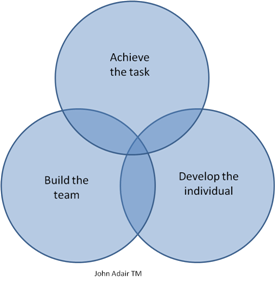
Developed by leadership expert John Adair, the Action-Centred Leadership Model has stood the test of time because of its simplicity and practicality. While the workplace has changed dramatically since the model was introduced, its core message remains highly relevant: effective leadership is about balancing three interconnected responsibilities.


Leadership circles


The overlapping circles illustrate that these responsibilities are interconnected. They influence one another. Progress in one area often strengthens the others. A leader who develops individuals builds a stronger team. A stronger team collaborates more effectively, making it easier to achieve objectives. Likewise, successfully achieving meaningful goals builds confidence, strengthens relationships, and creates new opportunities for individual growth.

This is why the model remains so powerful. Rather than viewing leadership as a series of competing priorities, it encourages leaders to see task, team, and individual development as mutually reinforcing. The challenge is finding the “right” balance so that each area supports the others, rather than allowing one to dominate.

Understanding the Three Leadership Responsibilities

Before reflecting on your own leadership approach, it is useful to explore what each of the three circles represents.

Achieve the task

Every leader has a responsibility to deliver results. This involves setting clear objectives, making effective decisions, solving problems, allocating resources, and ensuring that important work gets completed. Strong task leadership creates clarity. People understand what needs to be achieved, why it matters, and what success looks like.

Build and maintain the team

Results are rarely achieved by individuals working alone. Leaders also need to create the conditions for people to work effectively together. This means building trust, encouraging collaboration, creating a shared sense of purpose, managing conflict constructively, and developing a team environment where people feel motivated to contribute.

Develop individuals

Effective leaders recognise that every team member has different strengths, motivations, and development needs. Developing individuals involves coaching, providing meaningful feedback, recognising achievements, delegating opportunities, and helping people build the skills and confidence they need to grow.

A practical exercise to reflect on your leadership balance

This exercise is not intended to provide an objective assessment of your leadership effectiveness. Its purpose is to encourage honest reflection and help you identify where small changes could make the biggest difference. Applying it to your own leadership is where the real value of this model lies.

You’ll need an uninterrupted 10 minutes, pen and paper.

Step 1 – draw your 3 circles

  • Take a moment and think about how well you are performing in the three areas.
  • Now take a pen and draw the three circles in proportion to how satisfied you are with your performance in each area. (and not how much time you spend on each area).  For example, if you feel that you are doing a good job of achieving the task, but your team members aren’t really developing and there’s very little team building then you might have something like the example below:

LeadershipStep 2 – reflect on your leadership balance

Now look at your circles and consider the following questions:

  • How satisfied are you with your current leadership balance?
  • Which area would have the greatest impact if you improved it?
  • What three specific actions could you take to strengthen your effectiveness?
  • What has prevented you from taking these actions so far, and how could you overcome those barriers?

Step 3 – choose 1 action 

Choose one practical step you can take in the coming days and commit to doing it. Small changes in how you lead—such as having an open conversation, clarifying expectations, or creating more opportunities for team collaboration—can have a significant impact over time.

Conclusion

The enduring appeal of John Adair’s Action-Centred Leadership Model lies in its simplicity. It reminds leaders that effective leadership comes down to balancing three fundamental responsibilities: achieving the task, building the team, and developing individuals.

However, finding the right balance does not mean giving equal attention to each area at all times. Leadership situations are constantly changing. A new project may require a stronger focus on achieving the task. A team facing challenges may need greater attention on trust and collaboration. An individual taking on new responsibilities may need more coaching and support.

The skill of effective leadership is recognising what the situation requires and adjusting accordingly.

Simple frameworks can be powerful because they give us a clear way to pause, reflect, and ask better questions. Adair’s model provides leaders with a practical lens to consider where they are having the greatest impact, and where small changes could make a meaningful difference.

Leadership development starts with awareness. Real improvement comes when that awareness leads to action.

Key Takeaways

  • Effective leadership is not measured by results alone. Great leaders balance achieving objectives with building strong teams and developing individuals.
  • John Adair’s Action-Centred Leadership Model provides a simple framework for understanding the three responsibilities every leader must manage: task, team, and individual.
  • The three areas are interconnected. Investing in people strengthens teams, stronger teams improve performance, and achieving meaningful goals creates opportunities for further growth.
  • The challenge for leaders is not giving equal attention to every area at all times, but finding the right balance for the situation they are facing.
  • Regular reflection helps leaders recognise where they are performing well and where small changes could improve their impact.
  • Leadership development starts with awareness but real improvement comes from turning reflection into action.


Giving feedback effectively will have a real impact on your business

Everybody understands that performance feedback should be constructive, focused and to the point. Effective feedback can resolve conflicts, overcome problems and improve individual and team morale. It doesn’t really need mentioning that ineffective feedback often accomplishes the opposite. Or that if you are skilled at giving effective feedback, your team will be more motivated, which leads to better performance.

While feedback should focus on behavior, performance feedback is still a personal conversation between people about people. Emotions always play a part in interpersonal communication. Effective feedback is as much about bringing the right message(s) across as it is about how your message is interpreted.

No matter how skilled the feedback giver is, if the receiver isn’t interested in hearing or taking the feedback, nothing will get through.http://www.forbes.com/sites/danschawbel/2014/03/05/douglas-stone-the-importance-of-feedback-in-business-communications/

The more difficult the feedback, the more the giver needs to consider the the emotional impact of the feedback. Giving positive feedback is easy.
Writing emails that people read: Free eBook download hbspt.cta.load(455190, ‘aaa71860-e705-4a7e-b8e5-ab6e16849d2e’, {});

DESC is simple and it works

In our skills-based Leadership training, we use the simple 4-step model DESC for structuring feedback. Participants in our “Practical Toolbox for Managers” seminars often highlight DESC as one of the most valuable tools they are taking away. This model is designed to help you to get your message clear and it can even take the stress out of the feedback conversation for those of us that weren’t born with effective feedback-giving skills.

DESCRIPTION

Give an objective and concrete description of what you have observed using “I” statements.

EFFECT

Explain the effect or impact it had on your business, the team or its members. If the effect was an emotion, name it. Your body language and tone of voice will already be showing your elation or frustration – putting them out in the open can help you move things forward.

SOLUTION

Build the solution through a directive (“What I would like you to do next time is …”) or a participative approach (“What do you think we can do to avoid this next time?”).

CONCLUSION

Build a “contract of commitment”. Check your understanding of what has been agreed, and get commitment for the future.

Further Leadership resources: