
Action-Centred Leadership: A Practical Exercise to Find Your Leadership Balance

- Reading time
- 8 Minutes
- Target audience
- Managers, team leaders, and aspiring leaders looking for a practical framework to improve their leadership effectiveness and balance task delivery, team performance, and individual development.
Introduction
Delivering results is only one measure of an effective leader. Today’s leaders are expected to engage and develop their people, foster collaboration, navigate change, and lead across hybrid or geographically dispersed teams. We often hear about the impact of having to balance these responsibilities from participants in our leadership training programmes. “There is little time to reflect on anything and I have no idea if I’m even doing a good job in leading my team”, one participant said. And a few others nodded in agreement.
Leadership is a constant balancing act between achieving objectives, building strong teams, and developing individuals. That’s why practical leadership frameworks remain so valuable. Especially when they turn complexity into something tangible and actionable. John Adair’s Action-Centred Leadership Model remains one of the most relevant because it focuses on what leaders actually do every day.

The John Adair action-centred leadership model
Developed by leadership expert John Adair, the Action-Centred Leadership Model has stood the test of time because of its simplicity and practicality. While the workplace has changed dramatically since the model was introduced, its core message remains highly relevant: effective leadership is about balancing three interconnected responsibilities.
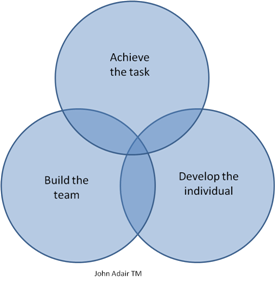
The overlapping circles illustrate that these responsibilities are interconnected. They influence one another. Progress in one area often strengthens the others. A leader who develops individuals builds a stronger team. A stronger team collaborates more effectively, making it easier to achieve objectives. Likewise, successfully achieving meaningful goals builds confidence, strengthens relationships, and creates new opportunities for individual growth.
This is why the model remains so powerful. Rather than viewing leadership as a series of competing priorities, it encourages leaders to see task, team, and individual development as mutually reinforcing. The challenge is finding the “right” balance so that each area supports the others, rather than allowing one to dominate.
Understanding the Three Leadership Responsibilities
Before reflecting on your own leadership approach, it is useful to explore what each of the three circles represents.
Achieve the task
Every leader has a responsibility to deliver results. This involves setting clear objectives, making effective decisions, solving problems, allocating resources, and ensuring that important work gets completed. Strong task leadership creates clarity. People understand what needs to be achieved, why it matters, and what success looks like.
Build and maintain the team
Results are rarely achieved by individuals working alone. Leaders also need to create the conditions for people to work effectively together. This means building trust, encouraging collaboration, creating a shared sense of purpose, managing conflict constructively, and developing a team environment where people feel motivated to contribute.
Develop individuals
Effective leaders recognise that every team member has different strengths, motivations, and development needs. Developing individuals involves coaching, providing meaningful feedback, recognising achievements, delegating opportunities, and helping people build the skills and confidence they need to grow.
A practical exercise to reflect on your leadership balance
This exercise is not intended to provide an objective assessment of your leadership effectiveness. Its purpose is to encourage honest reflection and help you identify where small changes could make the biggest difference. Applying it to your own leadership is where the real value of this model lies.
You’ll need an uninterrupted 10 minutes, pen and paper.
Step 1 – draw your 3 circles
- Take a moment and think about how well you are performing in the three areas.
- Now take a pen and draw the three circles in proportion to how satisfied you are with your performance in each area. (and not how much time you spend on each area). For example, if you feel that you are doing a good job of achieving the task, but your team members aren’t really developing and there’s very little team building then you might have something like the example below:
 Step 2 – reflect on your leadership balance

Now look at your circles and consider the following questions:
- How satisfied are you with your current leadership balance?
- Which area would have the greatest impact if you improved it?
- What three specific actions could you take to strengthen your effectiveness?
- What has prevented you from taking these actions so far, and how could you overcome those barriers?
Step 3 – choose 1 action
Choose one practical step you can take in the coming days and commit to doing it. Small changes in how you lead—such as having an open conversation, clarifying expectations, or creating more opportunities for team collaboration—can have a significant impact over time.
Conclusion
The enduring appeal of John Adair’s Action-Centred Leadership Model lies in its simplicity. It reminds leaders that effective leadership comes down to balancing three fundamental responsibilities: achieving the task, building the team, and developing individuals.
However, finding the right balance does not mean giving equal attention to each area at all times. Leadership situations are constantly changing. A new project may require a stronger focus on achieving the task. A team facing challenges may need greater attention on trust and collaboration. An individual taking on new responsibilities may need more coaching and support.
The skill of effective leadership is recognising what the situation requires and adjusting accordingly.
Simple frameworks can be powerful because they give us a clear way to pause, reflect, and ask better questions. Adair’s model provides leaders with a practical lens to consider where they are having the greatest impact, and where small changes could make a meaningful difference.
Leadership development starts with awareness. Real improvement comes when that awareness leads to action.
Key Takeaways
- Effective leadership is not measured by results alone. Great leaders balance achieving objectives with building strong teams and developing individuals.
- John Adair’s Action-Centred Leadership Model provides a simple framework for understanding the three responsibilities every leader must manage: task, team, and individual.
- The three areas are interconnected. Investing in people strengthens teams, stronger teams improve performance, and achieving meaningful goals creates opportunities for further growth.
- The challenge for leaders is not giving equal attention to every area at all times, but finding the right balance for the situation they are facing.
- Regular reflection helps leaders recognise where they are performing well and where small changes could improve their impact.
- Leadership development starts with awareness but real improvement comes from turning reflection into action.









Great tip for visualization! It can be really helpful to see our view of our own situation. Taking practical, behavior based steps afterward is certainly the important next step.