This post explores the other side of the conversation: what speakers can do to make listening easier. It offers practical ways to prepare listeners, communicate more effectively, and increase the chances that your message is understood as intended.

  • Reading time
  • 9 Minutes
  • Target audience
  • Anyone who wants to communicate more effectively at work, particularly managers, team leaders, project managers, and professionals who regularly explain ideas, solve problems, or influence others.

We deliver a lot of communication training. None the many sessions we deliver to our clients focus on listening skills. The topic of listening skills usually appears as part of a broader programme—effective communication in virtual teams, coaching skills for managers, giving feedback, difficult conversations. Is that because our clients think everyone is already a great listener? No. They know that poor listening causes problems at work every day. I think the reason is simpler: listening feels like a life skill. Unlike presenting, writing reports or leading a department, it’s something we assume we’ve learned simply by growing up.

The trouble is, research consistently suggests that we’re not nearly as good at listening as we think we are. Great listeners are rare. In leadership, some studies estimate they make up only a small percentage of people. Research on informational listening—the ability to accurately retain and understand information—shows that most of us overestimate our own ability. Which means there are probably people in your life who interrupt, jump to conclusions, filter what you say through their own experiences, get distracted halfway through the conversation or begin solving a problem before they’ve fully understood it.

Most articles and also our training solutions focus on becoming a better listener. This one takes the opposite perspective.

Consider for a moment, all those people who aren’t being listened to. The colleague whose explanation gets interrupted before they’ve finished. The project manager who keeps raising a scheduling conflict that nobody seems to hear. The employee who leaves a meeting thinking, I don’t think anyone actually understood what I was trying to say.

New Call-to-action

What can you do to help other people listen better?

We can’t control how someone else listens. We can, however, make it easier for them to succeed.

Here are nine ways to do that.

  • Prepare them for listening.
  • Ask whether they have time to listen.
  • Look for the type of listener you need.
  • Tell them how you need them to listen.
  • Ask them where they’d like to start.
  • Highlight what matters most.
  • Give them time to process.
  • Ask them to summarise what they heard.
  • Acknowledge the listening.

Prepare them for listening

We often assume that if someone doesn’t understand us, they’ll simply ask questions. They don’t always do that.  At work we explain complex situations, hoping the other person will recognise the issue, validate our concerns or arrive at the same conclusion we have. If we’re still organising our own thoughts—or we’re communicating something emotionally charged—that makes listening even harder. A listener has to separate facts from feelings, context from content and assumptions from evidence.

If you know what kind of conversation you want to have, you can set expectations with your listeners.

For example:

  • “Would you mind if I just talked for a few minutes before we start troubleshooting this problem?”
  • “I’m nervous about Tuesday’s meeting. Could I talk it through with you?”

Those simple introductions prepare people for the kind of listening you’re asking them to do.

Ask whether they have time to listen

Listening requires space, attention and willingness. Those three things aren’t always available. If someone is rushing between meetings, answering emails or thinking about the next deadline, they probably aren’t going to give you their best attention, however willing they may be. Sometimes the simplest question produces the biggest improvement.

For example:

  • “Is now a good time to talk about something?”
  • “When would you have ten minutes to properly listen to this?”

Look for the type of listener you need

Listening is a skill, but people don’t all listen in the same way. The right listener often matters just as much as the right message.

Some listeners are naturally time-oriented. They appreciate concise explanations and want you to get to the point. Others are people-oriented. They naturally focus on relationships, emotions and experiences. Some enjoy analysing ideas, identifying risks and solving problems. Others excel at helping you think aloud without rushing to conclusions.

So, If you need someone to challenge your thinking and pressure-test an idea, look for a critical listener. If what you really need is someone who understands your frustration before suggesting solutions, look for an empathetic listener.

Tell them how you need them to listen

Don’t assume people know what you need simply because they’ve heard your words. Do you want understanding? Reflection? Practical advice? A decision? Emotional support? Giving people a listening role helps them listen with purpose.

Imagine you’re presenting a new idea to six colleagues. Everyone hears the same words, but they process them differently. Some notice your enthusiasm. Others immediately start evaluating the risks. Someone else begins reflecting your ideas back to you, while another starts thinking about implementation.

People can listen in different ways – they have a preferred style and type but for many listeners, the situation and the speaker determine which listening style they use.

So, tell them which listening style or type to use. For example: “I would like everyone to use their best critical listening skills, do you think this idea has any merit, and if yes, how can we get it implemented?”

Ask them where they’d like to start

How do you get someone to listen? By presenting the information in the way they prefer it. This is especially useful when you’re communicating something complex. Perhaps you need to explain the background, the data, the risks, your recommendation and the impact on the team. Rather than deciding where to begin yourself, ask your listener.

For example: “Would you prefer the short version first, or would it help if I explained the background?”

Some people want the conclusion before the detail. Others need the context before the recommendation makes sense. Starting where your listener is naturally interested makes it much easier for them to stay engaged.

Highlight what matters most

Conversations rarely stay on track by themselves. A discussion about a project suddenly becomes a discussion about workload, customer satisfaction or team morale. All of those topics may be important, but they can also distract from the reason you started talking in the first place. When you notice the conversation drifting, gently bring it back.

For example: “Those are all important conversations, and I’d like to come back to them. Right now, the priority for me is resolving the issues with this project because my team have been waiting for feedback.”

Your listener doesn’t have to remember everything. They won’t. Help them remember the part that matters most.

Give them time to process

Listening doesn’t stop when you stop talking. Many people need a few moments to organise what they’ve heard before responding.

Resist the temptation to fill every silence. Don’t immediately ask, “Does that make sense?” after two seconds. Don’t jump back in because you’ve thought of one more thing to add.

Sometimes the most helpful thing you can do is simply wait.

Ask them to summarise what they heard

Great listeners often summarise naturally. “So what I’m hearing is…”

But you don’t have to wait for that to happen. Especially in important conversations, it’s perfectly reasonable to ask: “Just so I know I’ve explained this clearly, would you mind summarising what you’ve understood?”`

If their summary differs from what you intended, you’ve discovered a misunderstanding while there’s still time to correct it.

Acknowledge the listening

Finally, recognise that listening has taken place—even when the other person hasn’t interpreted your message the way you hoped. Perhaps you wanted to discuss a solution, but your listener focused on the problem instead. Perhaps they heard additional work where you saw opportunity. That doesn’t necessarily mean they weren’t listening.

Listening is an active process of interpretation. People hear your words through the lens of their own experiences, assumptions, priorities and concerns. You can’t completely control what someone hears.

What you can do is acknowledge where they have understood you, clarify where they haven’t and continue the conversation from there.

Conclusion

Listeners have different needs, different attention spans, different ways of processing information, and different expectations about the conversation. The more we can prepare them, guide them, and make it easier for them to listen well, the more likely we are to achieve understanding.

Listening will always be a shared responsibility. While we should all continue to develop our own listening skills, we can also become better communicators by taking some responsibility for how our message is received.

Key Takeaways

  • Listening is a shared responsibility. Yes, we should all try to become better listeners. But if we only think about listening from the listener’s perspective, we miss half of the conversation.
  • As speakers, we have more influence than we sometimes realise.
  • By preparing people for the conversation, choosing the right listener, explaining what kind of listening you need and making your message easier to process, you dramatically increase the chances of being heard.
  • Sometimes the difference between feeling listened to or not listened to isn’t finding a better listener. It’s helping the listener you already have.

This post provides a practial framework for understanding trust and explores the everyday behaviours that increase and weaken it. 

  • Reading time
  • 5 Minutes
  • Target audience
  • Leaders, managers, facilitators, and professionals who want to improve collaboration, strengthen relationships, and build trust within their teams.

Introduction

Trust is one of those things we know is important, but often struggle to define. We know when we don’t have it. A lack of trust is easy to define. Conversations feel guarded, commitments are questioned, and collaboration becomes harder. But when someone asks us “How exactly do you build trust?”, the answer is often surprisingly vague.

In this article, we’ll explore a practical way to understand trust in working relationships: the Trust Equation. Developed by David Maister, Charles Green and Robert Galford, this model breaks trust down into four elements that influence how trustworthy others perceive us to be: credibility, reliability, intimacy and self-orientation.

By understanding these elements, we can move beyond the idea that trust is simply something we “have” or “don’t have” and instead focus on the everyday behaviours that build stronger professional relationships.

Why use it?

For the teams we work with, being able to break down trust into specific and easy-to-understand elements is always a great first step to identifying how to demonstrate behaviours that can build more trust. In short: the Trust Equation helps teams move from “we need more trust” to understanding exactly what behaviours create it, because it:

  1. creates a shared language
  2. shows trust can be developed
  3. improves collaboration
  4. helps leaders understand their impact
  5. diagnoses relationship challenges
  6. supports modern, distributed teams

New Call-to-action

The Trust Equation: Four factors that influence trust 

The Trust Equation is useful in the workplace because it turns something that often feels vague and personal (“I trust this person”) into something we can understand, discuss and improve. Many organisations talk about the importance of trust, but people often mean different things by it. One person might think trust means competence. Another might think it means honesty. Someone else might define it as feeling safe enough to speak openly.

The Trust Equation (David Maister, Charles Green & Robert Galford, 2004, The Trusted Advisor) breaks down trust (T) into an equation of 4 elements:

  • C = Credibility – Do people believe I know what I’m talking about?
  • R = Reliability – Can people count on me?
  • I = Intimacy – Do people feel safe being open with me?
  • S = Self-Orientation – Do people believe I care about their needs, or mainly my own?


For trust to “work” in the workplace, it requires high scores in the first three elements (C, R, I) but a low score in the final one (S). In other words, the Trust Equation tells us that high self-orientation undermines the other elements that are essential for trust.

How to Build (or Lose) Trust in the Workplace

Credibility – “Do people believe I know what I’m talking about?”

Credibility is about the confidence others have in your knowledge, skills and judgement. You don’t need to have all the answers but that you are as competent and honest about your abilities.

You build credibility by:

  • demonstrating your expertise through your work
  • communicating clearly and confidently
  • backing up your opinions with evidence or experience
  • admitting when you don’t know something and finding the answer

You lose credibility by:

  • exaggerating your knowledge
  • making claims you can’t support
  • giving inconsistent information
  • pretending to know more than you do

Reliability – “Can people count on me?”

Reliability is about consistency. People trust colleagues who do what they say they will do. Reliability isn’t about doing everything perfectly or always being available. It’s about being dependable and communicating clearly.

You build reliability by:

  • meeting deadlines
  • following through on commitments
  • preparing for meetings
  • communicating early if plans need to change
  • doing the small things consistently well

You lose reliability by:

  • frequently missing deadlines
  • overpromising and underdelivering
  • forgetting commitments
  • failing to keep people informed

Intimacy – “Do people feel safe being open with me?”

Intimacy in the workplace means creating a sense of psychological safety where people feel comfortable being honest, asking questions or admitting mistakes. People trust those who make them feel respected rather than judged.

You build intimacy by:

  • listening without interrupting
  • showing empathy
  • respecting confidentiality
  • asking genuine questions
  • admitting your own mistakes
  • giving people your full attention

You weaken intimacy by:

  • dismissing concerns
  • interrupting frequently
  • gossiping
  • reacting defensively
  • criticising people rather than ideas

Self-orientation – “Whose interests come first?”

Self-orientation is about where people believe your attention is focused. When people believe you’re primarily interested in helping yourself, trust declines—even if you’re highly competent.

You reduce self-orientation by:

  • asking more questions than you answer
  • being curious about other people’s priorities
  • sharing credit
  • listening before offering solutions
  • making decisions that benefit the team, not just yourself

High self-orientation often looks like:

  • dominating conversations
  • constantly promoting your own ideas
  • taking credit for shared success
  • ignoring other people’s concerns
  • focusing on being right

Final thoughts

Trust is built through hundreds of small, everyday interactions. The Trust Equation reminds us that trust is less about intention and more about experience. People trust us when they see consistent competence, reliability, openness and genuine concern for their interests.

The good news is that every element of the equation can be strengthened through deliberate behaviour. Rather than asking, “How can I get people to trust me?”, a better question is, “Which part of the Trust Equation should I improve today?”

Trusted Advisor offers a free Trust Quotient Assessment which we highly recommend because the results include feedback on which elements are strengths and weaknesses for you.

This post explores Stephen R. Covey’s Emotional Bank Account concept and how managers can use it to strengthen relationships, improve communication, and create higher-performing teams. It includes practical ways to make more positive deposits, repair trust when withdrawals happen, and a 10-minute reflection activity to help you assess your own team relationships.

  • Reading time
  • 8 Minutes
  • Target audience
  • Managers, team leaders, and anyone responsible for building trust, engagement, and performance within a team.

Whether you’re leading a team through change, managing a hybrid workforce, or trying to improve performance, the quality of your relationships has a direct impact on your success as a manager. When there is trust between people, they are more likely to share ideas, raise concerns, accept feedback, and work collaboratively. When trust is lacking, even routine conversations can become difficult.

One of the most useful ways to think about trust in the workplace comes from Stephen R. Covey’s concept of the Emotional Bank Account, from The Seven Habits of Highly Effective People. Every interaction either makes a deposit or a withdrawal. In Covey’s own words:


An emotional bank account is a metaphor that describes the amount of trust that’s been built up in a relationship.  It’s the feeling of safeness you have with another human being.  When the trust account is high, communication is easy, instant, and effective.


Deposits are made through positive actions—such as keeping promises, listening with empathy, recognising good work, and treating people with respect. Withdrawals are made through negative actions: dismissing concerns, breaking commitments, or failing to communicate openly.

For managers, this analogy is a practical leadership tool. Every conversation, decision, and action either strengthens or weakens the relationships that underpin team performance. Understanding how to make regular deposits into your team’s emotional bank accounts can help create an environment where people feel valued, supported, and motivated to do their best work.

New Call-to-action

Why should managers care about emotional bank accounts?

Few managers would argue against the importance of trust. Most leaders want to build positive, productive relationships where people feel respected, valued, and motivated to do their best work. Leadership qualities such as authenticity, credibility, empathy, and trust continue to be recognised as essential for effective management.

Building strong relationships is about much more than being a “nice” manager. Trust has a measurable impact on performance. Meaningful and strong relationships in the workplace lead directly to tangible results. Teams with high levels of trust tend to experience better communication, stronger engagement, and higher levels of commitment.

As a manager, your success is closely linked to the success of your team. Every interaction—whether you’re delegating work, coaching, recognising achievements, resolving conflict, leading meetings, or having a difficult conversation—either strengthens or weakens the relationships that support high performance. These everyday moments are opportunities to make deposits into, or withdrawals from, your team’s emotional bank accounts.

Managers who consistently invest in relationships build the trust needed to navigate challenges, encourage innovation, and sustain performance over the long term. Conversely, when withdrawals outweigh deposits, trust begins to erode. Without that foundation, even the most capable teams can struggle with engagement, collaboration, and accountability.

How do you build a healthy emotional bank account with your team?

Trust is built through consistent, everyday behaviour. While every individual and team is different, Stephen Covey identified several practical ways managers can make regular “deposits” into their team’s emotional bank accounts.

Understand the individual

Everyone values different things. One employee may appreciate public recognition, while another would rather receive a quiet thank you. Taking time to understand what motivates each person, how they like to be recognised, and what matters to them allows you to build stronger, more meaningful relationships.

Keep your commitments

One of the quickest ways to build trust is to do what you say you’ll do. Keeping promises, following through on commitments, being reliable, and respecting deadlines all demonstrate that people can depend on you. Equally, broken promises and missed commitments quickly become withdrawals.

Clarify expectations

Misunderstandings often arise because people make different assumptions. Taking time to agree on priorities, responsibilities, deadlines, and expected outcomes helps prevent confusion and reduces unnecessary frustration—particularly when working remotely or across different locations.

Pay attention to the little things

Small actions can have a lasting impact. Saying thank you, checking in on someone’s wellbeing, remembering important milestones, listening without distractions, or simply making time for a conversation all help strengthen relationships. These everyday moments often matter more than grand gestures.

Demonstrate personal integrity

Trust grows when managers act consistently and fairly. Being honest, admitting mistakes, treating people with respect, and behaving in line with your values all reinforce your credibility. Integrity isn’t something you switch on when it’s convenient—it’s reflected in your actions every day.

When you make a withdrawal, apologise sincerely

Every manager makes mistakes, misses commitments, or says the wrong thing. What matters is how we respond.

A sincere apology can be one of the most powerful deposits you make after a withdrawal. Acknowledging your actions, taking responsibility, and making amends demonstrates humility, integrity, and respect. It also shows your team that accountability applies to everyone—not just them.

Managers who apologise when they’ve got it wrong don’t lose credibility—they often strengthen it. Admitting mistakes builds trust and creates a culture where people feel safe to learn, take responsibility, and support one another.

Putting emotional bank accounts into practice – A 10-minute activity for managers

Understanding the idea of emotional bank accounts is useful, but the real value comes from applying it to your own relationships. Every manager has relationships that are strong, relationships that need attention, and moments where they may have made more withdrawals than deposits.

The following activity is designed to help you reflect on your current relationships with your team and identify practical actions you can take to build more trust. It isn’t about judging yourself or creating a perfect balance sheet—it is about increasing your awareness and making intentional choices about how you lead.

Step 1: Choose five people

Write down the names of five team members who are critical to your team’s success.

Step 2: Review your recent interactions

Look back over the past two weeks. Use your calendar, emails, messages, and memory to identify moments that were likely to be deposits or withdrawals.

For each person, create two simple lists:

**Deposits**

  • Listened without interrupting
  • Recognised good work
  • Kept a commitment
  • Offered support or coaching
  • Showed appreciation

**Withdrawals**

  • Cancelled or rushed a meeting
  • Failed to follow through
  • Gave unclear expectations
  • Dismissed a contribution
  • Had a difficult conversation that didn’t go well

Don’t worry about making the list perfect—you’re looking for patterns rather than keeping score.

Step 3: Think about what matters to them

Now put your notes aside for a while. When you come back, write down what you know about each person.

  • What motivates them?
  • What gives them energy?
  • How do they prefer to receive recognition?
  • How do they like to communicate?
  • What behaviours from a manager help them feel trusted and valued?

Remember, deposits are personal. What builds trust with one employee may have little impact—or even feel like a withdrawal—to another.

Step 4: Make a plan

Looking at your notes, ask yourself:

  • Which relationships need more deposits?
  • What could I do differently over the next month?
  • What specific opportunities already exist in my calendar?

Rather than making a vague commitment to “be a better listener”, identify real moments where you can put it into practice. For example, use your next one-to-one meeting to ask more questions before offering solutions, or take time to recognise a recent achievement.

Small, consistent deposits build trust over time. Choose one or two actions and commit to making them part of your everyday leadership.

Key takeaways

Building healthy emotional bank accounts is not about occasional big gestures. It is about the small, consistent actions that shape how people experience working with you.

The key points to remember are:

  • Trust is built through everyday interactions. Every conversation, decision, and action can either strengthen or weaken a relationship.
  • Deposits are personal. What one person experiences as recognition or support may not have the same impact on someone else. Take time to understand the individuals in your team.
  • Reliability matters. Keeping commitments, clarifying expectations, and following through are some of the simplest ways to build trust.
  • Mistakes happen. Effective managers recognise when they have made a withdrawal, take responsibility, and work to rebuild trust.
  • Strong relationships enable performance. Emotional bank accounts are not separate from results—they are one of the foundations that allow teams to collaborate, adapt, and succeed.

Great managers don’t build trust through one big action. They build it through hundreds of small deposits made consistently over time.

This post explores how managers can lead through change by understanding how people experience change, communicating effectively, building trust, and supporting their teams as they adapt.

  • Reading time
  • 10 Minutes
  • Target audience
  • Managers, team leaders, and anyone responsible for helping people navigate change, maintain engagement, and deliver results during periods of uncertainty or transition.

Change has become a constant part of working life. Whether it is a new strategy, a change in structure, new technology, evolving customer expectations, or different ways of working, teams are regularly asked to adapt.

People experience change differently. Some may see change as opportunity and embrace new possibilities, while others may feel uncertain or concerned about what the change means for them. For managers, the biggest challenge is helping people understand what is happening, navigate uncertainty, and stay engaged throughout the transition. Their role is not to remove every difficulty, but to provide clarity, support, and direction when people need it most.

Successful change happens when people feel informed, involved, and supported. In this article, we explore practical ways managers can help their teams adapt, build confidence, and move forward during times of change.


“Change has a bad reputation in our society. But it isn’t all bad – not by any means. In fact, change is necessary in life – to keep us moving … to keep us growing … to keep us interested … Imagine life without change. It would be static … boring … dull.”

Dr. Dennis O’Grady


New Call-to-action

Changing how people feel about change

When organisations introduce change, managers often focus on what needs to happen: new processes, new systems, new behaviours, or new ways of working. But successful change depends just as much on how people feel about it.

People do not usually resist change itself. They often resist uncertainty, a lack of control, or not understanding why the change is happening. A change that seems logical from a business perspective can still feel challenging from an individual perspective.

Managers play an important role in helping people move from uncertainty to confidence. This does not mean convincing everyone that change is easy or ignoring legitimate concerns. It means creating the conditions where people feel informed, supported, and able to adapt.

Understanding how people experience change: the Satir Change Model

People rarely move through change in a straight line or at the same speed. Some team members may embrace change quickly, while others may need more time and support.The Satir Change Model helps explain the emotional journey people often experience when facing something new. The model describes five stages:

Late status quo

Before change happens, people are familiar with the current way of working. Even if things are not perfect, there is a sense of stability and predictability.

Resistance

When change is introduced, people often experience uncertainty. They may question the reasons for the change, worry about the impact on them, or feel frustrated about leaving familiar ways of working behind. This is not necessarily negativity—it is often a natural response to uncertainty.

Chaos

As people let go of old ways and learn new ones, there can be a period of confusion and reduced confidence. Mistakes may happen, productivity may dip, and people may need additional support.

Integration

Gradually, people begin to understand the new reality. They develop new skills, find new ways of working, and start to see the benefits of the change.

New status quo

Eventually, the change becomes the new normal. People regain confidence, performance improves, and the new behaviours or processes become established.


“Change is hard because people overestimate the value of what they have and underestimate the value of what they may gain by giving that up.”

James Belasco and Ralph Stayer

Change happens through people

One of the biggest mistakes organisations make during change is viewing people as a barrier to progress. When employees question decisions, raise concerns, or struggle to adapt, it can be tempting to label them as “resistant to change.”

But people are not obstacles to overcome. People are the reason why the change will be successful (or not).

Concerns, questions, and different perspectives are often valuable sources of information. They can highlight practical challenges, identify risks, and reveal where more clarity and support are needed. A team member who asks difficult questions may not be blocking change—they may be helping the organisation understand what is needed to make it work.

The role of a manager is not to eliminate all uncertainty or convince everyone to feel positive about the change. It is to create an environment where people feel heard, supported, and involved.

This means:

  • listening to concerns before responding
  • asking for input where people can genuinely influence the outcome
  • explaining decisions and the reasons behind them
  • recognising that different people will adapt at different speeds

When people push back against change, the easiest response is often to see it as a problem. But resistance is usually a signal that something needs attention.

A concern may indicate that someone:

  • does not understand the reason for the change
  • feels they have not been listened to
  • is worried about their ability to succeed
  • has experienced poorly managed change in the past
  • needs more information, time, or support

The best managers do not ask, “How do I overcome resistance?” They ask, “What is this resistance/concern telling me, and what support do people need to move forward?”

How to communicate change effectively

Effective communication is one of the biggest factors influencing how people experience change. When information is limited, people naturally fill the gaps themselves—and those assumptions are not always helpful. During change, managers do not need to have every answer, but they do need to create clarity. People want to understand what is happening, why it is happening, and what it means for them.

Communicating change successfully doesn’t automatically mean that you’ll achieve change successfully, because ultimately, the organizational capacity for change relies heavily on the individual’s capacity for change. In other words, some people will reach the New Status Quo much faster than others, others not at all. Some will have few problems, others a lot. But there’s no doubt about it, you need a communication plan/strategy to accompany the change.

Effective change communication starts with four key questions:

Why is this change happening?

People are more likely to support change when they understand the reason behind it. Explain the purpose, the challenges being addressed, and the benefits the change is intended to create.

What will change, and what will stay the same?

Uncertainty often comes from not knowing what the future looks like. Be clear about what will be different, including any changes to processes, responsibilities, behaviours, or ways of working. Avoid focusing only on the solution. Help people understand the journey from where they are now to where they need to be.

How will this affect people?

Everyone affected by change will naturally ask: “How will this impact me?” Managers should consider what individuals need to know about their role, expectations, skills, priorities, and day-to-day work. Avoid communicating only from the organisation’s perspective.

Consider the questions employees will have:

  • How will this impact my role?
  • What will I need to learn?
  • What support will I receive?
  • What is expected of me?

How can people share their thoughts and concerns?

Communication during change should be a conversation, not just an announcement. Create opportunities for people to ask questions, share concerns, and provide feedback. Listening does not mean every request can be acted upon, but it shows people that their experience matters.

A few tips for managers:

  • Communicate early, even when some details are still developing.
  • Repeat key messages—people rarely absorb important information the first time.
  • Be honest when you don’t know something and commit to finding out.
  • Avoid overly positive messages that ignore genuine challenges.
  • Adapt your communication to the needs of different individuals and teams.

During change (uncertainty), people often judge the message by the messenger. Managers who communicate openly, consistently, and with empathy help create the trust people need to move forward.

Are we there yet? – The importance of measuring progress and highlighting success

When people are asked to change, one of the questions they naturally ask is: How will I know this is working?”

Without clear signs of progress, change can feel endless. People may put in significant effort without knowing whether they are moving in the right direction, whether the change is having an impact, or whether their contribution is making a difference.

Understanding what success looks like helps people connect their daily actions with the bigger goal. They need to know:

  • What outcomes are we working towards?
  • How will we measure progress?
  • What will be different when the change is successful?
  • How will we know that the effort has been worthwhile?

Clear measures provide direction and confidence. They help people understand what is expected, recognise improvements, and see how their role contributes to the overall success of the change.

It is also important to recognise that success is not only about reaching the final destination. During change, progress often happens through small steps: learning new skills, adopting new behaviours, solving problems, and finding better ways of working.

When managers highlight these moments, they help people see that progress is happening. Celebrating milestones, sharing success stories, and recognising individual contributions all build confidence and motivation.

Summary

Leading through change is about helping people navigate uncertainty, understand the reason behind the change, and feel supported as they adapt. As a manager, you don’t need to have all the answers or convince people that the change will be good and easy to achieve.

Successful change happens when managers recognise the human side of change. People need clarity, communication, involvement, and evidence that their efforts are making a difference. They need to feel that they are part of the change, not as someone who the change is happening to.

The most effective managers understand that change is a journey. Different people will move through that journey at different speeds, and each person may need different levels of support. By building trust, listening to concerns, communicating openly, and recognising progress, managers can help their teams move from uncertainty towards confidence and commitment.

Key takeaways

  • Change is personal. People respond to change differently based on their experiences, concerns, and perception of what they may gain or lose. Understanding where people are in the change process helps managers respond more effectively. Someone in the resistance stage may need clarity and reassurance, while someone in the chaos stage may need coaching and practical support.
  • Resistance is often a signal, not a problem. Questions and concerns can reveal where people need more information, involvement, or support.
  • Communication creates clarity. People need to understand why the change is happening, what it means for them, and how success will be measured.
  • People support what they help create. Involving employees where possible builds ownership, trust, and commitment.
  • Managers set the tone during change. The way leaders communicate, behave, and respond to uncertainty has a significant impact on how people experience change.
  • Progress needs to be visible. Recognising small wins, celebrating milestones, and highlighting success helps people see that their efforts are making a difference.
  • The goal is not to rush people through change. The goal is to provide the support, clarity, and confidence people need to successfully navigate it.

This post introduces the Action-Centred Leadership Model and provides a practical exercise to help leaders reflect on how they achieve objectives, develop their people, and create high-performing teams.

  • Reading time
  • 8 Minutes
  • Target audience
  • Managers, team leaders, and aspiring leaders looking for a practical framework to improve their leadership effectiveness and balance task delivery, team performance, and individual development.

Introduction

Delivering results is only one measure of an effective leader. Today’s leaders are expected to engage and develop their people, foster collaboration, navigate change, and lead across hybrid or geographically dispersed teams. We often hear about the impact of having to balance these responsibilities from participants in our leadership training programmes. “There is little time to reflect on anything and I have no idea if I’m even doing a good job in leading my team”, one participant said. And a few others nodded in agreement.

Leadership is a constant balancing act between achieving objectives, building strong teams, and developing individuals. That’s why practical leadership frameworks remain so valuable. Especially when they turn complexity into something tangible and actionable. John Adair’s Action-Centred Leadership Model remains one of the most relevant because it focuses on what leaders actually do every day.

New Call-to-action

The John Adair action-centred leadership model

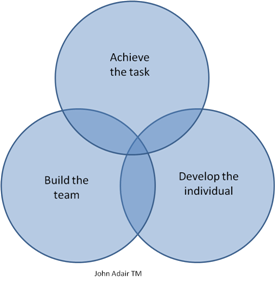
Developed by leadership expert John Adair, the Action-Centred Leadership Model has stood the test of time because of its simplicity and practicality. While the workplace has changed dramatically since the model was introduced, its core message remains highly relevant: effective leadership is about balancing three interconnected responsibilities.


Leadership circles


The overlapping circles illustrate that these responsibilities are interconnected. They influence one another. Progress in one area often strengthens the others. A leader who develops individuals builds a stronger team. A stronger team collaborates more effectively, making it easier to achieve objectives. Likewise, successfully achieving meaningful goals builds confidence, strengthens relationships, and creates new opportunities for individual growth.

This is why the model remains so powerful. Rather than viewing leadership as a series of competing priorities, it encourages leaders to see task, team, and individual development as mutually reinforcing. The challenge is finding the “right” balance so that each area supports the others, rather than allowing one to dominate.

Understanding the Three Leadership Responsibilities

Before reflecting on your own leadership approach, it is useful to explore what each of the three circles represents.

Achieve the task

Every leader has a responsibility to deliver results. This involves setting clear objectives, making effective decisions, solving problems, allocating resources, and ensuring that important work gets completed. Strong task leadership creates clarity. People understand what needs to be achieved, why it matters, and what success looks like.

Build and maintain the team

Results are rarely achieved by individuals working alone. Leaders also need to create the conditions for people to work effectively together. This means building trust, encouraging collaboration, creating a shared sense of purpose, managing conflict constructively, and developing a team environment where people feel motivated to contribute.

Develop individuals

Effective leaders recognise that every team member has different strengths, motivations, and development needs. Developing individuals involves coaching, providing meaningful feedback, recognising achievements, delegating opportunities, and helping people build the skills and confidence they need to grow.

A practical exercise to reflect on your leadership balance

This exercise is not intended to provide an objective assessment of your leadership effectiveness. Its purpose is to encourage honest reflection and help you identify where small changes could make the biggest difference. Applying it to your own leadership is where the real value of this model lies.

You’ll need an uninterrupted 10 minutes, pen and paper.

Step 1 – draw your 3 circles

  • Take a moment and think about how well you are performing in the three areas.
  • Now take a pen and draw the three circles in proportion to how satisfied you are with your performance in each area. (and not how much time you spend on each area).  For example, if you feel that you are doing a good job of achieving the task, but your team members aren’t really developing and there’s very little team building then you might have something like the example below:

LeadershipStep 2 – reflect on your leadership balance

Now look at your circles and consider the following questions:

  • How satisfied are you with your current leadership balance?
  • Which area would have the greatest impact if you improved it?
  • What three specific actions could you take to strengthen your effectiveness?
  • What has prevented you from taking these actions so far, and how could you overcome those barriers?

Step 3 – choose 1 action 

Choose one practical step you can take in the coming days and commit to doing it. Small changes in how you lead—such as having an open conversation, clarifying expectations, or creating more opportunities for team collaboration—can have a significant impact over time.

Conclusion

The enduring appeal of John Adair’s Action-Centred Leadership Model lies in its simplicity. It reminds leaders that effective leadership comes down to balancing three fundamental responsibilities: achieving the task, building the team, and developing individuals.

However, finding the right balance does not mean giving equal attention to each area at all times. Leadership situations are constantly changing. A new project may require a stronger focus on achieving the task. A team facing challenges may need greater attention on trust and collaboration. An individual taking on new responsibilities may need more coaching and support.

The skill of effective leadership is recognising what the situation requires and adjusting accordingly.

Simple frameworks can be powerful because they give us a clear way to pause, reflect, and ask better questions. Adair’s model provides leaders with a practical lens to consider where they are having the greatest impact, and where small changes could make a meaningful difference.

Leadership development starts with awareness. Real improvement comes when that awareness leads to action.

Key Takeaways

  • Effective leadership is not measured by results alone. Great leaders balance achieving objectives with building strong teams and developing individuals.
  • John Adair’s Action-Centred Leadership Model provides a simple framework for understanding the three responsibilities every leader must manage: task, team, and individual.
  • The three areas are interconnected. Investing in people strengthens teams, stronger teams improve performance, and achieving meaningful goals creates opportunities for further growth.
  • The challenge for leaders is not giving equal attention to every area at all times, but finding the right balance for the situation they are facing.
  • Regular reflection helps leaders recognise where they are performing well and where small changes could improve their impact.
  • Leadership development starts with awareness but real improvement comes from turning reflection into action.