This post explores the techniques storytellers use to hold attention, build credibility and leave audiences with ideas they remember. Then, we’ll compare their different storytelling styles and uncover the hidden structures that make both talks so compelling.

  • Reading time
  • 10 Minutes
  • Target audience
  • Trainers, facilitators, leaders, managers and professionals who want to become a more engaging presenter or storyteller.

Let’s not talk about our storytelling solutions and how you could benefit from adding stories to your workplace communication. Instead, let’s watch 2 great storytellers in action and judge how they do it :-)

In this article, we’ll dissect two of the most influential TED Talks ever delivered: Andrew Stanton’s The Clues to a Great Story and Simon Sinek’s How Great Leaders Inspire Action. Although their styles are very different, both speakers consistently hold their audience’s attention and leave them with ideas that are remembered years later. Stanton, the Pixar filmmaker behind Toy Story, Finding Nemo and WALL-E, shows how stories create emotional connection. Simon Sinek, leadership author and creator of the Golden Circle, demonstrates how a simple framework can make a complex idea memorable and persuasive.

Rather than focusing on what they say, we’ll examine how they say it. We’ll look at the storytelling techniques, presentation structure, audience psychology and rhetorical devices that make each talk so compelling. Finally, we’ll compare their contrasting approaches to reveal an important insight: there isn’t one formula for great storytelling. Stanton persuades through emotion and narrative, while Sinek persuades through logic, patterns and a simple mental model.

Andrew Stanton: The clues to a great story

Andrew doesn’t merely describe storytelling—he performs it. The audience experiences curiosity, surprise, laughter, and emotional connection in the same sequence that his principles recommend. That’s why the talk remains one of TED’s most enduring presentations on communication.


Here are the techniques that make him so compelling.

1. He opens with a story, not thesis

Instead of explaining what is he about to do with his TED talk – he starts talking about someone called MacGregor and for the first half of the joke, you have no idea what’s going on. Using this approach, he’s creating what psychologists call an information gap. Humans dislike unfinished patterns, so we keep listening.

He lets you experience the idea before defining it. Only after the punchline does he explain: “Storytelling is joke-telling.”

2. He constantly creates unanswered questions

Throughout the talk he repeatedly makes you wonder:

  • Why does Pixar tell stories this way?
  • What is the one secret?
  • What does “make me care” actually mean?
  • Why does he keep mentioning his childhood?
  • Where is this leading?

Every answer leads naturally to another question. That’s what makes the talk feel like one continuous journey rather than a list of tips.

3. He never teaches in the abstract

Notice how few theoretical statements are made in this video. Instead, nearly every concept comes wrapped inside:

  • an anecdote
  • a childhood memory
  • a movie example
  • a quote
  • a joke
  • a personal confession

4. He earns authority instead of announcing it

He almost never says, “I’ve won two Oscars.” Instead, authority emerges naturally. He casually references:

  • writing Toy Story
  • directing Finding Nemo
  • making WALL-E
  • conversations inside Pixar

You think, “This person has actually lived this.” That makes the advice feel authentic rather than promotional.

5. His talk has emotional variety

Many presentations stay at one emotional level. Stanton constantly changes rhythm. He moves between humor, curiosity, surprise, nostalgia, vulnerability and inspiration, never allowing the audience to settle into predictability.

6. He trusts the audience

One of his biggest ideas is Pixar’s famous principle: “Don’t give the audience 4. Give them 2 + 2.” He believes audiences enjoy participating. He practices this throughout the talk. He rarely over-explains. Instead he gives enough pieces for listeners to connect themselves. When people arrive at an insight on their own, it feels like their discovery rather than his lecture.

7. Everything serves one central idea

Many storytellers try to include too many messages or lessons in their story. This one doesn’t. Everything points back to one overarching message: Great stories make people care.

Every anecdote, joke and movie example reinforces that single idea. Because there’s one clear thread, the audience never feels lost.

8. He mixes confidence with vulnerability

Toward the end, he shares the story of being born prematurely and how that shaped his outlook. Until then, he’s been the expert. Suddenly he’s simply another human being. That shift creates emotional connection. Many speakers reveal personal stories too early or too dramatically. Stanton waits until the audience already trusts him, so the story lands with greater impact.

9. He finishes with meaning, not information

Most presentations end with a summary. He ends with a belief. His closing message is essentially: Stories affirm that our lives matter. That is much bigger than “here are some storytelling techniques”. He elevates storytelling from a communication skill to something fundamentally human.

People don’t leave remembering everything he said. They leave remembering how he made them feel.


New Call-to-action


Simon Sinek: How great leaders inspire action

This is one of the most analyzed TED Talks ever, and for good reason. Like Andrew Stanton, Simon Sinek isn’t simply presenting an idea—he’s carefully constructing an experience that leads the audience to his conclusion. By the time he introduces his main idea, many listeners already feel that it “makes sense,” even before they’ve fully examined it. Unlike many presentations that offer a collection of tips, Sinek gives the audience a single mental model that they can apply across different situations. Whether or not every claim holds universally, the talk’s enduring appeal comes from its simplicity, consistency, and memorable structure.


1. He starts with a puzzle followed by examples

He begins his story with a mystery: “How do you explain when things don’t go as we assume?” Immediately he follows with examples:

  • Why is Apple consistently innovative?
  • Why did the Wright brothers succeed?
  • Why do some leaders inspire while others don’t?

Notice what happens. Your brain starts searching for an explanation before he’s provided one. He’s created a problem that demands a solution.

Only after establishing the mystery does he introduce his framework.

2. He uses one idea to explain many things

One hallmark of memorable speakers is that they reduce complexity. Sinek doesn’t present five leadership principles.

He presents one simple model:

WHY → HOW → WHAT

Then he uses that same framework to explain:

  • Apple
  • Martin Luther King Jr.
  • the Wright brothers
  • leadership
  • marketing
  • customer loyalty

Because one idea keeps solving different problems, it feels powerful.

3. He speaks in patterns

Much of the talk relies on repetition.

  • First:  Most companies communicate from the outside in.
  • Then: Great leaders communicate from the inside out.

He repeats this idea several times, each time with a different example. Every repetition strengthens the mental model. Instead of feeling repetitive, it feels increasingly convincing because each example adds another layer.

4. He uses contrast constantly

This is one of the most sophisticated techniques in Sinek’s talk, and it’s easy to miss because he uses it so naturally.  Most speakers explain an idea by definition. Sinek explains it by contrast. Instead of saying “Great leaders are people who inspire others through purpose” he repeatedly puts two examples side by side and lets the audience notice the difference. Comparison is so powerful in storytelling because our brains are much better at detecting differences than absorbing abstract definitions.

5. He explains abstract ideas with concrete examples

Purpose is abstract. Belief is abstract. Inspiration is abstract. Instead of defining them academically, Sinek uses stories everyone can visualize. Apple isn’t discussed as a technology company. It’s presented almost as a character. Concrete stories make abstract ideas easier to remember.

Likewise:

  • Martin Luther King becomes an example of purpose.
  • The Wright brothers become an example of belief overcoming resources.

6. He keeps returning to one unforgettable sentence

Perhaps the most memorable line in the talk is: “People don’t buy what you do; they buy why you do it.”

Whether you agree with it universally or see it as an oversimplification in some contexts, it’s an exceptionally effective communication device. It’s short, rhythmic, slightly surprising, and easy to repeat. It becomes the lens through which listeners interpret everything that follows.

7. His visuals are almost unbelievably simple

The Golden Circle is just three concentric circles.

WHY – HOW – WHAT

That’s it. Too many speakers create complex diagrams. Sinek creates a picture you can redraw from memory on a napkin.

The simpler the visual, the easier it is to remember—and the easier it is for the audience to reuse later.

8. He makes the audience feel clever

This is subtle.

Rather than saying, “Here’s the answer”, he says “think about it” repeatedly guiding the audience to discover the pattern themselves. When people feel they’ve reached the conclusion on their own, they’re more likely to accept and remember it.

9. His talk has remarkable structural discipline

Almost everything supports one central message. If you removed any example, the talk would still work. That’s because each part of the story serves exactly the same purpose: to reinforce the WHY → HOW → WHAT framework. There’s very little that feels like a tangent. This is one reason the talk remains easy to follow despite introducing examples from business, history, biology, and leadership.

A comparison: Andrew vs. Simon

What’s particularly interesting is that Sinek’s style is almost the opposite of Stanton’s.

  • Andrew Stanton tells stories that reveal ideas.
  • Simon Sinek tells ideas through stories.

Both are compelling, but they achieve it in different ways. Andrew Stanton relies heavily on emotional storytelling, while Sinek is primarily using argumentative storytelling. His examples are selected less to evoke emotion and more to persuade. Each one acts like another piece of evidence in a case he’s building.

Hidden structures

Stanton’s talk mirrors the structure of a good film:

  • Inciting incident – the Scottish joke sparks curiosity.
  • Rising action – he introduces clue after clue about storytelling, each one answering part of the puzzle while opening another.
  • Midpoint revelation – “Make me care.” The audience begins to see the unifying principle.
  • Deepening stakes – the talk shifts from craft (“how to tell stories”) to purpose (“why stories matter”).
  • Emotional climax – his personal reflections reveal that storytelling isn’t just a professional skill; it’s how we connect with each other.
  • Resolution – the audience leaves with both practical tools and a renewed appreciation for the role stories play in human life.

What makes Sinek’s talk so effective is that it follows the structure of a compelling argument.

  • Inciting question – Why do some leaders and organizations consistently inspire while others don’t?
  • Rising investigation – He presents case after case that challenges conventional explanations, building curiosity and tension.
  • Midpoint revelation – The Golden Circle is introduced. Suddenly, the audience has a simple framework that appears to explain the earlier mysteries.
  • Testing the theory – Rather than moving on, Sinek stress-tests the model with examples from technology, aviation, civil rights, and biology. Each example strengthens the audience’s confidence in the framework.
  • Broadening the implications – The talk expands from marketing into leadership, culture, communication, and decision-making. What began as a business puzzle now feels like a universal principle.
  • Resolution – The audience leaves not just with a slogan but with a new way of interpreting organizations, leaders, and even their own communication.

Key takeaways

After analysing both talks, one thing becomes clear: there is no single formula for great storytelling. Andrew Stanton and Simon Sinek take almost opposite approaches, yet both keep people engaged because they understand how audiences think.

As you have seen in the videos, great communicators design an experience. Whether that experience is emotional (Stanton) or intellectual (Sinek), the audience is taken on a journey. That’s a much more powerful takeaway than any individual storytelling technique.

Here are the lessons that any presenter, trainer or leader can apply:

  • Start with curiosity – Don’t begin by explaining. Begin by creating a question, a mystery or a reason to keep listening.
  • Have one clear message – Both talks are built around one memorable idea. Every story, example and detail supports that central message.
  • Show before you explain – Your audience experience the idea first. Stories and examples often communicate more powerfully than abstract explanations.
  • Make ideas concrete – Turn concepts into examples people can picture. Stories make abstract ideas easier to understand and remember.
  • Trust your audience – Don’t over-explain. Give people enough information to discover the insight themselves.
  • Design the journey – Stanton creates emotional connection through narrative. Sinek creates understanding through patterns and logic. Both succeed because they take the audience somewhere.

This post explores the other side of the conversation: what speakers can do to make listening easier. It offers practical ways to prepare listeners, communicate more effectively, and increase the chances that your message is understood as intended.

  • Reading time
  • 9 Minutes
  • Target audience
  • Anyone who wants to communicate more effectively at work, particularly managers, team leaders, project managers, and professionals who regularly explain ideas, solve problems, or influence others.

We deliver a lot of communication training. None the many sessions we deliver to our clients focus on listening skills. The topic of listening skills usually appears as part of a broader programme—effective communication in virtual teams, coaching skills for managers, giving feedback, difficult conversations. Is that because our clients think everyone is already a great listener? No. They know that poor listening causes problems at work every day. I think the reason is simpler: listening feels like a life skill. Unlike presenting, writing reports or leading a department, it’s something we assume we’ve learned simply by growing up.

The trouble is, research consistently suggests that we’re not nearly as good at listening as we think we are. Great listeners are rare. In leadership, some studies estimate they make up only a small percentage of people. Research on informational listening—the ability to accurately retain and understand information—shows that most of us overestimate our own ability. Which means there are probably people in your life who interrupt, jump to conclusions, filter what you say through their own experiences, get distracted halfway through the conversation or begin solving a problem before they’ve fully understood it.

Most articles and also our training solutions focus on becoming a better listener. This one takes the opposite perspective.

Consider for a moment, all those people who aren’t being listened to. The colleague whose explanation gets interrupted before they’ve finished. The project manager who keeps raising a scheduling conflict that nobody seems to hear. The employee who leaves a meeting thinking, I don’t think anyone actually understood what I was trying to say.

New Call-to-action

What can you do to help other people listen better?

We can’t control how someone else listens. We can, however, make it easier for them to succeed.

Here are nine ways to do that.

  • Prepare them for listening.
  • Ask whether they have time to listen.
  • Look for the type of listener you need.
  • Tell them how you need them to listen.
  • Ask them where they’d like to start.
  • Highlight what matters most.
  • Give them time to process.
  • Ask them to summarise what they heard.
  • Acknowledge the listening.

Prepare them for listening

We often assume that if someone doesn’t understand us, they’ll simply ask questions. They don’t always do that.  At work we explain complex situations, hoping the other person will recognise the issue, validate our concerns or arrive at the same conclusion we have. If we’re still organising our own thoughts—or we’re communicating something emotionally charged—that makes listening even harder. A listener has to separate facts from feelings, context from content and assumptions from evidence.

If you know what kind of conversation you want to have, you can set expectations with your listeners.

For example:

  • “Would you mind if I just talked for a few minutes before we start troubleshooting this problem?”
  • “I’m nervous about Tuesday’s meeting. Could I talk it through with you?”

Those simple introductions prepare people for the kind of listening you’re asking them to do.

Ask whether they have time to listen

Listening requires space, attention and willingness. Those three things aren’t always available. If someone is rushing between meetings, answering emails or thinking about the next deadline, they probably aren’t going to give you their best attention, however willing they may be. Sometimes the simplest question produces the biggest improvement.

For example:

  • “Is now a good time to talk about something?”
  • “When would you have ten minutes to properly listen to this?”

Look for the type of listener you need

Listening is a skill, but people don’t all listen in the same way. The right listener often matters just as much as the right message.

Some listeners are naturally time-oriented. They appreciate concise explanations and want you to get to the point. Others are people-oriented. They naturally focus on relationships, emotions and experiences. Some enjoy analysing ideas, identifying risks and solving problems. Others excel at helping you think aloud without rushing to conclusions.

So, If you need someone to challenge your thinking and pressure-test an idea, look for a critical listener. If what you really need is someone who understands your frustration before suggesting solutions, look for an empathetic listener.

Tell them how you need them to listen

Don’t assume people know what you need simply because they’ve heard your words. Do you want understanding? Reflection? Practical advice? A decision? Emotional support? Giving people a listening role helps them listen with purpose.

Imagine you’re presenting a new idea to six colleagues. Everyone hears the same words, but they process them differently. Some notice your enthusiasm. Others immediately start evaluating the risks. Someone else begins reflecting your ideas back to you, while another starts thinking about implementation.

People can listen in different ways – they have a preferred style and type but for many listeners, the situation and the speaker determine which listening style they use.

So, tell them which listening style or type to use. For example: “I would like everyone to use their best critical listening skills, do you think this idea has any merit, and if yes, how can we get it implemented?”

Ask them where they’d like to start

How do you get someone to listen? By presenting the information in the way they prefer it. This is especially useful when you’re communicating something complex. Perhaps you need to explain the background, the data, the risks, your recommendation and the impact on the team. Rather than deciding where to begin yourself, ask your listener.

For example: “Would you prefer the short version first, or would it help if I explained the background?”

Some people want the conclusion before the detail. Others need the context before the recommendation makes sense. Starting where your listener is naturally interested makes it much easier for them to stay engaged.

Highlight what matters most

Conversations rarely stay on track by themselves. A discussion about a project suddenly becomes a discussion about workload, customer satisfaction or team morale. All of those topics may be important, but they can also distract from the reason you started talking in the first place. When you notice the conversation drifting, gently bring it back.

For example: “Those are all important conversations, and I’d like to come back to them. Right now, the priority for me is resolving the issues with this project because my team have been waiting for feedback.”

Your listener doesn’t have to remember everything. They won’t. Help them remember the part that matters most.

Give them time to process

Listening doesn’t stop when you stop talking. Many people need a few moments to organise what they’ve heard before responding.

Resist the temptation to fill every silence. Don’t immediately ask, “Does that make sense?” after two seconds. Don’t jump back in because you’ve thought of one more thing to add.

Sometimes the most helpful thing you can do is simply wait.

Ask them to summarise what they heard

Great listeners often summarise naturally. “So what I’m hearing is…”

But you don’t have to wait for that to happen. Especially in important conversations, it’s perfectly reasonable to ask: “Just so I know I’ve explained this clearly, would you mind summarising what you’ve understood?”`

If their summary differs from what you intended, you’ve discovered a misunderstanding while there’s still time to correct it.

Acknowledge the listening

Finally, recognise that listening has taken place—even when the other person hasn’t interpreted your message the way you hoped. Perhaps you wanted to discuss a solution, but your listener focused on the problem instead. Perhaps they heard additional work where you saw opportunity. That doesn’t necessarily mean they weren’t listening.

Listening is an active process of interpretation. People hear your words through the lens of their own experiences, assumptions, priorities and concerns. You can’t completely control what someone hears.

What you can do is acknowledge where they have understood you, clarify where they haven’t and continue the conversation from there.

Conclusion

Listeners have different needs, different attention spans, different ways of processing information, and different expectations about the conversation. The more we can prepare them, guide them, and make it easier for them to listen well, the more likely we are to achieve understanding.

Listening will always be a shared responsibility. While we should all continue to develop our own listening skills, we can also become better communicators by taking some responsibility for how our message is received.

Key Takeaways

  • Listening is a shared responsibility. Yes, we should all try to become better listeners. But if we only think about listening from the listener’s perspective, we miss half of the conversation.
  • As speakers, we have more influence than we sometimes realise.
  • By preparing people for the conversation, choosing the right listener, explaining what kind of listening you need and making your message easier to process, you dramatically increase the chances of being heard.
  • Sometimes the difference between feeling listened to or not listened to isn’t finding a better listener. It’s helping the listener you already have.

“We want to be a ‘cool’ company and attract younger people, at the same time we want to retain our long-serving employees with their wisdom and years of experience.” “We hope our younger generation leaders will push our organisation towards a growth mindset, at the same time we don’t want our more senior employees to feel they are not as valued as before.” These are some of the comments we recently heard from a global communications client we work with. They explained to us that they need to ensure they have the future leaders who will ensure the company stays relevant and competitive. But as their comments show, recruiting younger generations also brings challenges. In this post we will explore in detail the diverse attitudes and expectations that different generations have, and the impact this is having in organisations right now. 

In fact, we hear this story with virtually all our clients that we work with in diversity and inclusion training [link to product pages when up]. If you’re managing a multi-generational team, or trying to bring new talent into an organisation, you might be facing similar challenges. And you will know that managing a multi-generational workforce is a real issue that urgently needs solutions today.

When talking about generations, we never want to over-generalise and automatically put people into boxes. On the other hand, we also don’t want to assume everyone is the same. And when it comes to the workplace, different generations have quite different ideas. So if we want to attract new generations and also retain existing talent, we will need to consider how to design a workplace that works for both. To start, let’s look at what a multi-generational workplace looks like in reality…

In this post we’ll describe the different attitudes and expectations of the three main generations in today’s workplace across four flashpoints, and offers practical tips and advice for managing those differences, based on our experience of what works well in organisations we have worked with.

What are the different generations?

Walk into any large company today and you are likely to see much greater age diversity than you would have seen even at the start of this century. The workforce is getting younger; flexible working and technology has meant that more people (especially women) have access to the workforce today, and this will continue. It’s worth re-iterating this; there are more younger people in the workforce today and that population is more diverse than previous generations.

At the same time, due to pension reforms and health advances, older workers are staying in their jobs longer, especially in Europe. While the generational makeup of the workplace varies in different world regions (and you can see some interesting comparisons here, it’s useful to define and contrast the 3 biggest generations currently in the workforce:

Millennials Generation X Baby Boomers


Born

1981-1994

Born

1965-1980

Born

1946-1964

Age in 2020

26-39

Age in 2020

40-55

Age in 2020

56-74

Large and diverse generation and tomorrow’s leaders Smallest generation, stepping into leadership roles now Large generation, today’s traditional leaders

What are the attitudes of different generations?

Now let’s look now at 4 common flashpoints created by generational differences (a flashpoint is a potential conflict which arises from different attitudes or perspectives). As you read this section, ask yourself whether you can see any concrete examples of these differences in your organisation.

1. Ambitions

Younger generations may expect to progress more quickly in their career and can be impatient with traditional routes to promotion and new opportunities. Personal and professional growth and social recognition are probably more important to them than material rewards or status. They may not find the existing rewards system especially motivating. Older generations may see them as over-ambitious and not as committed to the organisation.

Here is a more segmented description of the different ambitions of specific generations:

Millennials Generation X Baby Boomers


Expect to have several careers (average tenure is 2 years), therefore value CV building Motivation comes from being challenged and receiving constructive feedback Prefer more formal approaches e.g. pension or ‘status’ rewards like titles and office space

Do you see different attitudes to career and progression from different generations of worker?

2. Technology

The most obvious and most talked about difference. But it’s an oversimplification to say that older generations are not comfortable with technology, because we all need to use it for work nowadays. However, there are differences in how different generations use technology; younger generations seem to be constantly connected and technology is their default way to interact with the world. Older generations tend to see technology as a tool to perform a specific task and they are fine with just turning it off. Millennials will expect to be able to ‘plug in’ to technology in your organisation straight away. Older generations may feel overwhelmed by how younger generations use technology and feel that they simply won’t be able to catch up.

Here is a more segmented description of the different ambitions of specific generations:

Millennials Generation X Baby Boomers


Grew up with it in personal and work life, so don’t see a divide. Competent in less tangible technologies e.g. social media Good at adapting to new technologies but still view it as something tangible that does not include personal/social life Need time to be convinced and shown tangible results of using it

Do you see different attitudes to using technology in different generations of worker?

3. Communications

Younger generations may prefer to communicate more often, in person, and more informally. They may not see the need to adjust how they communicate based on who they are talking with. And of course, they will probably prefer to do it with technology. Older generations often prefer more formal ways of communicating e.g. written over spoken. They could feel that lines of communication are not being respected by younger generations and also feel overwhelmed by the constant communication flow.

Here is a more segmented description of the different ambitions of specific generations:

Millennials Generation X Baby Boomers


Prefer informal, personal and face to face communication. Emotions have a place at work. Likes straight-talking, email is preferred communication tool. But can also adapt to generations on either side. Communication at work is formal, e.g. prefer things to be documented. Dress and behaviour is also more formal at work.

Do you see different attitudes to communication from different generations of worker?

4. Work life balance

Should work be ‘fun’? We might all answer yes, but different generations have slightly different ideas for how far work should be a social experience and where to draw a line between personal and professional life. For older generations, the phrase ‘work life balance’ probably means enough time outside work to enjoy life with friends and family or alone. For younger generations this phrase is more likely to mean personal goal-fulfilment and social networks inside the workplace, and the flexibility to work when and where they want. This can be difficult for organisations which are still struggling to introduce and control flexible working arrangements.

Here is a more segmented description of the different ambitions of specific generations:

Millennials Generation X Baby Boomers


No clear boundaries, work should be fun, expect to work anywhere, anytime. Family and work life boundaries are important, need to ‘switch off’, ‘work to live’ Work takes place in the office, long hours means loyalty, ‘live to work’

Do you see different attitudes to work life balance from different generations of worker?

As mentioned already, let’s look at some offers practical tips and advice for managing those differences.

1. Ambitions

Different generations can have different motivations and expectations for job progression and career planning. Tailoring how you reward and recognise performance is a good place to start addressing these differences, and it is not hard to do. We recently worked with a global telecommunications company who told us they had great success when they decided to let managers decide how to reward team members. These managers came up with new types of rewards for younger generations like gym membership and Amazon vouchers, in addition to the standard types of recognition offered.

Getting generations to mentor each other can be more effective than formal performance management at cutting across generational silos. Providing a younger employee with a more experienced mentor or coach provides them with personalised growth opportunities and gain valuable knowledge fast. At the same time, it can help older employees learn practical things form younger ones, e.g. how to use new technologies, how to work from home. The personal nature of mentoring or coaching also helps to build relationships that can bridge different attitudes and approaches that the generations have.

Here is a summary of tips for how to manage the different motivations of specific generations:

Millennials Generation X Baby Boomers


Don’t think about how long they will stay; instead, consider what they bring to the organisation and how to benefit from it Ensure they are challenged to grow in a supported way; growth is a career goal in itself for this generation Show them that they can teach and also learn from other generations, and assure their experience is respected and valued

2. Technology

Marc Prensky coined the terms ‘digital natives’ and ‘digital immigrants’ nearly 20 years ago to describe different generations’ entry points into technology. Today that gap has narrowed, but as you saw in Part 1 of this post, generations still have quite different attitudes to how they use technology. This takes careful managing. Ensure you show older generations a tangible benefit of technology, i.e. something that will help them succeed in their job role and meet business targets. Support them as they get to grips with new tech and new ways of using it and praise them when they make progress.

The challenge for younger generations is to show that technology has a real purpose and is not just for fun or following the latest trend. This is especially true for less tangible forms of technology like social media. Millennials grew up on Twitter, Instagram, Facebook and they understand better than any generation how it works. If you don’t, that’s fine, but make sure you hire someone who does to run your social media marketing.

As with career and progression, mentoring can help bridge the different attitudes and experience. Gen X can also act as a bridge generation, especially for technology because they have traits of both generations that came before and after them. After all, they grew up in the first iteration of a digital world and were the first generation to get their hands on personal computers, CD’s, iPods, etc. The adaptation and learning they went through is a valuable lesson for generations either side of them.

Here is a summary of tips for how to manage how different generations use technology:

Millennials Generation X Baby Boomers


Use their competency and experience to benefit the organisation and learn from them Use their experience of adapting and learning new technologies to bridge attitudes and knowledge Be patient, let them learn at their own pace, make sure they can see tangible, business benefits

3. Communications

Much of the above advice also applies to this topic, as nearly all our communications nowadays are via technology. In Part 1 you saw that the generations have different expectations for how to communicate at work, and this could lead to conflict if communication styles get in the way of what is actually being communicated. To prevent this, generations need to come together and talk about their preferences in order to reach agreements and manage each other’s expectations. It’s fine for me to be constantly connected – that lets my manager know I will read her communication quickly. It’s also fine that I expect a delayed response from a colleague who likes to switch off out of working hours.

Technology can also be used to get different generations communicating. Many organisations we know use company-wide platforms like Slack, Yammer or IBM Connect to discuss issues and exchange opinions. These platforms are a great way to bring diverse generations together to work through issues that are common to everyone. These corporate versions of social media will provide natural avenues for younger generations, while for generations which are newer to technology they can provide tangible benefits in the form of information sharing and learning.

Here is a summary of tips for how to manage communication between specific generations:

Millennials Generation X Baby Boomers


Expect a more informal and even emotional style, check in with them regularly and show you’re listening Avoid over-burdening with many different forms of communication, use to bridge communication gaps between generations Expect a more formal style and respect/adjust to it, emphasise the goals of communication over the medium

4. Work life balance

Work to live, or live to work? Different generations have different perspectives and in a multi-generational workplace you will need to cater to both. Go with flexible working but make sure that people who use it understand their accountabilities and are reachable, which will assure those people who are resistant to it. Empower managers to set up agreements with team members that respect their individual preferences for where and how to work, including staying in the office. This may mean a shift in culture away from hours put in and towards performance measured by outputs. In other words, saying “We don’t mind how you work, we just want to see the results”. The benefit of focusing out outputs rather than inputs is that individual preferences can actually become less important and noticeable. Still, as with all culture change, the road getting there could be a bit rocky.

Here is a summary of tips for managing different generational attitudes to work-life balance:

Millennials Generation X Baby Boomers


Acknowledge their need for flexibility and independence, while setting clear boundaries and expectations Respect their need to ‘switch off’ and have a personal life that is separate to work Don’t force them to work flexibly, respect the hours they put in, talk to them about different generation’s attitudes


We hope you enjoyed reading this post. If you would like to know more about our experience of working with clients in different areas of diversity, please contact us.

This post explores how the SCARF model can help managers make feedback conversations more effective and meaningful and provides practical tips and insights on how managers can better understand reactions, build stronger connections and influence future behaviour.

  • Reading time
  • 7 Minutes
  • Target audience
  • Managers and leaders who want to better understand how to influence others, have better feedback conversations, and bring about positive change in the workplace.

The intention behind giving feedback is to bring about positive change in the workplace by influencing future behaviour and outcomes. Sometimes that means helping someone improve. At other times, it’s about recognising success, reinforcing effective behaviours, clarifying expectations, or addressing issues before they become bigger problems.

Whether a feedback conversation achieves its goal depends on many factors, but two stand out: the person giving the feedback and the person receiving it. Both play an active role in determining whether the conversation leads to understanding, acceptance and ultimately, positive change. When both have the skills and confidence to engage in an open, constructive dialogue, the chances of success increase significantly.

Of course, not all feedback conversations are equally challenging. Positive feedback—recognising good work or encouraging someone to continue doing what’s working well—is generally easier to give and easier to receive.


New Call-to-action


When the feedback is critical or corrective, the chances of success decrease because people are more likely to feel threatened or misunderstood.  The key word here is “feel”.

In feedback conversations, people don’t simply respond to the words they hear. They respond to what those words mean to them. A comment intended to be helpful can be interpreted as criticism. A suggestion can feel like a personal attack. When people perceive a threat—whether that threat is real or not—their ability to listen, reflect and respond is limited. Perceived threat invokes a primal response (fight or flight) and we can no longer hear what the rational brain is saying.

This is where the SCARF model, developed by neuroscientist David Rock, helps us understand what is happening beneath the surface.

The SCARF model: Minimize danger – Maximize reward

David Rock believes that our response has its roots in the way our brains deal with perceived danger and how we always seek to minimise threats and maximise rewards. He developed it into a model of 5 areas that influence our behaviour, the SCARF model.

Watch the video here:


Managers who want to influence others, their job is to find just the right levers to move people into that ‘maximize reward’ state. Leaders tend to know all about the carrot and stick. They use money and other external rewards to try to motivate people. Turns out there are often far more powerful rewards and threats going on inside people’s heads that are generating their behavior. So if you want to be the best that you can be at influencing others, you need to better understand what makes people tick.

Dr. David Rock


As Dr. Rock explains in the video, these five factors have a tremendous impact on our motivation on whether we are in a “reward” state or a “danger” state.

  • Status – our relative importance to others
  • Certainty – our ability to predict the future
  • Autonomy – our sense of control over events
  • Relatedness – how safe we feel with others
  • Fairness – how fair we perceive the exchanges between people to be

Understanding what happens beneath the surface is only valuable if it changes what we do above the surface. The SCARF model gives us insight into why people may react the way they do during feedback conversations, but the real benefit comes from using that understanding to adapt our approach. Small changes in how we prepare, communicate and involve others can make all the difference between feedback that creates resistance and feedback that creates positive change.

S – Status 

How we see ourselves in relation to others – do we feel respected, valued and competent.

Research shows that a perceived loss of status activates many of the same brain regions associated with physical pain. When people feel that their competence or value is under threat, they’re far less likely to listen openly to feedback.

The opposite is equally true. When feedback reinforces our sense of competence or recognises our contribution, it activates the brain’s reward response. That’s why genuine recognition from someone we respect can be so motivating.
Before giving feedback, ask yourself:

  • How might this person perceive my status in relation to theirs?
  • Am I reinforcing their sense of value, or unintentionally threatening it?
  • What can I do to reduce unnecessary status differences before giving the feedback?

Practical tips: 

  • Remember that status is personal. It isn’t only determined by job title or hierarchy; it’s also influenced by experience, expertise, reputation and how valued people feel.
  • Status derives from credibility but also from knowledge and competence, so if you lack credibility with a specific audience you can gain it from demonstrating what you know/can do
  • Build credibility before offering challenge. People are more receptive when they trust your intentions and believe you understand their work.
  • Use inclusive language. Words like we, us and our encourage collaboration, while excessive use of <emI and you can reinforce unnecessary hierarchy.
  • Protect status by recognising the person’s value, experience and contribution before addressing concerns. Genuine recognition helps protect a person’s sense of competence and reduces defensiveness.
  • Help people feel valued. Everyone wants to know that their contribution matters, regardless of their role.

C – Certainty

The brain is a certainty-seeking machine, constantly trying to predict what’s going to happen. When we have a clear understanding of what to expect, we generally feel safer and more able to focus on the conversation. When we don’t, uncertainty can quickly become a threat.

This is particularly relevant in feedback conversations. When people know why the conversation is happening, what will be discussed, or what is expected of them, they may spend less energy trying to interpret the situation and more on listening to the feedback. By creating clarity around the purpose, process and desired outcome of the conversation, managers can help people feel more prepared and more open.

Practical tips: 

  • Explain the purpose of the conversation. Don’t leave people guessing why you want to talk. A simple explanation can reduce unnecessary uncertainty.
  • Set expectations about the process. Let the person know what you would like to discuss and how the conversation will work.
  • Be clear about what is expected. People feel more confident when they understand their role, responsibilities and what success looks like.
  • Communicate even when there is uncertainty. If you don’t have all the answers, explain what you know, what you are still exploring and when you expect to know more.
  • Focus on what can be influenced. When outcomes are uncertain, clarity about purpose, priorities and next steps can provide stability.

A – Autonomy

Autonomy is our need to feel that we have some control over our work, our choices and the way we approach challenges. It is closely linked to motivation because people are more engaged when they feel they have ownership.

Autonomy is also closely connected to certainty. When we cannot predict what will happen, it can be difficult to feel that we have any control over our situation.

Autonomy is particularly important in feedback conversations. If feedback is intended to create growth and development, managers need to avoid simply prescribing the solution. Telling someone exactly what to do may create short-term compliance, but helping them reflect, explore options and find their own path builds greater ownership and commitment. The idea of having options, i.e. making choices, is important to a person’s sense of control.

Practical tips: 

  • Focus on the outcome, not every step. Be clear about needs to be achieved while allowing the person to consider how they will get there.
  • Ask before telling. Encourage reflection by asking questions such as, “How do you see the situation?” or “What options do you think would work?”
  • Offer choices where possible. Even small opportunities to make decisions can strengthen a person’s sense of ownership.
  • Create psychological safety. People need to feel they can share their perspective, admit mistakes and express concerns without fear of negative consequences.
  • Balance support with independence. Provide guidance and resources while allowing the person to take responsibility for their development.
  • The idea of having options, i.e. making choices, is important to a sense of control

R – Relatedness

Relatedness is about our sense of connection and belonging with others. It is the feeling that we are understood, respected and valued as individuals.

When we feel connected with the people around us we are more likely to be open, share our thoughts, and reflect on our own behaviours.

Relatedness is often communicated through small interactions: listening attentively, showing interest, acknowledging someone’s perspective, or simply demonstrating that their contribution matters. These signals help people understand that they are part of a supportive relationship rather than being evaluated.

Practical tips: 

  • Build trust before you need it. A strong relationship makes feedback conversations easier and more productive.
  • Show that you understand the person, not just the performance issue. Consider their perspective, circumstances and intentions.
  • Listen before responding. People are more open to feedback when they feel genuinely heard.
  • Use feedback as a two-way dialogue. Invite discussion and encourage the person to share their view.
  • Create connection across teams. Help people understand how their work contributes to a wider purpose and shared goals.

F – Fairness

Fairness is about our perception of whether things are reasonable, consistent and just. Importantly, fairness does not mean treating everyone exactly the same. People have different roles, responsibilities, experiences and circumstances. What matters is that people understand the principles behind decisions and feel they are being treated with respect.

Because fairness is subjective, two people can experience the same situation very differently. What feels reasonable to one person may feel unfair to another. When we perceive unfairness, our brain quickly moves into a defensive response. This is particularly relevant in feedback conversations; If someone believes they are being singled out, judged more harshly than others, or held to unclear standards, they are less likely to focus on the feedback . Instead, they may focus on whether the process feels fair.

Managers can reduce this threat by being clear about expectations, explaining the reasons behind decisions, and applying standards consistently. When exceptions are necessary, explaining the context helps people understand why a different approach is appropriate.

Practical tips:

  • Explain the “why”. Help people understand the reasoning behind decisions, expectations or changes.
  • Apply clear and consistent standards. People are more accepting of different outcomes when they understand the principles behind them.
  • Recognise contribution, not preference. Ensure rewards, opportunities and recognition are linked to achievements and behaviours rather than personal relationships.
  • Be transparent about decisions. Sharing the factors considered can help people see that decisions were thoughtful rather than arbitrary.
  • Consider different perspectives. Encourage people to explore situations from multiple viewpoints to build understanding and reduce assumptions.

Summary & Key Takeaways

Feedback conversations are about much more than the words being exchanged. Beneath every conversation, people are also responding to what the feedback means for them. Do they feel valued? Do they understand what is happening? Do they feel they have a voice? Do they trust the person giving the feedback? Do they believe the process is fair?

The SCARF model helps us understand these underlying responses through five social needs: Status, Certainty, Autonomy, Relatedness and Fairness.

When these needs are supported, people are more likely to feel safe, listen openly and engage constructively. When they are threatened, even well-intentioned feedback can trigger defensiveness, resistance or disengagement.

  • Remember the person behind the performance – Feedback is received by a person, not just a role or job title. Consider how your message may be experienced, not just what you intend to communicate.
  • Reduce unnecessary threats – People are less likely to engage when they feel their status, security, independence, relationships or sense of fairness are under threat.
  • Create clarity – Explain why you are having the conversation, what you want to discuss and what happens next. Reducing uncertainty helps people focus on the feedback itself.
  • Protect ownership – Don’t just provide answers. Where possible, involve people in finding solutions and deciding how they can move forward.
  • Build relationships – Strong relationships make it easier to have feedback conversations.Trust and connection make feedback easier to give and easier to receive.
  • Make fairness visible – Explain your reasoning, apply standards consistently and recognise that fair does not always mean identical.
  • Focus on the outcome, not just the conversation – The goal of feedback is not simply to deliver a message. The goal is to create understanding, encourage reflection and influence future behaviour.

To wrap up

We hope you’ll consider using the power of SCARF in your next feedback conversation. For more feedback content, these posts might be of interest to you:

“We know what unconscious bias is, and why it’s important. But we don’t know how to start having a conversation about unconscious bias in the workplace in our organisation”. This was a statement from leaders from a multi-national pharma company headquartered in Europe. Any organisation which is trying to build diversity and manage unconscious bias will start with this, or a similar statement. We worked with the group to break their words down into 3 sub questions and this post shares how we worked with our client to answer these questions.

Should we start with training?

Training seems an obvious place to start. But if you can’t make it mandatory (and ensure that 100% of your employees attend), the people who attend training will be self-selecting. We see this time and again on our training courses, when we hear the common comment “Person X should really attend this training”. Person X is usually a senior manager or a ‘problem’ colleague who probably really needs the training, except that no one seems willing to tell them!

Running training courses is also not practical for many industries. For example, about 50% of the employees of our pharma client work in labs. Small teams with a constant workflow will find it difficult to leave their workstations to attend training.

We are not saying that training is not part of the solution, just not the solution. In the next section you will see some ideas on how to work with people on this topic outside the training room.

How can we support attitude changes?

A workplace is a collection of people with different backgrounds, experiences and views. Everyone is entitled to their views but at the same time we have a right to ensure that the people who work with us work to our goals and values. ‘Inclusion nudges’ are a very effective way of achieving this. An inclusion nudge is defined as “a relatively soft and non-intrusive mental push that mitigates implicit bias and helps the brain make more objective decisions”[1]. Here are 3 types of nudges with examples:

Feel the need

In one organisation we work with, 24.5% of employees are women. What percentage of executives in the company do you think are women? The answer is 7.1%. What do you think about the gap between the two figures? This is an inclusion nudge based on data that aims to help people ‘feel the need’ for change by creating a kind of ‘ah-ha’ moment.

Process

A Process Nudge means changing a system or organisational process in order to eliminate bias by default. Changing the way you conduct meetings or screen candidates are examples of this kind of nudge. We know companies who use a Gender Decoder [http://gender-decoder.katmatfield.com] to ensure the language in job ads is not biased to male candidates.

Framing

The way we frame things can also nudge our brains to think differently about bias. Consider the question “Should we hire more women and ethnic minorities?” reframed as “Are we getting our fair share of the talent that is out there?” Which question would steer you to take action?

Inclusion nudges are a simple and cost-effective way to start working on attitudes and behaviours and they can be launched anywhere and anytime; on a poster in the office corridor, on the intranet, in a conversation in the canteen over lunch. In the next section you will read more advice on how to get these kinds of conversations going.

For more ideas on how to create nudges to reveal bias, see the post 9 Questions to Uncover Unconscious Bias:


How do we convince people this is an important topic?

To put the question another way – what will motivate people to get interested and want to do something about it? For some this will simply be a matter of politics or ethics, i.e. it’s just the right thing to do. For others, this may not seem a topic that impacts their jobs. However, something that will appeal to everyone is the success of the business.

Two of the biggest concerns for organisations we work with are talent acquisition and employee engagement. Removing bias is a key component of managing these challenges. You just saw the link between bias and talent acquisition in the framing example above. Consider another common question, “How can we increase our employee engagement scores?”. Now let’s reframe the question as “Which people in our organisation don’t have a voice and how can we involve them more?”

In other words, by addressing diversity and inclusion we can find a way to address some of the biggest challenges that organisations face today. For more examples of the link between bias and common challenges faced by organisations, read this post What Is Unconscious Bias and Why Does It Matter?

Tackling unconscious bias in organisations means starting conversations that will interest and motivate people to do something about it. The key to doing this is to make the link between bias and what is important to everyone in the organisation.

Read more in this post…


We hope you enjoyed reading this post. If you would like to know more about our experience of working with clients in this area, feel free to contact us. Or, take a look at some of our training solutions in this area.

[1] Inclusion Nudges Guidebook: Practical Techniques for Changing Behaviour, Culture & Systems to Mitigate Unconscious Bias and Create Inclusive Organisations https://www.amazon.com/Inclusion-Nudges-Guidebook-Unconscious-Organisations/dp/152363541X

Our clients have trusted us to deliver practical training solutions since 1994. One of the lessons we’ve learned over the years is the importance of spotting patterns. Being able to proactively meet our clients’ needs adds value and feels right. With that in mind, towards the end of 2020 we began gathering perspectives from our network. We spoke with 94 of our clients, leads and contacts (43 L&D professionals and 51 team leaders). 31 people were interviewed face to face.  The remaining 63 were initially interviewed through an online survey. Some excerpts and the results of the survey are below. If you are interested to read the full document, you can download it here.

The rise in individualised, self service training clearly shifts the obligation onto the learner

Almost everyone who took part in our survey envisaged training increasingly becoming personalised. This means that, for better or for worse, the responsibility for learning will shift to the learner. Employees will be expected to select, organise and take part in training, rather than have management and L&D mandate it and organize it.


“Training will be like scheduled TV and Netflix. Individuals will expect to find what they want when they want it and how they want it. Central L&D departments will be about making helping and guiding learners and scheduling if required. Learning is learner driven. The L&D departments are less needed” N.L. (CEO)


Technology is enabling and driving learning on demand

Almost all interviewees see technology playing an increasingly pivotal role in learning and feelings are mixed. More and more interviewees expect learners to access learning in a range of formats via smartphones and tablets. Many employers will choose this route as a low cost training solution. Some see technology as the driver behind this change, but interestingly a few pointed out that the very human desire to communicate itself is what pushes the advancements in the technology. Either way, technology in training is key to enabling and driving learning on demand.


“I see this digital training world being about learning on demand. Short, focused learning will be the majority. People have a problem or a need and then they find their own solution.” G.R. (L&D EMEA)


“I anticipate that the trends I’m seeing today will continue flexible learning, bite sized learning, the fragmentation of learning so that people focus on what they need to know or learn at that moment. This will be software based and virtual … and I feel that the solutions we see today with the big platforms is bullshit, but everybody believes in it. We used to have books and now
we have ‘animated summaries’. This isn’t learning” K.K. (L&D Manager)


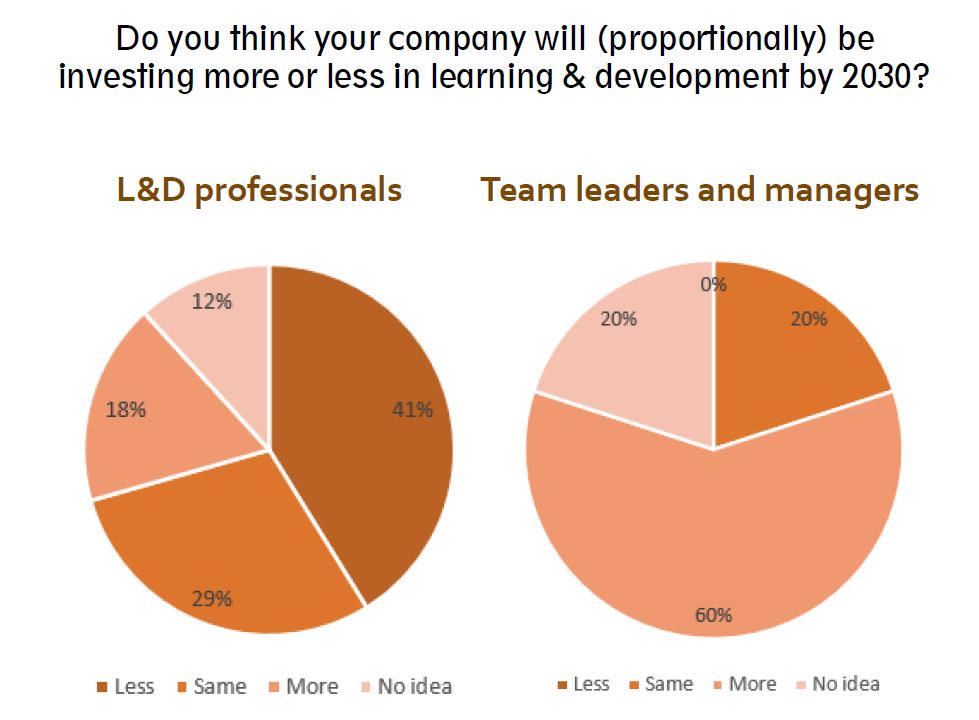
Managers believe their companies will be investing more in learning but L&D professionals believe the opposite

This finding deserves to be explored more. None of the line managers expected to see L&D investment shrink BUT 41% of L&D professionals did. Equally surprising was that 60% of line managers expected to see more money invested in L&D … compared to just 18% of L&D professionals.


Thoughts are divided on the need to develop English language skills in staff

Both L&D managers and line managers are split down the middle on whether companies will need to be investing in Business English training. Our first assumption was that this was connected to the type of industry, the country or even the company size, but we could not find a pattern with the sample size (of 43 L&D professionals and 51 team leaders, managers and senior
managers).


“We will less likely hire staff who don’t have necessary language skills, and if we do we will be looking for a service to bring them up to speed fast so they can perform on the job”. D.F. (Technical Manager)


“I hear a lot from our HR that our new hires can work in English. I don’t think this is accurate. Some of them have spent a year in a foreign country, and many of them have good English listening
skills. But many of them aren’t so called advanced. They don’t have the communication skills we need and the emails they are writing just aren’t professional enough!” C.G. (Senior Manager)


Download the full version

If you are interested to read more about training in 2030, you can download the full version of the survey here.

In December 2021 we surveyed our clients and contacts, receiving 192 responses across a wide range of roles, industries, and European nationalities. Respondents commented on 7 simple statements. Some excerpts and the results of the survey are below. If you are interested to read the full whitepaper, you can download it here.

What is accountability?

Merriam-Webster defines accountability as “an obligation or willingness to accept responsibility or to account for one’s actions”.  Clearly there is an obligation for accountability in organisations via job descriptions, performance reviews, etc. However, today’s workplace with its demands for individual autonomy, remote working and complex project structures means that the ‘willingness’ to be accountable must be continually developed by leaders. Some effective, concrete ways of doing this are:

  • making clear agreements
  • empowering people to make own decisions
  • providing feedback
  • recognising achievements
  • modelling accountability

Our experience shows us that leaders sometimes lack the full range of skills to do this. However, let’s first turn to the factors responsible for the gap in expectations and practice of accountability, by looking at the research we carried out.


Analysis of results

  • Respondents answered positively to most statements, particularly recognition (Q.7) and empowerment (Q.3)
  • Respondents’ impressions of effective delegation (Q.1), clarity of expectations (Q.2), and feedback giving (Q.4) were also significantly positive
  • HOWEVER … when it came to managing accountability within and across teams (Q.5 and Q.6), respondents were divided, many disagreeing that managers hold team members accountable to the commitments they give each other.

There is salience in the results. There are positive impressions of managers’ abilities and willingness to hold individuals to account. However, Q.5 and Q.6 suggest managers may need to develop their skills at managing accountability between team members and teams.

Conclusions and recommendations

Our research suggests that while some leaders are very capable of demonstrating the elements that build accountability with individuals, they may struggle with building and displaying accountability between individuals and teams.

Leaders need to …

  • develop accountability with and between individuals
  • develop their team member’s skills to have courageous conversations and hold each other accountable
  • hold the team, as a unit, accountable
  • contribute to a culture of accountability within their management team

The process for developing accountability in Fig. 2 (not shown in this post) applies to all 4 of these challenges, but the actions required differ!

Ultimately, accountability is as much about ‘doing’ as ‘being’. It is the small, noticeable actions over time that build it, specifically:

  • Being clear – delivering an unambiguous message about roles and responsibilities
  • Being courageous – challenging individuals and teams to take responsibility… and taking responsibility ourselves
  • Being empathetic – understanding individuals and relationships

Leaders need to invest in the steps, skills and behaviours that build accountability naturally. Our experience is that when we can break down big concepts into smaller, more practical elements, we can help people to take the everyday steps they need to achieve bigger goals.

Download the whitepaper

The answers to “How can accountability be developed in individual leaders and organisations?” and “What are the skills and behaviours driving each element?” are discussed in the full version. You can download it here.

This post explores how hidden biases can affect recruitment, performance management, teamwork, and leadership, and provides practical steps to recognise and reduce their impact in the workplace.

  • Reading time
  • 8 Minutes
  • Target audience
  • Managers, team leaders, HR professionals, recruiters, and anyone involved in hiring, developing, or leading people.


Unconscious bias in the workplace influences how we make decisions, communicate, give feedback, and recognise talent. While most people want to believe they judge others objectively, the reality is that everyone relies on mental shortcuts that can influence their perceptions and decisions.

We all like to believe that we make fair, rational decisions based on facts and evidence. We want to think that we judge people on their skills, behaviours, and achievements rather than assumptions or personal preferences. Every day, we process huge amounts of information, make decisions quickly, and rely on mental shortcuts to help us navigate the world around us. These shortcuts are useful, but they can also influence the way we see and work with other people. Some of these influences are hidden and known as unconscious biases.

Unconscious bias in the workplace can affect how we recruit, communicate, give feedback, recognise performance, and make decisions about people’s opportunities. While unconscious bias is not usually intentional, it can still influence workplace experiences and outcomes. The important question is not whether we have biases. We all do. The more useful question is: How aware are we of them, and what systems and behaviours can we put in place to make better decisions?

What is unconscious bias?

Unlike conscious bias, where someone deliberately holds a particular belief or preference, unconscious bias happens automatically. Unconscious bias refers to assumptions, associations, or preferences that affect our thoughts, decisions, and behaviours without conscious intention. They are sometimes also called implicit biases. Importantly, having unconscious biases does not mean someone is deliberately unfair or prejudiced. It means that, like everyone else, we are influenced by our experiences, culture, environment, and the information we have absorbed throughout our lives.

Unconscious bias develops through our experiences, upbringing, culture, education, and the environments we spend time in. Everyone has unconscious biases. They are a normal part of how the human brain works.


“Our unconscious thinking is responsible for the vast majority of the routine decisions we make. So clearly, engaging our conscious, reflective system is going to be a challenge.”


New Call-to-action


Why does unconscious bias happen?

Unconscious biases exist because of the way your brain processes information. From a cognitive perspective, it requires less mental effort to rely on existing patterns and assumptions than it does to carefully analyse every situation from scratch. Your brain will always look for the most efficient way to process the enormous amount of (often complex) information that it receives. It naturally creates mental shortcuts that help us recognise patterns, make decisions quickly, and respond to situations without having to consciously and objectively analyse every detail.

These shortcuts are an essential part of how we function. Without them, even simple decisions would require a huge amount of time and mental effort. However, the same shortcuts that help us navigate everyday life can also influence how we perceive and evaluate other people. Sometimes, they can lead us to make assumptions that are inaccurate or incomplete.


We tend to focus on information that we have to hand, and this can limit our ability to find new kinds of solutions. Expedience Bias pushes us to make quick decisions and avoid too much deliberation. Above all it prevents us from spending time on finding out what we don’t know.


For example, we may feel more comfortable with someone because they share similar experiences or backgrounds to our own. We may assume that a confident person is more capable, or interpret the same behaviour differently depending on who displays it. We may also pay more attention to information that supports what we already believe while overlooking evidence that challenges our assumptions.

These reactions usually happen automatically and are not a reflection of our intentions or values. The challenge is developing the awareness to recognise when our assumptions may be influencing our judgement. By slowing down our thinking, questioning our first impressions, and actively seeking different perspectives, we can make more thoughtful and inclusive decisions.

Here’s a video explaining that a little bit more:


The impact of unconscious bias in the workplace

Unconscious bias influences many aspects of working life, from recruitment and promotion decisions to everyday communication and teamwork. Because these biases often operate without conscious awareness, they can be difficult to recognise. However, their impact can accumulate over time, affecting who receives opportunities, whose ideas are heard, and how people experience the workplace.

Hiring and career opportunities

One of the most significant impacts of unconscious bias is that it can lead to less fair decisions around hiring, career development, and promotion. For example, a manager may unconsciously favour someone who shares similar experiences, interests, or communication styles (affinity bias), or they may associate confidence and visibility with competence (halo effect). While these decisions are rarely intentional, they can result in organisations overlooking talented people who bring different perspectives and strengths.

Lack of diverse thinking

Unconscious bias can also reduce diversity of thought within teams. When people naturally gravitate towards those who are similar to themselves, teams may become less varied in their experiences and approaches to problem-solving. A key indicator of this is groupthink, where teams are less likely to challenge assumptions, explore alternatives, or identify creative solutions.

Innovation and problem-solving

When teams rely too heavily on familiar ideas, experiences, or ways of working, they may miss opportunities to innovate. Inclusive teams benefit from different perspectives because people are more likely to identify risks, challenge assumptions, and suggest alternative solutions.

Psychological safety

The effects of unconscious bias are also closely connected to psychological safety. When employees feel that certain voices are valued more than others, they may become less willing to share ideas, ask questions, admit mistakes, or challenge existing ways of working. A team where people do not feel heard or respected will find it harder to collaborate effectively and learn from different perspectives.

Feedback and evaluation

Unconscious bias can also influence feedback conversations. Managers may unintentionally interpret the same behaviour differently depending on who displays it. For example, confidence in one person may be viewed as leadership potential, while similar behaviour from another person may be perceived negatively. These patterns can affect performance evaluations, development opportunities, and employees’ confidence in their own abilities.

Employee engagement

Ultimately, unconscious bias can affect employee engagement, trust, and belonging. When people believe that decisions are influenced by assumptions rather than evidence, they may feel less valued and less connected to the organisation. Recognising unconscious bias does not mean assuming people have bad intentions; it means understanding how human decision-making works and creating processes and behaviours that help everyone contribute fairly.


We quite naturally warm to people who are similar to us. The Similarity Bias can be harmless in everyday life, but in recruitment it can have more serious consequences. I saw this for myself several years ago; I was interviewing with a colleague and when one of the candidates left the room I turned to my colleague and said, “I really like that candidate”. My colleague replied, “Of course you do, she’s just like you!”. I suddenly realised that if my colleague hadn’t been there, I would never have noticed this bias and how it was affecting my decision-making.

How can leaders reduce unconscious bias?

The goal is not to eliminate bias completely. That is unrealistic. Instead, the focus should be on developing awareness, questioning assumptions, and creating workplace environments where different perspectives are welcomed and valued. The goal is to become more aware of the assumptions we make and create habits and systems that help us make fairer decisions. Reducing unconscious bias requires awareness, reflection, and practical action.

Inclusive workplaces are built when leaders look beyond traditional expectations, recognise individual strengths, and create environments where people are judged on their abilities and contributions rather than assumptions about who they are.

1. Slow down important decisions

Bias often has more influence when decisions are made quickly. The questions below do not remove bias completely. Instead, they create a moment of reflection where leaders can slow down their thinking, challenge assumptions, and make more balanced decisions.Before making an important judgement, ask:

  • What evidence am I using to support this decision?
  • Am I applying the same standards to everyone?
  • Am I responding this way because it’s familiar to me?
  • Am I judging the behaviour, or my interpretation of the behaviour?
  • Would I make the same decision if this person had a different background?
  • Whose perspective am I missing?

2. Create structured decision-making processes

Clear processes help reduce the influence of unconscious bias.

Examples:

  • Use consistent interview questions.
  • Define evaluation criteria before reviewing candidates.
  • Use objective measures during performance reviews.
  • Include different perspectives in important decisions.

3. Develop self-awareness

Interpersonal skills begin with understanding ourselves. Small moments of reflection can improve the quality of workplace relationships. When you notice a strong reaction to someone, ask:

  • Why am I responding this way?
  • Is this based on evidence or assumption?
  • Am I judging this person differently from others?

When is unconscious bias training useful?

Our range of solutions on this topic are valuable for helping people understand how automatic assumptions may influence their workplace decisions, behaviours, and interactions. It can create awareness, encourage reflection, and give people a shared language for discussing inclusion and decision-making. However, training alone cannot remove unconscious bias. A single workshop will not suddenly eliminate years of learned experiences, assumptions, or social influences for any participant. The real value of unconscious bias training comes when it helps people become more aware of their thinking patterns and by providing practical strategies they can apply in their everyday work.

For example, training can help a manager recognise how affinity bias may influence who they naturally connect with, or how confirmation bias may affect the way they interpret an employee’s performance. This awareness creates an opportunity to pause, question assumptions, and make more evidence-based decisions.

Training is always most effective when it is part of a wider organisational approach but this is especially true for unconscious bias. If recruitment or evaluation processes remain inconsistent or support biased decision-making, leaders are not held accountable for inclusive behaviours, or employees do not feel safe speaking up, the impact of training will be limited.

Creating a more inclusive workplace requires a combination of awareness, supportive systems, effective leadership, and everyday behaviours. Unconscious bias training can be an important starting point, but lasting change happens when organisations turn awareness into action.

Why unconscious bias matters for leaders

Leaders influence the experiences and opportunities of the people around them.

By understanding unconscious bias, leaders can:

  • make fairer decisions,
  • improve recruitment and development processes,
  • strengthen trust,
  • encourage different perspectives,
  • create more inclusive teams.

The most effective leaders recognise that good intentions are not always enough. Creating a fair workplace requires awareness, reflection, and consistent action.

Progress, changing expectations, and the importance of challenging assumptions

It is important to recognise that workplaces have changed significantly over time. For generations, many gender-based biases have existed around certain careers, skills, and behaviours.

This progress shows that many of the assumptions people once held about who could or could not succeed in certain careers were based on social expectations rather than ability. For example, women now represent a significant proportion of the science and engineering workforce in many countries. In the European Union, women accounted for around 40% of people working as scientists and engineers (in 2024), demonstrating how representation has increased in fields that were historically male-dominated.

However, progress does not mean that unconscious bias has disappeared. Even when organisations become more diverse, hidden assumptions continue to influence everyday experiences. A woman entering an engineering team, a man working in a traditionally female-dominated profession, or someone from a different cultural background joining an established team may still encounter assumptions about their skills, interests, or suitability for the role.

Key takeaways: Understanding unconscious bias in the workplace

  • Unconscious bias is part of being human. Everyone develops automatic assumptions based on their experiences, background, culture, and environment. Our unconscious thinking is responsible for 99% of the routine decisions we make. So clearly, engaging our conscious, reflective system is going to be a challenge. The trick is not to fight against bias; it’s a natural product of our brains. Instead, seek to understand what could be biasing our decisions and then makes changes to the way we do things in order to mitigate the biases.
  • The goal is not to eliminate bias completely, but to recognise and manage it. We cannot remove every automatic thought or assumption we have, but we can develop the awareness and habits needed to question our first impressions and make more balanced decisions.
  • Unconscious bias can influence everyday workplace decisions. It can affect recruitment, performance feedback, promotions, communication, and whose ideas are heard and valued within teams.
  • Inclusive workplaces are built through awareness and action. Leaders who recognise unconscious bias can create fairer processes, encourage different perspectives, and build environments where people feel respected and included.
  • Understanding unconscious bias strengthens relationships and decision-making. When leaders and teams challenge assumptions and remain open to different perspectives, they create workplaces where people feel valued, trusted, and able to contribute their best work.

Ultimately, the important question is not whether bias exists. The important question is whether we are willing to recognise it, reflect on it, and take meaningful steps to reduce its impact.

We hope you enjoyed reading this post. If you would like to know more about our experience of working with clients in this area, feel free to contact us.

When we first started doing training for our clients on unconscious bias and diversity we realised the main challenge of this topic was to create an environment where trainees can be open and honest and challenge themselves and others. We also realised that unconscious bias is not something you can ‘teach’ someone about; the only way to understand it is to experience it. So, in our training programmes we typically start with brain teasers to get trainees engaged and interested right away. The value of these brain teasers is the discussions that they lead to, where trainees can link the bias they have experienced in a simple quiz question to a real issue or example from their professional lives. The little ‘jolt’ they get from getting a simple question wrong can be a powerful way of nudging them to think differently about what they see and experience in the workplace, and lead to actions.

Try it for yourself. Here are nine questions that should get you thinking! Answers and commentary are at the end of the post.

Contact us now

Q1

A father and son are in a car accident. The father dies and the son is rushed to hospital for surgery. The surgeon says: “I can’t operate on this boy, he’s my son”. How this is possible?

Q2

A bat and a ball cost EUR 1.10. The bat costs one Euro more than the ball. How much does the ball cost?

Q3

How did the number of deaths per year from natural disasters change over the last 100 years?

  • More than doubled
  • Decreased by 50%
  • Remained the same

Q4

When recruiting a new role which job title attracted more female candidates?

  • Senior Engineer (m/f)
  • Senior Engineer (f/m)
  • Senior Engineer

Q5

What proportion of our thought processes are unconscious?

  • 99%
  • 85%
  • 75%

Q6

You need to choose between two final candidates in a job interview. Candidate A has 15 years’ experience in a similar role. Candidate B has only 5 years’ experience. Which candidate is more likely to succeed in the role?

Q7

Which statement is true?

  • Happy, successful people have fewer biases
  • You can reduce the biases your brain produces
  • We all have biases – it’s what makes us human

Q8

If a woman is involved in a car crash, she is 47% more likely to be seriously injured than a man. Why is this?

Q9

Which sentence is more factual?

  • Gender diverse executive teams produce better results
  • High performing executive teams have more female executives

Answers and comments

  1. The surgeon is the boy’s mother. English is a ‘gender neutral’ language, which means we do not change words to show if they are male or female (as in French, German, Italian, etc.). However, many people still assume the job of ‘surgeon’ is inherently male and may struggle to get the right answer to this question. If job roles like ‘engineer’, ‘HR, ‘manager’ carry similar assumptions, this could influence how people are hired and promoted in organisations.
  2. 5 cents. If you answered 10 cents you were probably using intuition to answer. However, the obvious answer is not always the correct one. If we take a bit of time and use our reasoning rather than our quick-thinking intuition, the question is simple to answer. Many decisions in business are actually taken on intuition. Why do you think this is, and does it have any risks?
  3. Remained the same. In Hans Rosling’s 2018 book Factfullness [https://www.amazon.com/Factfulness-Reasons-World-Things-Better/dp/1250107814] he describes how many people, even ‘experts’, get this question wrong because we are influenced by what the media shows us. A common bias is to make decisions based on a narrow selection of information (often what we have close to hand) instead of looking for other sources. If you are a decision-maker it is important to gather as many sources of information as possible and especially important to ask yourself, “What don’t I know?”
  4. Option (b). This experiment, recounted in Inclusion Nudges [https://www.amazon.com/Inclusion-Nudges-Guidebook-Unconscious-Organisations/dp/152363541X], suggests that we need to be very explicit if we want to recruit female candidates into roles that are very strongly perceived as male, even when not indicated as in option (c). In Germany it became law in 2019 to add ‘(m/f)’ to all job advertisements. This may look like a step forward. What do you think? In fact, there is no evidence that this leads to any changes in who applies.
  5. Neuroscientists estimate it is 99%. This makes it virtually impossible to prevent bias by just thinking ‘consciously’ because it means going against our nature. A more useful strategy is to make changes to processes and systems to ‘build out’ bias, e.g. changing the way we write job roles.
  6. We simply don’t know because past experience is no guarantee of future performance. Our over-reliance on past experience is a powerful bias. The only way to overcome it is to look for evidence-based data. For example, what is the correlation between previous experience and actual performance for everyone you have hired in the last 5 years?
  7. Bias is a natural part of our brain and is actually useful in many situations. The trick is to recognise when it is useful and when it is not, and develop decision-making habits that use the correct system [link to system 1 and 2 video].
  8. Isn’t this a shocking statistic? In her 2019 book Invisible Women [https://www.amazon.com/Invisible-Women/dp/1784742929], Caroline Criado Perez explains how cars are designed by men and therefore they are built for men and men’s bodies. This powerful book uses data to show how women’s absence has lead to a world designed without women in mind. The book will help you to see many examples of this in the workplace that you may simply not have seen before, and perhaps make some changes!
  9. Only sentence (b) could be a fact. Sentence (a) takes two facts and assigns causality to them. The causality bias is very common and we do it all the time because it’s neat and quick. But beware when you see links between disparate facts. Always ask ‘why’ and ‘how’ before accepting cause and effect statements!

How to turn this into action?

Finally, here are 7 ideas for practical steps you can take in the workplace to mitigate bias. These ideas were generated by training groups which discussed some of the questions above.

  1. Try to ensure that interview panels have diverse individuals – think about different ages, genders, nationalities, job roles. Because bias is unconscious, you really need someone with a different perspective to point it out to you.
  2. Establish criteria for making important decisions e.g. at least 3 solutions to every problem, ensure you have counter-evidence for each solution, and seek other people’s input
  3. Replace resumes with a standard application form all candidates must complete. This ensures you get the same information on every candidate and you can limit the amount of personal information that could bias short-listers.
  4. Back up decisions with real data and evidence and challenge others to do the same; this can mitigate bias in decisions made with ‘gut instinct’.
  5. In performance reviews, don’t ask people to rate themselves. This could set up a bias in your mind and prevent you being objective.
  6. Ask different people chair meetings so that you get different perspectives on the table.
  7. Spend regular time getting to know remote team members as individuals, in order to remove the feeling of distance in virtual teams.

We hope you enjoyed reading this post. If you would like to know more about our experience of working with clients in this area, feel free to contact us.

In this post, we’ll explore each element of the CIA Model—Control, Influence, and Accept—and show how leaders can use it to respond more effectively to challenges, support their teams, and maximise their personal impact.

  • Reading time
  • 5 Minutes
  • Target audience
  • For leaders, managers, and professionals who want to strengthen their ability to navigate uncertainty, influence outcomes, and respond effectively to challenging situations.

One of the challenges of leadership is knowing where to focus your attention and energy. Whether you’re leading organisational change, navigating a difficult conversation, or responding to unexpected challenges, your effectiveness depends on recognising what you can control, where you can influence outcomes, and what you simply need to accept.

A framework that we use in our leadership and communication training is the CIA Model,from The Critically Reflective Practitioner. The model provides a practical way to cut through uncertainty and focus effort where it can have the greatest impact. By helping leaders separate what they can control, what they can influence, and what they need to accept, it enables more effective decision-making, resilience, and purposeful action.

CIA Model

Control InfluenceAccept
identify which elements of the situation you can directly controlidentify the elements that you can’t control, but that you can perhaps influenceidentify the things that you can neither control or influence, and learn to live with them

New Call-to-action

Control

When we deliver training on leadership, change management and influencing skills, we often begin with a simple exercise: asking participants to list the things they can directly control in a challenging situation. The first lists are usually quite short. But as the discussion develops, people begin to realise they have far more control than they first thought.

The first lesson of the CIA Model is that we usually have more control than we think—we just need to know where to look. By focusing our energy on the things we can control, we put ourselves in the best position to influence the things we can’t.

Some of the things that are within our control include:

  • our attitude and mindset
  • how we respond
  • the effort we put in
  • the decisions we make
  • how we communicate with others
  • our knowledge and skills
  • our preparation
  • behaviours and habits

You may notice that our emotions don’t appear on this list. That’s because we can’t always control what we feel in the moment. Emotions are a natural response to our experiences. What we can control is how we respond to those emotions—the choices we make, the words we use, and the actions we take.


“Make the best use of what is in your power, and take the rest as it happens.”

Epictetus


Influence

Once we’ve identified what we can and can’t control, the next step is to consider where we can have influence. This is often where leadership has its greatest impact. While we can’t control every decision, every person or every outcome, we can shape what happens through our actions, relationships and communication.
For example, a leader may not be able to control a change initiative decided by senior leadership, but they can influence how their team understands the change, how concerns are discussed, and how effectively people adapt.

Rather than becoming frustrated by circumstances beyond our control, we identify the areas where we can make a difference through influencing. Influence comes in many forms: building trust, asking thoughtful questions, communicating clearly, sharing expertise, setting a positive example and developing strong relationships. These behaviours don’t guarantee the outcome we want, but they significantly increase the likelihood of achieving it.

Accept

The final part of the CIA Model is often the most challenging: accepting the things we can neither control nor influence. Acceptance isn’t about giving up or lowering our expectations. A cceptance does not mean agreeing with everything that happens or becoming passive. It means acknowledging reality so that we can make better choices about what to do next, rather than wasting energy wishing it were different.
Every leader will encounter setbacks, unexpected change, difficult people and decisions they disagree with. While these situations may be frustrating, dwelling on them rarely improves the outcome. Instead, acceptance allows us to conserve our energy and redirect it towards the things we can control and the people we can influence.

Conclusion

The CIA Model is ultimately about directing our energy wisely. We cannot control every challenge we face, but we can choose where we focus our attention, how we respond, and where we seek to make an impact. For leaders, this shift in perspective can make the difference between feeling overwhelmed by circumstances and responding with clarity, confidence and purpose.

For more information

For more tips and advice on influencing and dealing with change, see these posts:

This post provides a practial framework for understanding trust and explores the everyday behaviours that increase and weaken it. 

  • Reading time
  • 5 Minutes
  • Target audience
  • Leaders, managers, facilitators, and professionals who want to improve collaboration, strengthen relationships, and build trust within their teams.

Introduction

Trust is one of those things we know is important, but often struggle to define. We know when we don’t have it. A lack of trust is easy to define. Conversations feel guarded, commitments are questioned, and collaboration becomes harder. But when someone asks us “How exactly do you build trust?”, the answer is often surprisingly vague.

In this article, we’ll explore a practical way to understand trust in working relationships: the Trust Equation. Developed by David Maister, Charles Green and Robert Galford, this model breaks trust down into four elements that influence how trustworthy others perceive us to be: credibility, reliability, intimacy and self-orientation.

By understanding these elements, we can move beyond the idea that trust is simply something we “have” or “don’t have” and instead focus on the everyday behaviours that build stronger professional relationships.

Why use it?

For the teams we work with, being able to break down trust into specific and easy-to-understand elements is always a great first step to identifying how to demonstrate behaviours that can build more trust. In short: the Trust Equation helps teams move from “we need more trust” to understanding exactly what behaviours create it, because it:

  1. creates a shared language
  2. shows trust can be developed
  3. improves collaboration
  4. helps leaders understand their impact
  5. diagnoses relationship challenges
  6. supports modern, distributed teams

New Call-to-action

The Trust Equation: Four factors that influence trust 

The Trust Equation is useful in the workplace because it turns something that often feels vague and personal (“I trust this person”) into something we can understand, discuss and improve. Many organisations talk about the importance of trust, but people often mean different things by it. One person might think trust means competence. Another might think it means honesty. Someone else might define it as feeling safe enough to speak openly.

The Trust Equation (David Maister, Charles Green & Robert Galford, 2004, The Trusted Advisor) breaks down trust (T) into an equation of 4 elements:

  • C = Credibility – Do people believe I know what I’m talking about?
  • R = Reliability – Can people count on me?
  • I = Intimacy – Do people feel safe being open with me?
  • S = Self-Orientation – Do people believe I care about their needs, or mainly my own?


For trust to “work” in the workplace, it requires high scores in the first three elements (C, R, I) but a low score in the final one (S). In other words, the Trust Equation tells us that high self-orientation undermines the other elements that are essential for trust.


How to Build (or Lose) Trust in the Workplace

Credibility – “Do people believe I know what I’m talking about?”

Credibility is about the confidence others have in your knowledge, skills and judgement. You don’t need to have all the answers but that you are as competent and honest about your abilities.

You build credibility by:

  • demonstrating your expertise through your work
  • communicating clearly and confidently
  • backing up your opinions with evidence or experience
  • admitting when you don’t know something and finding the answer

You lose credibility by:

  • exaggerating your knowledge
  • making claims you can’t support
  • giving inconsistent information
  • pretending to know more than you do

Reliability – “Can people count on me?”

Reliability is about consistency. People trust colleagues who do what they say they will do. Reliability isn’t about doing everything perfectly or always being available. It’s about being dependable and communicating clearly.

You build reliability by:

  • meeting deadlines
  • following through on commitments
  • preparing for meetings
  • communicating early if plans need to change
  • doing the small things consistently well

You lose reliability by:

  • frequently missing deadlines
  • overpromising and underdelivering
  • forgetting commitments
  • failing to keep people informed

Intimacy – “Do people feel safe being open with me?”

Intimacy in the workplace means creating a sense of psychological safety where people feel comfortable being honest, asking questions or admitting mistakes. People trust those who make them feel respected rather than judged.

You build intimacy by:

  • listening without interrupting
  • showing empathy
  • respecting confidentiality
  • asking genuine questions
  • admitting your own mistakes
  • giving people your full attention

You weaken intimacy by:

  • dismissing concerns
  • interrupting frequently
  • gossiping
  • reacting defensively
  • criticising people rather than ideas

Self-orientation – “Whose interests come first?”

Self-orientation is about where people believe your attention is focused. When people believe you’re primarily interested in helping yourself, trust declines—even if you’re highly competent.

You reduce self-orientation by:

  • asking more questions than you answer
  • being curious about other people’s priorities
  • sharing credit
  • listening before offering solutions
  • making decisions that benefit the team, not just yourself

High self-orientation often looks like:

  • dominating conversations
  • constantly promoting your own ideas
  • taking credit for shared success
  • ignoring other people’s concerns
  • focusing on being right

Final thoughts

Trust is built through hundreds of small, everyday interactions. The Trust Equation reminds us that trust is less about intention and more about experience. People trust us when they see consistent competence, reliability, openness and genuine concern for their interests.

The good news is that every element of the equation can be strengthened through deliberate behaviour. Rather than asking, “How can I get people to trust me?”, a better question is, “Which part of the Trust Equation should I improve today?”

Trusted Advisor offers a free Trust Quotient Assessment which we highly recommend because the results include feedback on which elements are strengths and weaknesses for you.

Virtual teams have clear advantages, but they also come with a set of unique challenges; building trust and getting people to work together is just not the same in a virtual environment. If you are leading virtual teams you will already be aware of many of these challenges. If you are not, or if you are new to this, or if your teams are not telling you everything; this post is for you! In over ten years of working with virtual teams in global companies we have collected the challenges that they have shared with us. We can now share with you some of the most common challenges we hear time and again, and some suggestions for how to help with them. This post is even more relevant in our current situation, when teams are going virtual out of necessity rather than design. So, we hope that this post will be a valuable resource to you as you adapt to the new normal of virtual working!

New Call-to-action

Challenge 1: Connecting across different time zones

Knowing when to connect with someone halfway across the world is a key challenge that people share with us again and again. Technology allows us to send communications at any time of the day or night. But it does not tell us when we can expect a reply. Delays in response can lead to miscommunication and frustration; not something you want in any team.

How a team leader can help

It really helps to have a whole team discussion about the time zones people are working in. Don’t assume anything; we often find that some virtual teams are completely unaware what time it is for their counterparts! But don’t limit the discussion to just the time of day; in addition, bring in people’s preferred working patterns. We have found that these types of discussions can help people manage their own expectations and tailor their communications more effectively to their remote colleagues.

Challenge 2: Getting to know other team members as individuals

It is much simpler to know our colleagues’ working styles and flex to them in a co-located space because we can see how they work. In a virtual team these things are more hidden. Virtual teams who don’t know each other are more likely to fall into conflict and work to separate agendas.

How a team leader can help

The secret to building intimacy in virtual teams is to do more of it and be explicit about it. Explain why the team needs to make extra efforts to get to know each other and the benefits of doing it. Plan time at the start of meetings for personal check-ins, encourage people to reveal non-work related things about each other. Host a ‘virtual’ breakfast or coffee meeting for people to socialise. One team we worked with devised a set of 20 questions for new teams to break the ice; simple, non-threatening questions like ‘Do you prefer coffee or tea?’ can start things going and encourage people to open up. The time you create for personal bonding will pay rewards later. But the key is to realise it doesn’t happen naturally in virtual teams.

Challenge 3: Holding each other accountable and giving feedback

This is even more critical in a virtual team because we simply can’t see what other people are doing. Distance can too easily undermine the things we do more naturally in co-located teams such as giving feedback and holding each other accountable.

How a team leader can help

Ensure that the same processes and standards are applied for giving honest and timely feedback and holding each other accountable. DEEP and DESC are two approaches that work extremely well. In the office you may stipulate that feedback and performance conversations happen face to face. In a virtual team this means video calls; don’t let email take over just because it’s more convenient.

See the next challenge for a technique that can help drive team accountability.

Challenge 4: Keeping focused and engaged

Individuals will need to work more independently and with less supervision in a virtual environment but will also become more easily distracted and may lose focus due to competing work/life priorities.

How a team leader can help

Borrow a very effective technique from the iterative, agile approach; ‘Stand Up’ meetings are a short daily meeting to check-in and align with each other. In the meeting, team members are asked to share what they will be working on today and what obstacles they may face. For a team leader this provides valuable insights into problems that you will need to work on that day. For team members this is a routine event than can help them focus and energise.

Challenge 5: Making it more personal

Technology has introduced many more personal features today but teams that we work with still say that having a screen between them can make virtual teams feel impersonal.

How a team leader can help

Virtual hugs or pats on the back, telling jokes and playing games can all help to make things more personal. But the number one thing that creates the biggest impact is to turn on the webcam! As humans we connect to faces instantly and, according to the Mehrabian studies, our body language accounts for 55% of how we express emotion and attitude. It still surprises us how many virtual teams do not switch on their cameras. It’s a small step that makes a very big impact.

Challenge 6: Scheduling too many (and too long) meetings

Meetings can be draining in a physical environment. For virtual teams they can feel even longer due to the lack of physical interaction and interruption from technical problems. So, it’s important to manage meetings a bit differently in a virtual environment.

How a team leader can help

Acknowledge that virtual meetings are more of a strain and mitigate this by making them shorter and more frequent. Ensure that meetings are timetabled with people’s time zone and schedule considered; remember that these things are not as visible as they are in a co-located space. Use the tools you have in meeting software to involve everyone and keep people attentive and engaged; for example, hand raising, emoticons, breakout rooms. Check out the links below for specific posts on meetings.

Challenge 7: Knowing how much to communicate

When we are not working physically together it’s difficult to know what is too much, or too little communication. If we get it wrong we risk over-burdening our team mates, or feeling isolated.

How a team leader can help

Finding that ‘Goldilocks moment’ of just the right amount of communication means agreeing together when and what to communicate. It’s also worth thinking about which tools to use for which kinds of communication and the differences between synchronous (real time e.g. video calls) and asynchronous (delayed e.g. email). Successful virtual teams we have worked with use some simple techniques to manage their team communications, e.g. asking before interrupting, having agreed communications ‘black out’ times, and simply sharing their preferences.


More information on this topic

For more advice and tips on virtual teams, see these posts:

If you are interested in our training programmes on managing virtual teams, click on the links to learn more.


Virtual teams work across time, space, and organizational boundaries—and they are becoming increasingly common. As these virtual teams interact through technology and only occasionally meet face-to-face, it is important to rethink and sharpen the way we collaborate and communicate . In this short video Scott Levey, a director at Target Training outlines 3 simple steps you can follow to make sure your virtual team makes an impact.


Storytelling is a topic of great interest in the business communications world.  Conferences and speakers around the world are praising the power of storytelling and attracting audiences. Why? Humans have told stories since our earliest beginnings. We all tell stories. It was part of our survival and development. Stories are all around us, from campfires to multimillion dollar movies, so why do we have to make a case for it in a business environment? Why do people want training on something that comes naturally? In a business context, perhaps we don’t want reveal too much of ourselves, show too much emotion or not be taken seriously at work. Our storytelling seminar gives participants the skills and determination to tell more stories and better stories in the workplace. This post shares five lessons learned about storytelling in business.

Lesson 1 – What does your listener want?

What attracts audiences to the telling of a story? We identified three things:

  1. emotion

  2. energy

  3. authenticity

Children will demand expressions of the energy of the characters, the emotion of the plot and telling the story “like you mean it”. Telling bedtime stories to children is a practical example of the standards adults have for stories as well, though many may not say it. Adults need the same things to be engaged.

Lesson 2 –  What makes a good story good?

As Aristotle observed, a good story starts with a character in trouble. The character is one the audience can identify with–not too good to be in trouble and not too bad to deserve the trouble to come.  The story progresses with the development and deepening of the trouble to create a sense of fear in the audience so the resolution of the problems leaves the audience with a sense of relief.
Aristotle referred to the stages as pity, fear, and catharsis. Stories from Greek tragedy to Toy Story follow this model in one way or another.

In the workplace we can tell stories about problems, consequences and solutions to reflect Aristotle’s model.


“Storytelling comes naturally to humans, but since we live in an unnatural world, we sometimes need a little help doing what we’d naturally do.”

 Dan Harmon


Lesson 3 – Crafting stories that fit

The STAR Model is a basic and effective format for telling stories in a business environment. The model fits the needs of business audiences as it sets the scene, describes the action in it and talks about what happened to resolve the situation. This model is very effective in behavioral interviewing, answering questions about past performance and offering a status update.

  • Situation – clearly explain the facts and assumptions that make up the context of the action.
  • Task – detail the task to be completed or the goal to be reached.
  • Actions taken – describe all relevant actions taken to complete the task.
  • Results achieved – describe the immediate outputs and eventual outcomes of the actions taken.

Lesson 4 – Courage to connect

If work for you is simply an exchange of power, storytelling and other enhanced communication tools are not important.  Others will translate what you say into orders if you are in a power position just as you may interpret orders from your superiors. If you want your workplace to be a place where people build something together instead of following the orders of the few, storytelling is an active strategy to humanize the workplace for you and your co-workers. It provides opportunities for meaningful connections that inspire trust.

Lesson 5 – From stories to action

A good story can set the stage in a business environment and yet we often need to make the purpose clear once it is complete. We can achieve that Socratically through a debriefing method or by simply telling the listeners what we had in mind directly.

A clear explanation of the purpose of the story provides a natural, logical connection to the observation of what the teller and the listeners need to accomplish in a business environment. When listeners can connect the story to their current situation, they become involved in the process of identifying what to do and why it needs to be done—without having to be told.


Related training services

For more information about what we can do to help you succeed globally, here are some of our leadership solutions


When workers are suddenly sent home to work they will face plenty of challenges, especially if they’ve never done it before. Team leaders will face an additional challenge: Leading a team that is working from home. In this post we offer a range of tips and advice for how you can do that. To keep it simple and easy to implement we’ve stuck to a 3-step approach:

  1. Start by understanding the challenges
  2. Keep the team working together
  3. Lead your team as they work from home

Go to the eBook

What are the challenges?

Technical

An immediate priority for leading a team that is working from home is to ensure that team members have the tools to do their jobs remotely. This includes both productivity and communication tools. As a leader you can approach this with the whole team by checking they have what they need and discussing which kinds of communication technologies work well for them. Not everything will work as it did in the office and as a team you may need to decide to use ad-hoc technologies as a temporary solution.

Emotional

Some team members may feel isolated and this can have a serious impact on motivation. This is best discussed in a one-to-one setting. Individuals will all have different emotional and psychological challenges and you need to know what these are in order to help them. A simple question like, “How are you looking after yourself?” can open up a discussion and go a long way to making team members feel supported individually. Read more on this topic in our post Dealing with Loneliness and Isolation when Working from Home.

Personal

Don’t forget to also look after your own needs and work through your own personal and logistical challenges. If you don’t address these, you won’t be as effective at helping other people with their issues. Get advice on how to do this in our post Three Steps to Adapt to Home Working.

How do I keep the team working together?

In the 1970s, MIT Professor Thomas Allen discovered that team cohesion is strongest when employees are physically closer. His ideas have been taken forward by some of the most successful companies who engineer ‘collisions’ between employees to strengthen bonding and group affiliation; simple things like coffee-machine conversations, team social events, sharing stories, etc. So, how can you do this with a team that works in physical isolation from each other? Here are some ideas we have seen that work:

  • Set up daily check-ins or ‘stand-up meetings’ at the start of each day where the team shares their priorities for the day and any impediments they face. This can give team members a reassuring routine which is both work and socially focused and help to overcome feelings of isolation. It also gives you a helicopter-view of what’s happening each day.
  • In team meetings always add an agenda item with a question like, “How is this arrangement working for us?” This helps to address emotional/psychological issues of individuals and build trust. Avoid closed questions (asking “Is everyone ok?” won’t give you much information) and use “us” and “we” to reinforce team togetherness.
  • Monitor team communication patterns to pick up on problems, side issues and tone that team members are using with each other. This doesn’t mean using spyware! You just need to go over conversations that are happening on Slack, Teams and other conversation channels.
  • Use video in team communications; humans bond much better to faces than to voices and non-verbal communication sends powerful signals of belonging and empathy. Seeing faces also puts more energy into calls, which helps to overcome feelings of isolation.
  • Create and manage social interaction to replicate what normally happens in the office; have a virtual lunch together, share internet memes, play games together, just get people laughing and having fun. Social interaction is the base of creating trust in a team; you just need to do it a bit differently in a virtual work setting.

Which skills do I need for leading a team that is working from home?

 You don’t need new skills to become an effective leader of a home-working team, but you will need to use some of them more. Here is a short list of where to focus your leadership skills:

Be available

You may have an open door policy in the office but that won’t work in a remote team. So, be explicit about when and how team members can contact you. If you haven’t heard from someone in a while, check in with them and ask how they are. At the same time be careful that you also ring-fence the time you need for yourself and your own tasks.

Solve problems

This is probably the biggest thing your team will need from you, at least at the start. You may need to be flexible and change processes if necessary, for example lifting constraints on how and where data is stored and shared. Focusing on outputs rather than processes will help push the team towards purposeful activity and away from missing their old physical environment.

Make rules and hold people accountable to them

It’s important to establish some ground rules with the team, for example on which communication tools to use for different tasks, how and when to contact each other. You then need to monitor that the team is sticking to those rules and jump in when they are not.

Continue to manage performance

Research shows that employees value their performance being managed and they rate managers highly when it’s done well. This is still true in a home-working environment, but it will take more communication and more regular, smaller steps to address the distance and isolation. A practical start is to set some short term performance goals on adjusting to home-working at the beginning.

We hope you enjoyed reading this post and please share what works for you in the comments. If you would like to know more about our experience of helping teams with remote working, feel free to contact us. We also offer training on managing your focus, energy and impact when working from home and leading people when they are working from home.


People have always told stories and they are a vital part of our communication. Today, storytelling has become accepted (and sometimes expected) in a professional context. We’ve seen a rapid demand for our practical storytelling in business training solutions. Whereas 8 years ago there was sometimes a need to convince people that a storytelling approach was valid, we rarely get any pushback today. This change in attitudes can be partly attributed to the power of the TED talk format, partly to our push back against death by PowerPoint and people speaking to us in bullets … and mainly because storytelling never went away. When done well, storytelling connects with people in a way no other communication approach can. This post outlines the essentials so you can get started.

Contact us now

What is a story? And why should I use them?

Every story has …

  • a plot
  • a beginning, middle and end
  • often involves overcoming a problem, challenge, obstacle, dilemma
  • but above all …. a story connects on a human /emotional level

This last point is the key. A story is not a series of events or a case study. It should connect with people and create an emotional reaction.
This connecting makes stories easy to remember. When done well stories bring meaning to information and have the power to move people. Depending on the story and the skill of the storyteller our brains …

  • produce cortisol during the tense moments in a story, which allows us to focus
  • produce oxytocin, that promotes connection and empathy
  • release dopamine which makes us feel more hopeful and optimistic

If you are interested in the science behind these statements, these two HB articles explore the science behind storytelling and what makes storytelling so effective for learning.

This means you can choose to use a story in a wide range of situations. We often use stories when presenting, influencing, teaching, leading or just in day-to-day discussions. Consider using stories when you want to aid memory, celebrate, challenge assumptions, connect, convince, encourage, energize, entertain, explain, impress, inspire, motivate, persuade, reinforce values or beliefs, scare or shock, sell, support, teach or warn.

How do I build a story?

Learning to build a great story is a skill, and it can require practice. If you want to build a story you need to start with your audience. Your first question has to be “What do I want them to feel?”. Sometimes the emotion you arrive at may surprise you. Secondly ask yourself “What do I want them to understand? think? do?”. Then think back over the situations you’ve been part of, or have observed. It is far easier and far better to tell stories that mean something to you and are your stories. You can share other people’s stories but make sure you have the information and the understanding to bring it to life. Again, a story works because it connects on a human /emotional level.

This post goes behind the scenes with 2 of our staff, discussing the challenges some professionals have when building a story and how they approach this in a training environment.

If you are struggling to build a story, then try using the IDEAS approach:

  • Identify the emotion you are trying to create. Then identify what you want your listener to understand and do.
  • Decide which story would best accomplish this and connect with your listener
  • Expand your story. You have the bones, now put the flesh on them.
  • Anticipate their questions and reactions. Now choose to deal with these within your story or intentionally leave this out to provoke discussion once you’ve finished telling the story.
  • See the story as you tell it.

Finally, don’t assume you can just get up and tell it. You need to practice your story, if you want to make it matter.

How do I actually tell my story?

If the story means something to you, you will already have the content and the structure. Make things personal and tell tough stories. If your story is tough and personally matters to you, you will naturally find the pace, the tone and the body language you need to make your story captivating. When you are developing and practising your story, follow these 3 great pieces of advice:

  • Invest time in building it
  • Practice out loud
  • Make it personal to you

When you are delivering the story …

  • see the story as you tell it
  • use outer and inner language. Outer language is what physically happened, while inner language is how the person was feeling thinking. An advanced tip is to avoid eye contact when you are sharing the inner language.
  • use plenty of LOTS (language of the senses). This includes what you saw, heard, smelt, tasted, tough or felt
  • take your time. If your rush your story, you will rob it of its richness. You wouldn’t want to read a story structured into bullet points, would you?

And if you want to get really good …

  • use memory devices e.g. words, phrases or images repeated in different places
  • use a tangible object or image as a starting or closing point
  • when doing dialogues adopt a different voice/body/position for each person
  • consider your space – roam the room or sit on a chair – BUT actively think about it!

What should I not do when telling a story?

Telling a story is NOT the same as making a presentation. A lot of the techniques you’ve learned on presentation seminars are story-killers and using them will rob your story of its emotional content. For example:

  • Don’t put your key message up front
  • Don’t tell them what you’ll tell them, tell them, tell them what you told them
  • Don’t start with the structure, start with the emotion
  • We would also suggest you avoid the phrase “Let me tell you a story”

Storytelling is a learnable skill! It starts with identifying your goal and understanding your audience. You need to know the emotion you are looking for. From there you start hunting for the right story, which you then craft through practice. Don’t rush it, do not “present” it, and have the courage to just tell a story person to person. You’ll be surprised at the impact you can make.

And if you’d like support, whether it be coaching or training then do get in touch. We’d love to help you be even better at storytelling.

Recently one of our clients asked me to co-facilitate a workshop at an annual global event. The client is one of the largest building materials companies in the world, and their annual event is attended by plant managers, country directors and executives. Amongst the presentations and plenary sessions they wanted to run 2 challenging workshops which would then lead to concrete action plans. One of these workshops focused on the ambitious goal of quickly becoming carbon free, and the other on training. 

Our client wanted to further strengthen their learning culture and ensure top-level management were playing an active part in this journey. Rather than asking the senior leaders “What do you need?” the question they wanted to ask was “So. what can you do?” – and the participants loved it.  They were more than happy to share their experiences and opinions, and all were quite vocal when expressing that learning and development was their responsibility. As one Indonesian plant manager said  “You at headquarters support us and help us, we like the e-learning and the virtual delivery offers … but we are the important ones because we need to make it happen”.

Based upon their input, and expanded through interviews with other clients, here are 17 ways that senior managers and executives can actively support training and development within their organizations.

Go to the eBook

  1. Ensure that the message of how training connects into your long-term health and strategy is lived by all levels. This means looking for opportunities to repeat this message and using concrete and relatable stories.
  2. Be clear to your L&D teams about where you see your future challenges. What will the critical skills be in 5 years time? What trends do you see in your market? Where do you see the skills gap? What are the core behaviours you want to see in your staff’s DNA? If you show them where you want to go they will help you get there.
  3. Support the building of a skills matrix for roles , then with a rolling 36-month focus, ensure training is connected directly to this skills matrix. This is an upfront investment that then provides a clear framework for deciding where training budgets go.
  4. Tap into “management by objectives“ behaviours and make learning a target for your management team.
  5. Encourage awareness that people learn through experience and exposure. Be an example and look into include and involve upcoming talents and high-performers.
  6. Expect your management teams to lead by example and actively join training sessions. This helps ensure that training is seen as strengthening for the future and not a sign of weakness or gaps.
  7. Be seen to be looking for training and development for yourself. This sends a clear message that training is about becoming stronger and not a sign of weakness.
  8. Insist that managers actively feed back to the central L&D team regarding their current and future needs, satisfaction levels, and ideas for the medium and long-term. Strive to make the internal customer surveys a formality.  Your L&D teams should know in advance what is working and what is not if they are benefiting from direct conversations with the regions.
  9. Ask to see that all training has a clear objective and that this is reinforced before, during, and after the training by line managers in person. This isn’t about checking quality, but rather showing the people involved in the before and after that you care, and these steps aren’t nice-to-have add-ons!
  10. Connected to above, insist that all training programs lead to follow up actions by team leaders and line managers. See #4.
  11. Ensue that clear and tangible training objectives are communicated at multiple touch points. Find stories and examples which connect the importance of learning and development to medium- and long-term goals. Yes, this similar to points 1 & 2 but we can’t emphasize it enough. If people understand the “why” then things happen.
  12. Whenever you visit a plant or site, take the time to meet the local training dept and ask what else you can do to support them. They’ll really appreciate this … and you are again sending a clear signal that training and development is strategically important to you.
  13. Get involved with your emerging talents programs. These people are your future. They’ll be energized by your involvement and they’ll energize you too!
  14. Commit to actively supporting a training session once a month by joining the first 15 minutes, explaining why this training is relevant, showing interest in the people in the room and being clear about what we want to see afterwards
  15. Show little tolerance for regions reinventing the wheel. Identify the core strategic programs needed by all regions– get these programs right through piloting them – and then make sure there is budget to adapt them to the local skill levels and languages.
  16. Get involved when budget ownership questions threaten the actual delivery of training. Help cut through the complexity of cost centers and encourage the company to work as one organization.
  17. When costs need cutting, defend training budgets and training availability. It’s too easy to cut it and the savings are often small compared to more painful options but the message is clear. Do you want your employees to see training and development opportunities as a bonus or as an expectation?

For more information

If you’d like to know more about how you can actively make the most from your training investment then download this simple and practical guide.

Related pages

This post explores Stephen R. Covey’s Emotional Bank Account concept and how managers can use it to strengthen relationships, improve communication, and create higher-performing teams. It includes practical ways to make more positive deposits, repair trust when withdrawals happen, and a 10-minute reflection activity to help you assess your own team relationships.

  • Reading time
  • 8 Minutes
  • Target audience
  • Managers, team leaders, and anyone responsible for building trust, engagement, and performance within a team.

Whether you’re leading a team through change, managing a hybrid workforce, or trying to improve performance, the quality of your relationships has a direct impact on your success as a manager. When there is trust between people, they are more likely to share ideas, raise concerns, accept feedback, and work collaboratively. When trust is lacking, even routine conversations can become difficult.

One of the most useful ways to think about trust in the workplace comes from Stephen R. Covey’s concept of the Emotional Bank Account, from The Seven Habits of Highly Effective People. Every interaction either makes a deposit or a withdrawal. In Covey’s own words:


An emotional bank account is a metaphor that describes the amount of trust that’s been built up in a relationship.  It’s the feeling of safeness you have with another human being.  When the trust account is high, communication is easy, instant, and effective.


Deposits are made through positive actions—such as keeping promises, listening with empathy, recognising good work, and treating people with respect. Withdrawals are made through negative actions: dismissing concerns, breaking commitments, or failing to communicate openly.

For managers, this analogy is a practical leadership tool. Every conversation, decision, and action either strengthens or weakens the relationships that underpin team performance. Understanding how to make regular deposits into your team’s emotional bank accounts can help create an environment where people feel valued, supported, and motivated to do their best work.

New Call-to-action

Why should managers care about emotional bank accounts?

Few managers would argue against the importance of trust. Most leaders want to build positive, productive relationships where people feel respected, valued, and motivated to do their best work. Leadership qualities such as authenticity, credibility, empathy, and trust continue to be recognised as essential for effective management.

Building strong relationships is about much more than being a “nice” manager. Trust has a measurable impact on performance. Meaningful and strong relationships in the workplace lead directly to tangible results. Teams with high levels of trust tend to experience better communication, stronger engagement, and higher levels of commitment.

As a manager, your success is closely linked to the success of your team. Every interaction—whether you’re delegating work, coaching, recognising achievements, resolving conflict, leading meetings, or having a difficult conversation—either strengthens or weakens the relationships that support high performance. These everyday moments are opportunities to make deposits into, or withdrawals from, your team’s emotional bank accounts.

Managers who consistently invest in relationships build the trust needed to navigate challenges, encourage innovation, and sustain performance over the long term. Conversely, when withdrawals outweigh deposits, trust begins to erode. Without that foundation, even the most capable teams can struggle with engagement, collaboration, and accountability.

How do you build a healthy emotional bank account with your team?

Trust is built through consistent, everyday behaviour. While every individual and team is different, Stephen Covey identified several practical ways managers can make regular “deposits” into their team’s emotional bank accounts.

Understand the individual

Everyone values different things. One employee may appreciate public recognition, while another would rather receive a quiet thank you. Taking time to understand what motivates each person, how they like to be recognised, and what matters to them allows you to build stronger, more meaningful relationships.

Keep your commitments

One of the quickest ways to build trust is to do what you say you’ll do. Keeping promises, following through on commitments, being reliable, and respecting deadlines all demonstrate that people can depend on you. Equally, broken promises and missed commitments quickly become withdrawals.

Clarify expectations

Misunderstandings often arise because people make different assumptions. Taking time to agree on priorities, responsibilities, deadlines, and expected outcomes helps prevent confusion and reduces unnecessary frustration—particularly when working remotely or across different locations.

Pay attention to the little things

Small actions can have a lasting impact. Saying thank you, checking in on someone’s wellbeing, remembering important milestones, listening without distractions, or simply making time for a conversation all help strengthen relationships. These everyday moments often matter more than grand gestures.

Demonstrate personal integrity

Trust grows when managers act consistently and fairly. Being honest, admitting mistakes, treating people with respect, and behaving in line with your values all reinforce your credibility. Integrity isn’t something you switch on when it’s convenient—it’s reflected in your actions every day.

When you make a withdrawal, apologise sincerely

Every manager makes mistakes, misses commitments, or says the wrong thing. What matters is how we respond.

A sincere apology can be one of the most powerful deposits you make after a withdrawal. Acknowledging your actions, taking responsibility, and making amends demonstrates humility, integrity, and respect. It also shows your team that accountability applies to everyone—not just them.

Managers who apologise when they’ve got it wrong don’t lose credibility—they often strengthen it. Admitting mistakes builds trust and creates a culture where people feel safe to learn, take responsibility, and support one another.

Putting emotional bank accounts into practice – A 10-minute activity for managers

Understanding the idea of emotional bank accounts is useful, but the real value comes from applying it to your own relationships. Every manager has relationships that are strong, relationships that need attention, and moments where they may have made more withdrawals than deposits.

The following activity is designed to help you reflect on your current relationships with your team and identify practical actions you can take to build more trust. It isn’t about judging yourself or creating a perfect balance sheet—it is about increasing your awareness and making intentional choices about how you lead.

Step 1: Choose five people

Write down the names of five team members who are critical to your team’s success.

Step 2: Review your recent interactions

Look back over the past two weeks. Use your calendar, emails, messages, and memory to identify moments that were likely to be deposits or withdrawals.

For each person, create two simple lists:

**Deposits**

  • Listened without interrupting
  • Recognised good work
  • Kept a commitment
  • Offered support or coaching
  • Showed appreciation

**Withdrawals**

  • Cancelled or rushed a meeting
  • Failed to follow through
  • Gave unclear expectations
  • Dismissed a contribution
  • Had a difficult conversation that didn’t go well

Don’t worry about making the list perfect—you’re looking for patterns rather than keeping score.

Step 3: Think about what matters to them

Now put your notes aside for a while. When you come back, write down what you know about each person.

  • What motivates them?
  • What gives them energy?
  • How do they prefer to receive recognition?
  • How do they like to communicate?
  • What behaviours from a manager help them feel trusted and valued?

Remember, deposits are personal. What builds trust with one employee may have little impact—or even feel like a withdrawal—to another.

Step 4: Make a plan

Looking at your notes, ask yourself:

  • Which relationships need more deposits?
  • What could I do differently over the next month?
  • What specific opportunities already exist in my calendar?

Rather than making a vague commitment to “be a better listener”, identify real moments where you can put it into practice. For example, use your next one-to-one meeting to ask more questions before offering solutions, or take time to recognise a recent achievement.

Small, consistent deposits build trust over time. Choose one or two actions and commit to making them part of your everyday leadership.

Key takeaways

Building healthy emotional bank accounts is not about occasional big gestures. It is about the small, consistent actions that shape how people experience working with you.

The key points to remember are:

  • Trust is built through everyday interactions. Every conversation, decision, and action can either strengthen or weaken a relationship.
  • Deposits are personal. What one person experiences as recognition or support may not have the same impact on someone else. Take time to understand the individuals in your team.
  • Reliability matters. Keeping commitments, clarifying expectations, and following through are some of the simplest ways to build trust.
  • Mistakes happen. Effective managers recognise when they have made a withdrawal, take responsibility, and work to rebuild trust.
  • Strong relationships enable performance. Emotional bank accounts are not separate from results—they are one of the foundations that allow teams to collaborate, adapt, and succeed.

Great managers don’t build trust through one big action. They build it through hundreds of small deposits made consistently over time.

Healthy and respectful working relationships are a must if you want an effective and enjoyable workplace.  In the first post of this series, I introduced John Gottmann’s work on the 4 Horsemen of the Apocalypse. In the second post, we looked at what you can do to tackle the toxic behaviours of criticizing & blaming and defensiveness. This blog post will dive deeper into the last 2 toxic behaviours – and possibly the most damaging of the 4: stonewalling & contempt. We’ll explore why they happen, their impact and how both parties can change things for the better.  We’ll end with what a manger can do when they see these behaviours within their teams.

Writing emails that people read: Free eBook download

Contempt

Contempt is when somebody makes it clear that they feel somebody has no value and deserves no respect. As it has been built brick-by-brick over time, it is tough to dismantle, and is probably the most destructive behaviour amongst Gottman’s “Four Horsemen”.

Contempt can manifest itself as ongoing sarcasm, cynicism, insults and aggressive, belittling or mocking humour. It can be seen in small gestures (eye-rolling when a colleague starts talking in a meeting, snorting at the mention of a project, a smirk or a single “hah” when a  colleagues name is mentioned) to full on mocking and cruel statements e.g. “Wow, you’ve done better than I ever expected – even by your standards that’s truly great work Susanne. You must be exhausted after having made so many mistakes”.

When somebody shows contempt, they are actually communicating that they see themselves as better and worth more.

Why do we do show contempt?

Feelings of contempt are typically built up over time – negative experiences create their own story and, too often, nobody has tackled the situation effectively. This can leave a person feeling frustrated and angry and looking to establish some sort of “superiority”.  Contempt can also come from a sense of moral superiority based on class, cultural or religious differences. Peers can feed into it or enable it.

What happens when we show contempt?

Contempt destroys teams and relationships. It prevents trust and respect and makes it hard for any real human warmth. It is tangibly damaging, causes stress and can harm people emotionally, mentally and ultimately physically.

So, what can the person showing contempt do differently?

Truth be told, if you are showing contempt for others there is a good chance you no longer care about turning things around. However, if you have a high level of self-awareness and realise that you have become somebody you don’t want to be then this is already a great step. Going forward you can focus on redefining your relationship with your colleague through …

  • seeing the other person as a human being with equal value.
  • seeking a positive trait in them and acknowledge it first to yourself and then to the other.
  • finding something they do that you value – then tell them.
  • communicating your needs with “I” statements and not “you” statements e.g. “I feel…”, “I want…”
  • actively looking to find opportunities to make deposits in their “emotional bank account”.

And what can the person receiving contempt do to limit the toxic impact and turn things around?

  • Look after yourself and work to stay balanced and neutral when interacting with this person. Shut out the unhelpful “whatever I do will be seen as wrong” self- talk. Reward yourself for not feeding into a situation.
  • People don’t always realize that they are being offensive… or how offensive they are being. Raise awareness of behaviours in a neutral / inquiring tone e.g. “What would you like to achieve by saying that?”, “Why are you rolling your eyes?”
  • Ask questions about the other’s intent – especially if they are not communicating in their first language. e.g. “Are you aware that, when I hear you say … I feel …?” “
  • Reflect how the contemptuous behaviour is impacting you e.g. “I feel belittled when you roll your eyes when I talk. Is this intended?”
  • Say how you feel about what is going on and show your desire to make things right, e.g. “Can we take a step back and slow things down?” “Insulting me isn’t helping us to move forward and find a solution”, “ What is the best way to tackle this issue for both of us?”
  • Indicate that you are willing to move beyond the present and press the reset button e.g. “I feel we are struggling. How about we try and start again from the beginning and build a new working relationship?”
  • And when things get too much, don’t be afraid to seek support within your organization. When you do this focus on you and your feelings… and not what they said/did.
  • And finally, know where your limits are and seek support from your manager or HR if you feel these are being crossed.

Stonewalling                     

When somebody feels they are frequently and undeservedly being blamed or treated with contempt, they may choose to withdraw into themselves and give one-word answers or even refuse to participate at all. Discussion, healthy questioning and positive conflict are key elements of any successful team.  Stonewalling stops this from happening, and feeds contempt, defensiveness and blaming.

Why do we do stonewall?

By refusing to cooperate, engage, react or communicate we look to protect ourselves and ride it out. Beneath this we may be seeking to control or establish hierarchy e.g. “I don’t need to listen to you”.

What happens when we do this?

The impact is that communication stops. The other person may become increasingly frustrated, angry and then despondent. Communication collapses and relationships quickly collapse too. Other colleagues get pulled in to the toxic situation as they become impacted, and everything gets slower and tougher … meaning ultimately performance and results suffer.

So, what can the “stonewaller” do differently?

If you recognize this behaviour in yourself and want to change you can…

  • focus on who you choose to be – who am I really? How do I want to behave?  How do I behave when I am at my best?
  • ask for space if you need it, and commit to resume once things have calmed down.
  • find a way to calm your emotions. Is there a third party you can express your feelings to? Alternatively, verbalize them out loud to yourself (or write them down if you prefer).
  • work out why you have reached this point. Why are you so angry and reluctant to contribute? Answering these questions may help you to understand your feelings better and enable you to continue.
  • avoid righteous indignation e.g. “ I don’t have to take this anymore” or seeing yourself as an innocent victim

And what can the “stonewalled” do to limit the toxic impact?

  • Ask yourself why are they stonewalling? What are you doing/have you done that is making the other person not feel safe in expressing themselves?
  • Focus on building safety. Agree a fixed time, neutral and private location, confidentiality and help them come back into the conversation with simple exploratory open questions.
  • Accept that a break might be needed and press the “pause” button while communicating that you are committed to continuing the conversation later.
  • Really listen to what the other person is saying.

What can a manager do when they see contempt and stonewalling within their team?

The hard truth is that as a manager you probably won’t be able to do as much as you might like to.  Whereas a skilled manager can actively help team members get past criticizing, blaming and being defensive, contempt and stonewalling are far more difficult to deal with. In fact, any blog would struggle to explore the variables and options.  Here are some questions to ask yourself…

  • What is the impact of the behaviour on the team and our results?
  • What can I accept? What can’t I accept? Where is my line in the sand?
  • Where is the contempt or stonewalling coming from? e.g. why this person? this situation? this environment?
  • How willing am I to reflect back what I am seeing? The impact it is having? And the impact it may have later?
  • Am I prepared and committed to consistently confront contemptuous or stonewalling behaviors over the long-term?
  • To what extent can I ring-fence a person without impacting the team or passing more work and responsibility on to others?
  • Am I choosing to do nothing? Or am I afraid to do something?
  • Who else can help me in this situation?
  • To what extent has HR been involved so far? What can they do?
  • Under what circumstances am I prepared to let this person go?

Whether you are just moving into a management position, managing a conflict in your virtual team, or just want to get the very best from your staff and the teams you manage, being aware of Gottmann’s work on the 4 Horsemen of the Apocalypse is incredibly useful and practical. At the end of the day, results are delivered through people and people are complex. None of us are always at our best and we can all struggle in relationships.  Awareness of the 4 Horsemen is a start, followed by self-reflection and support.  An effective manager is neither a counsellor nor a buddy – but they do need to manage people as individuals – and this means managing knowledge, skills, attitudes and behaviours.

Healthy working relationships are a must if you want an effective, efficient and enjoyable workplace. In our last blog post I introduced John Gottmann’s work on the 4 Horsemen of the Apocalypse ; criticizing & blaming, defensiveness, contempt and stonewalling. We explored why tackling these 4 toxic behaviours is essential if you want to drive performance and deliver results. This blog post will dive deeper into the first 2 toxic behaviours. We’ll look at criticising & blame AND the defensiveness it creates. We’ll then explore why they happen, their impact and how both parties can change things for the better. Finally, we’ll look at what you as a manager can do when you run into these behaviours between team members.

eBook: The definitive checklist for qualifying training providers

How to detoxify criticism & blaming in the workplace

As every manager knows, when things go seriously wrong it is important to discuss “What happened?” and to ask “How can thing be done differently next time?”. Being able to do this in a transparent, open and constructive manner is hugely powerful.  Jim Collins explores this with the “autopsy without blame” behaviour in his excellent bestseller Good to Great. For “autopsy without blame” to work, you need people to feel safe – you need to detoxify criticism & blaming in the workplace.

First of all, it is important to understand the difference between complaining and criticizing. A complaint addresses a specific failed action. A criticism includes a negative judgement about the other’s personality or character. Blaming is when you are abdicating responsibility and laying all fault and consequences at the other person’s feet. For example …

  • Complaint“Thierry, we are now behind schedule with the FAT.  I’m in a really difficult position with the client.”
  • Criticism“We are behind schedule with the FAT because you forgot again to update Max. You’re so disorganized.  Now I’m in a really difficult position with the client, Thierry.”
  • Blaming“This is all your fault … and now yet again we are behind schedule with the FAT. You didn’t update Max like you should have, and now I have to solve things and deal with the client … what do you think about that? This is all on you Thierry.”

Clearly criticizing and blaming aren’t helpful or productive behaviours – but if we are honest with ourselves we have all displayed them at some point.

Why do we do blame and/or criticize others?

We have made up our mind about what happened and want to either hold somebody responsible or change somebody else’s behaviour. We tell ourselves we are just “giving feedback”, “holding others accountable” or “saying it how it is”.

What happens when we do this?

The typical (and often unintended) impact is that the receiver becomes defensive (the second of the 4 Horsemen) and constructive communication stops. The receiver will probably be less open about what actually happened as they don’t feel safe – and possibly even become dishonest, holding information back or reframing things. Alternatively, the receiver feels threatened and fights back with criticism or blame. None of this is very productive or beneficial for a healthy professional relationship.

So, what can the “blamer” do differently?

To best avoid the above, you as the potential “blamer” need to…

  • take responsibility for your own feelings – and don’t lay them on the “receiver”.
  • be open and curious about what happened. Look to understand first.
  • turn your “complaint” into a request. Concentrate on finding solutions to the problem and how you can avoid it in the future rather than focusing on the past e.g. Instead of saying “You didn’t tell me about the review meeting”, say “I really don’t want to miss another one of those review meetings, could you send me the dates for the rest of the year?”
  • use “I” language and not “you” language e.g. “I have the impression that… / To me this comes across as…”.
  • examine how you can actively contribute to a solution – it is unlikely you are completely powerless, and you will feel better if you are aware of what you can change and control regardless of what the other does.
  • be future-oriented. Again, look to understand so things can be better in the future. Mapping out on a piece of paper what happened and contributing factors can be a powerful and safe tool.
  • apologize when appropriate – did you intend to “attack”? It could be you do not feel you were being critical or had a different intent, but what matters is how the other experienced it.
  • and at all costs avoid trying to hurt the other with sweeping personal attacks such as “What is wrong with you?” or “What exactly is your problem?”

What can the “blamed” do to limit the toxic impact?

And if you find yourself being criticized or blamed try to…

  • assume their intentions are good. They are not intentionally trying to hurt you, nor do they want you to “feel useless”. They just aren’t doing a very good job of communicating.
  • listen and try to find a reasonable request embedded in their “complaint”.
  • focus on your relationship. If they are “blaming”, what are their needs?
  • resist the urge to fight back – don’t get stuck in a “who is doing what to who” spiral.
  • stay calm, assertive and openly empathic.
  • try to refocus the discussion on the future. As above, mapping out what happened and contributing factors helps.
  • help them to refocus on your relationship.

How to detoxify defensiveness in the workplace

The toxic behaviour of “defensiveness” often follows feeling criticized or blamed. It is a natural fight/flight response and, just like criticism & blaming, defending is very much about the past rather than the future.  Defending can look like excuses, denying responsibility, or even blaming the other (“I’m not the problem here – you’re the problem!”). Defensiveness rarely helps move things forward.

Why do we do defend ourselves?

We defend to preserve our own sense of self.  We want to preserve our self-identity, our sense of integrity and of being right/fair/committed/competent etc.  We are protecting our ego from criticism and can swiftly start to behave like the “victim”.

What happens when we do this?

The unintended impact is that conflict either festers or escalates.  Either way, the relationship suffers. Being defensive also prevents the autopsy and understanding of the problem, which in turn prevents finding sustainable and realistic solutions.

So, what can the “defender” do differently?

  • Really listen …. really, really listen. Shut out unhelpful self-talk and use active listening skills.
  • Connected to the above, look to clarify what you think you are hearing.
  • Now look for the “10%” of truth. It is incredibly unlikely that the other person is making everything up. Ignore the criticism and focus on the issue that is being raised. Even if you disagree with what they are saying and how they are saying it, there is probably some truth in there somewhere which connects to you and your part in the situation.
  • And once you have considered your contribution to the problem, accept and embrace your personal responsibility for the problem. Everybody is wrong sometimes.
  • Acknowledge the impact that you contributed to. Apologize when appropriate. And to quote an overused cliché, own your mistake. You’ll be surprised how powerful and effective saying “I’ve listened to what you said and after thinking it over … you are right. This is my mistake.” can be. Sometimes tackling a situation head on can also quickly change the dynamics e.g. “I’ve listened to what you are saying [criticizer braces them self for denial and prepares to continue attack] and I completely agree with you.  I didn’t do this in the right or best way [criticizer surprised and silent]. Let’s talk and see what you and I need me to do differently next time [criticizer pulled into future orientated discussion].”

 And what can the “attacker” do to limit the toxic impact of defensiveness?

  • Explicitly and authentically clarify your intention. Work to help them understand that your intention is not to hurt them. You just want to have a tough conversation because this is important to you.
  • Make them feel safe if you can.
  • Again, really listen … talk less and listen more.
  • Clarify what is being heard by the other person.
  • Use “I” language and not “you” language.
  • Show respect.
  • And reassure them that their image or reputation is not at stake. You are focusing on this situation and not everything in the past, present and future.
  • Reconnect to trust (past and future).

What can a manager do when they see criticism, blame and defensiveness within their team?

To criticize and blame is human. We have all done it.  All of us have also been unhelpfully defensive. Differentiate between a team member who displays this behaviour now an again (which is human) and one who displays a pattern on an ongoing basis

  1. Create a safe environment and build trust by sharing personal experiences of being on both ends – focus on the immediate and longer-term impact of the behaviour on individuals, team and results. Be careful not to lecture, and instead share your perceptions and experiences.
  2. Refocus the team on what happens next time (and reinforce this future-orientation when somebody starts using past tenses).
  3. When you run into a pattern where an individual is regularly criticizing and blaming others, don’t be afraid to assert your power as a manager and deliver feedback on the destructive behaviour you are seeing. Then, keep an eye out for this behaviour continuing under the surface or transforming into contempt.

In the 3rd and final part of this series we’ll look at how you can tackle and overcome the remaining 2 “horsemen” – stonewalling and contempt.

Since 2015 we’ve been heavily involved in a Management Development program for one of the big 4 accounting firms in Luxembourg. One of the many rewarding aspects of being involved in such large flagship projects, is the chance to co-train with other management trainers and learn from each other. In 2017, thanks to Alexandra D, I discovered John Gottman’s work and since then I’ve seen it help people in and out of work with the relationships that most matter to them. If (like me) you haven’t heard of him, John Gottman is a highly respected psychologist and relationship expert, who with his wife, Julie, leads The Gottman Institute [ https://www.gottman.com/]. Gottman studied relationships between spouses and couples for over two decades and discovered patterns of behaviour that he could use to predict which relationships would not survive with over 90% accuracy.  Although his research and calling focuses exclusively on couples, his thoughts and methods easily transfer to our professional lives and our workplace relationships too!

Go to the eBook

Meet the 4 Horsemen (or the 4 team toxins)

Gottman believes that there are 4 negative kinds of behaviour that can destroy relationships. This 2-minute video introduces them nicely.

The four destructive behaviours are:

  • blaming and criticism – attacking your partner’s character, behaviour or personality.
  • defensiveness – seeing yourself as the victim to pre-empt or ward off attacks and blaming others for your failures.
  • contempt – attacking your partner’s sense of self with sarcasm or cynicism to insult or abuse them.
  • stonewalling – withdrawing from the relationship and any meaningful connection.

Gottman calls these 4 destructive behaviours “the Four Horsemen of the Apocalypse”. I’ve also heard coaches and trainers rename them “The Four Team Toxins” in an effort to make them sound more business-relevant.

Why the 4 horsemen of the apocalypse matter in the workplace

And let us be honest – we have all probably displayed these 4 toxic behaviours and acted in a toxic way at one time or another. We are human. And whether you want to call them “the 4 horsemen” or “the 4 team toxins”, these behaviours matter in the workplace – and in a very tangible way.

These behaviours are toxic to an effective, respectful and rewarding workplace. If interpersonal relationships are breaking down, you can expect to see the quality of communication deteriorating.  Tasks and projects will take longer, work will be incomplete or below expected standards and, as the behaviours impact productivity, you can expect to see poor results.  Motivation, commitment and team spirit will all suffer, and destructive conflicts will increase. And at its worst you’ll see stress, illness and good people leaving because “They’ve just had enough”. If you want to drive performance, you need to tackle them head on.

So, what can managers do about the 4 Horsemen of the Apocalypse?

“Ok, some people aren’t as nice as others, that’s life … but as an Audit manager what should I do? I’m a manager not a counsellor.”

 – Marcel, Manager in Audit & Assurance

Every professional who cares about their relationships with others will benefit from exploring the 4 Horsemen by …

  • being able to recognize when you are behaving negatively.
  • learning to consciously shift your mindset when necessary.

Whether toxic behaviour is a common occurrence or a thankfully rare phenomenon, great managers need to …

  • be able to recognize when others are behaving negatively.
  • learn to help others understand their behaviours and the impact it may have.
  • be able to tackle difficult conversations with both individuals and teams.
  • learn to help others stop negative spirals and have a fighting chance of turning toxic relationships around.

In parts 2 and 3 of this blog we will explore how this can be achieved but to close, here are 5 practical tips to get you started…

  1. Take responsibility for your own feelings. This starts with you consistently building self-awareness and reflection into your actions. Focus on who you want to be and how you want to be … regardless of what the other person does or says. This is tough but immensely powerful.
  2. Practice curiosity – ask yourself “What is actually happening here?”, “What am I missing?”, “How have I contributed to this situation?” and “What will help us through this?”
  3. Do not make assumptions and openly check your findings. This will help increase others’ willingness to listen and engage in healthy conflict.
  4. Deposit into other people’s emotional bank accounts and feed positivity into your relationships: regularly have appreciative conversations and look to show recognition.
  5. And when you do see toxic behaviours between team members, tackle them.