Soft skills blog articles

This post explores the techniques storytellers use to hold attention, build credibility and leave audiences with ideas they remember. Then, we’ll compare their different storytelling styles and uncover the hidden structures that make both talks so compelling.

  • Reading time
  • 10 Minutes
  • Target audience
  • Trainers, facilitators, leaders, managers and professionals who want to become a more engaging presenter or storyteller.

Let’s not talk about our storytelling solutions and how you could benefit from adding stories to your workplace communication. Instead, let’s watch 2 great storytellers in action and judge how they do it :-)

In this article, we’ll dissect two of the most influential TED Talks ever delivered: Andrew Stanton’s The Clues to a Great Story and Simon Sinek’s How Great Leaders Inspire Action. Although their styles are very different, both speakers consistently hold their audience’s attention and leave them with ideas that are remembered years later. Stanton, the Pixar filmmaker behind Toy Story, Finding Nemo and WALL-E, shows how stories create emotional connection. Simon Sinek, leadership author and creator of the Golden Circle, demonstrates how a simple framework can make a complex idea memorable and persuasive.

Rather than focusing on what they say, we’ll examine how they say it. We’ll look at the storytelling techniques, presentation structure, audience psychology and rhetorical devices that make each talk so compelling. Finally, we’ll compare their contrasting approaches to reveal an important insight: there isn’t one formula for great storytelling. Stanton persuades through emotion and narrative, while Sinek persuades through logic, patterns and a simple mental model.

Andrew Stanton: The clues to a great story

Andrew doesn’t merely describe storytelling—he performs it. The audience experiences curiosity, surprise, laughter, and emotional connection in the same sequence that his principles recommend. That’s why the talk remains one of TED’s most enduring presentations on communication.


Here are the techniques that make him so compelling.

1. He opens with a story, not thesis

Instead of explaining what is he about to do with his TED talk – he starts talking about someone called MacGregor and for the first half of the joke, you have no idea what’s going on. Using this approach, he’s creating what psychologists call an information gap. Humans dislike unfinished patterns, so we keep listening.

He lets you experience the idea before defining it. Only after the punchline does he explain: “Storytelling is joke-telling.”

2. He constantly creates unanswered questions

Throughout the talk he repeatedly makes you wonder:

  • Why does Pixar tell stories this way?
  • What is the one secret?
  • What does “make me care” actually mean?
  • Why does he keep mentioning his childhood?
  • Where is this leading?

Every answer leads naturally to another question. That’s what makes the talk feel like one continuous journey rather than a list of tips.

3. He never teaches in the abstract

Notice how few theoretical statements are made in this video. Instead, nearly every concept comes wrapped inside:

  • an anecdote
  • a childhood memory
  • a movie example
  • a quote
  • a joke
  • a personal confession

4. He earns authority instead of announcing it

He almost never says, “I’ve won two Oscars.” Instead, authority emerges naturally. He casually references:

  • writing Toy Story
  • directing Finding Nemo
  • making WALL-E
  • conversations inside Pixar

You think, “This person has actually lived this.” That makes the advice feel authentic rather than promotional.

5. His talk has emotional variety

Many presentations stay at one emotional level. Stanton constantly changes rhythm. He moves between humor, curiosity, surprise, nostalgia, vulnerability and inspiration, never allowing the audience to settle into predictability.

6. He trusts the audience

One of his biggest ideas is Pixar’s famous principle: “Don’t give the audience 4. Give them 2 + 2.” He believes audiences enjoy participating. He practices this throughout the talk. He rarely over-explains. Instead he gives enough pieces for listeners to connect themselves. When people arrive at an insight on their own, it feels like their discovery rather than his lecture.

7. Everything serves one central idea

Many storytellers try to include too many messages or lessons in their story. This one doesn’t. Everything points back to one overarching message: Great stories make people care.

Every anecdote, joke and movie example reinforces that single idea. Because there’s one clear thread, the audience never feels lost.

8. He mixes confidence with vulnerability

Toward the end, he shares the story of being born prematurely and how that shaped his outlook. Until then, he’s been the expert. Suddenly he’s simply another human being. That shift creates emotional connection. Many speakers reveal personal stories too early or too dramatically. Stanton waits until the audience already trusts him, so the story lands with greater impact.

9. He finishes with meaning, not information

Most presentations end with a summary. He ends with a belief. His closing message is essentially: Stories affirm that our lives matter. That is much bigger than “here are some storytelling techniques”. He elevates storytelling from a communication skill to something fundamentally human.

People don’t leave remembering everything he said. They leave remembering how he made them feel.


New Call-to-action


Simon Sinek: How great leaders inspire action

This is one of the most analyzed TED Talks ever, and for good reason. Like Andrew Stanton, Simon Sinek isn’t simply presenting an idea—he’s carefully constructing an experience that leads the audience to his conclusion. By the time he introduces his main idea, many listeners already feel that it “makes sense,” even before they’ve fully examined it. Unlike many presentations that offer a collection of tips, Sinek gives the audience a single mental model that they can apply across different situations. Whether or not every claim holds universally, the talk’s enduring appeal comes from its simplicity, consistency, and memorable structure.


1. He starts with a puzzle followed by examples

He begins his story with a mystery: “How do you explain when things don’t go as we assume?” Immediately he follows with examples:

  • Why is Apple consistently innovative?
  • Why did the Wright brothers succeed?
  • Why do some leaders inspire while others don’t?

Notice what happens. Your brain starts searching for an explanation before he’s provided one. He’s created a problem that demands a solution.

Only after establishing the mystery does he introduce his framework.

2. He uses one idea to explain many things

One hallmark of memorable speakers is that they reduce complexity. Sinek doesn’t present five leadership principles.

He presents one simple model:

WHY → HOW → WHAT

Then he uses that same framework to explain:

  • Apple
  • Martin Luther King Jr.
  • the Wright brothers
  • leadership
  • marketing
  • customer loyalty

Because one idea keeps solving different problems, it feels powerful.

3. He speaks in patterns

Much of the talk relies on repetition.

  • First:  Most companies communicate from the outside in.
  • Then: Great leaders communicate from the inside out.

He repeats this idea several times, each time with a different example. Every repetition strengthens the mental model. Instead of feeling repetitive, it feels increasingly convincing because each example adds another layer.

4. He uses contrast constantly

This is one of the most sophisticated techniques in Sinek’s talk, and it’s easy to miss because he uses it so naturally.  Most speakers explain an idea by definition. Sinek explains it by contrast. Instead of saying “Great leaders are people who inspire others through purpose” he repeatedly puts two examples side by side and lets the audience notice the difference. Comparison is so powerful in storytelling because our brains are much better at detecting differences than absorbing abstract definitions.

5. He explains abstract ideas with concrete examples

Purpose is abstract. Belief is abstract. Inspiration is abstract. Instead of defining them academically, Sinek uses stories everyone can visualize. Apple isn’t discussed as a technology company. It’s presented almost as a character. Concrete stories make abstract ideas easier to remember.

Likewise:

  • Martin Luther King becomes an example of purpose.
  • The Wright brothers become an example of belief overcoming resources.

6. He keeps returning to one unforgettable sentence

Perhaps the most memorable line in the talk is: “People don’t buy what you do; they buy why you do it.”

Whether you agree with it universally or see it as an oversimplification in some contexts, it’s an exceptionally effective communication device. It’s short, rhythmic, slightly surprising, and easy to repeat. It becomes the lens through which listeners interpret everything that follows.

7. His visuals are almost unbelievably simple

The Golden Circle is just three concentric circles.

WHY – HOW – WHAT

That’s it. Too many speakers create complex diagrams. Sinek creates a picture you can redraw from memory on a napkin.

The simpler the visual, the easier it is to remember—and the easier it is for the audience to reuse later.

8. He makes the audience feel clever

This is subtle.

Rather than saying, “Here’s the answer”, he says “think about it” repeatedly guiding the audience to discover the pattern themselves. When people feel they’ve reached the conclusion on their own, they’re more likely to accept and remember it.

9. His talk has remarkable structural discipline

Almost everything supports one central message. If you removed any example, the talk would still work. That’s because each part of the story serves exactly the same purpose: to reinforce the WHY → HOW → WHAT framework. There’s very little that feels like a tangent. This is one reason the talk remains easy to follow despite introducing examples from business, history, biology, and leadership.

A comparison: Andrew vs. Simon

What’s particularly interesting is that Sinek’s style is almost the opposite of Stanton’s.

  • Andrew Stanton tells stories that reveal ideas.
  • Simon Sinek tells ideas through stories.

Both are compelling, but they achieve it in different ways. Andrew Stanton relies heavily on emotional storytelling, while Sinek is primarily using argumentative storytelling. His examples are selected less to evoke emotion and more to persuade. Each one acts like another piece of evidence in a case he’s building.

Hidden structures

Stanton’s talk mirrors the structure of a good film:

  • Inciting incident – the Scottish joke sparks curiosity.
  • Rising action – he introduces clue after clue about storytelling, each one answering part of the puzzle while opening another.
  • Midpoint revelation – “Make me care.” The audience begins to see the unifying principle.
  • Deepening stakes – the talk shifts from craft (“how to tell stories”) to purpose (“why stories matter”).
  • Emotional climax – his personal reflections reveal that storytelling isn’t just a professional skill; it’s how we connect with each other.
  • Resolution – the audience leaves with both practical tools and a renewed appreciation for the role stories play in human life.

What makes Sinek’s talk so effective is that it follows the structure of a compelling argument.

  • Inciting question – Why do some leaders and organizations consistently inspire while others don’t?
  • Rising investigation – He presents case after case that challenges conventional explanations, building curiosity and tension.
  • Midpoint revelation – The Golden Circle is introduced. Suddenly, the audience has a simple framework that appears to explain the earlier mysteries.
  • Testing the theory – Rather than moving on, Sinek stress-tests the model with examples from technology, aviation, civil rights, and biology. Each example strengthens the audience’s confidence in the framework.
  • Broadening the implications – The talk expands from marketing into leadership, culture, communication, and decision-making. What began as a business puzzle now feels like a universal principle.
  • Resolution – The audience leaves not just with a slogan but with a new way of interpreting organizations, leaders, and even their own communication.

Key takeaways

After analysing both talks, one thing becomes clear: there is no single formula for great storytelling. Andrew Stanton and Simon Sinek take almost opposite approaches, yet both keep people engaged because they understand how audiences think.

As you have seen in the videos, great communicators design an experience. Whether that experience is emotional (Stanton) or intellectual (Sinek), the audience is taken on a journey. That’s a much more powerful takeaway than any individual storytelling technique.

Here are the lessons that any presenter, trainer or leader can apply:

  • Start with curiosity – Don’t begin by explaining. Begin by creating a question, a mystery or a reason to keep listening.
  • Have one clear message – Both talks are built around one memorable idea. Every story, example and detail supports that central message.
  • Show before you explain – Your audience experience the idea first. Stories and examples often communicate more powerfully than abstract explanations.
  • Make ideas concrete – Turn concepts into examples people can picture. Stories make abstract ideas easier to understand and remember.
  • Trust your audience – Don’t over-explain. Give people enough information to discover the insight themselves.
  • Design the journey – Stanton creates emotional connection through narrative. Sinek creates understanding through patterns and logic. Both succeed because they take the audience somewhere.
This post explores the other side of the conversation: what speakers can do to make listening easier. It offers practical ways to prepare listeners, communicate more effectively, and increase the chances that your message is understood as intended.

  • Reading time
  • 9 Minutes
  • Target audience
  • Anyone who wants to communicate more effectively at work, particularly managers, team leaders, project managers, and professionals who regularly explain ideas, solve problems, or influence others.

We deliver a lot of communication training. None the many sessions we deliver to our clients focus on listening skills. The topic of listening skills usually appears as part of a broader programme—effective communication in virtual teams, coaching skills for managers, giving feedback, difficult conversations. Is that because our clients think everyone is already a great listener? No. They know that poor listening causes problems at work every day. I think the reason is simpler: listening feels like a life skill. Unlike presenting, writing reports or leading a department, it’s something we assume we’ve learned simply by growing up.

The trouble is, research consistently suggests that we’re not nearly as good at listening as we think we are. Great listeners are rare. In leadership, some studies estimate they make up only a small percentage of people. Research on informational listening—the ability to accurately retain and understand information—shows that most of us overestimate our own ability. Which means there are probably people in your life who interrupt, jump to conclusions, filter what you say through their own experiences, get distracted halfway through the conversation or begin solving a problem before they’ve fully understood it.

Most articles and also our training solutions focus on becoming a better listener. This one takes the opposite perspective.

Consider for a moment, all those people who aren’t being listened to. The colleague whose explanation gets interrupted before they’ve finished. The project manager who keeps raising a scheduling conflict that nobody seems to hear. The employee who leaves a meeting thinking, I don’t think anyone actually understood what I was trying to say.

New Call-to-action

What can you do to help other people listen better?

We can’t control how someone else listens. We can, however, make it easier for them to succeed.

Here are nine ways to do that.

  • Prepare them for listening.
  • Ask whether they have time to listen.
  • Look for the type of listener you need.
  • Tell them how you need them to listen.
  • Ask them where they’d like to start.
  • Highlight what matters most.
  • Give them time to process.
  • Ask them to summarise what they heard.
  • Acknowledge the listening.

Prepare them for listening

We often assume that if someone doesn’t understand us, they’ll simply ask questions. They don’t always do that.  At work we explain complex situations, hoping the other person will recognise the issue, validate our concerns or arrive at the same conclusion we have. If we’re still organising our own thoughts—or we’re communicating something emotionally charged—that makes listening even harder. A listener has to separate facts from feelings, context from content and assumptions from evidence.

If you know what kind of conversation you want to have, you can set expectations with your listeners.

For example:

  • “Would you mind if I just talked for a few minutes before we start troubleshooting this problem?”
  • “I’m nervous about Tuesday’s meeting. Could I talk it through with you?”

Those simple introductions prepare people for the kind of listening you’re asking them to do.

Ask whether they have time to listen

Listening requires space, attention and willingness. Those three things aren’t always available. If someone is rushing between meetings, answering emails or thinking about the next deadline, they probably aren’t going to give you their best attention, however willing they may be. Sometimes the simplest question produces the biggest improvement.

For example:

  • “Is now a good time to talk about something?”
  • “When would you have ten minutes to properly listen to this?”

Look for the type of listener you need

Listening is a skill, but people don’t all listen in the same way. The right listener often matters just as much as the right message.

Some listeners are naturally time-oriented. They appreciate concise explanations and want you to get to the point. Others are people-oriented. They naturally focus on relationships, emotions and experiences. Some enjoy analysing ideas, identifying risks and solving problems. Others excel at helping you think aloud without rushing to conclusions.

So, If you need someone to challenge your thinking and pressure-test an idea, look for a critical listener. If what you really need is someone who understands your frustration before suggesting solutions, look for an empathetic listener.

Tell them how you need them to listen

Don’t assume people know what you need simply because they’ve heard your words. Do you want understanding? Reflection? Practical advice? A decision? Emotional support? Giving people a listening role helps them listen with purpose.

Imagine you’re presenting a new idea to six colleagues. Everyone hears the same words, but they process them differently. Some notice your enthusiasm. Others immediately start evaluating the risks. Someone else begins reflecting your ideas back to you, while another starts thinking about implementation.

People can listen in different ways – they have a preferred style and type but for many listeners, the situation and the speaker determine which listening style they use.

So, tell them which listening style or type to use. For example: “I would like everyone to use their best critical listening skills, do you think this idea has any merit, and if yes, how can we get it implemented?”

Ask them where they’d like to start

How do you get someone to listen? By presenting the information in the way they prefer it. This is especially useful when you’re communicating something complex. Perhaps you need to explain the background, the data, the risks, your recommendation and the impact on the team. Rather than deciding where to begin yourself, ask your listener.

For example: “Would you prefer the short version first, or would it help if I explained the background?”

Some people want the conclusion before the detail. Others need the context before the recommendation makes sense. Starting where your listener is naturally interested makes it much easier for them to stay engaged.

Highlight what matters most

Conversations rarely stay on track by themselves. A discussion about a project suddenly becomes a discussion about workload, customer satisfaction or team morale. All of those topics may be important, but they can also distract from the reason you started talking in the first place. When you notice the conversation drifting, gently bring it back.

For example: “Those are all important conversations, and I’d like to come back to them. Right now, the priority for me is resolving the issues with this project because my team have been waiting for feedback.”

Your listener doesn’t have to remember everything. They won’t. Help them remember the part that matters most.

Give them time to process

Listening doesn’t stop when you stop talking. Many people need a few moments to organise what they’ve heard before responding.

Resist the temptation to fill every silence. Don’t immediately ask, “Does that make sense?” after two seconds. Don’t jump back in because you’ve thought of one more thing to add.

Sometimes the most helpful thing you can do is simply wait.

Ask them to summarise what they heard

Great listeners often summarise naturally. “So what I’m hearing is…”

But you don’t have to wait for that to happen. Especially in important conversations, it’s perfectly reasonable to ask: “Just so I know I’ve explained this clearly, would you mind summarising what you’ve understood?”`

If their summary differs from what you intended, you’ve discovered a misunderstanding while there’s still time to correct it.

Acknowledge the listening

Finally, recognise that listening has taken place—even when the other person hasn’t interpreted your message the way you hoped. Perhaps you wanted to discuss a solution, but your listener focused on the problem instead. Perhaps they heard additional work where you saw opportunity. That doesn’t necessarily mean they weren’t listening.

Listening is an active process of interpretation. People hear your words through the lens of their own experiences, assumptions, priorities and concerns. You can’t completely control what someone hears.

What you can do is acknowledge where they have understood you, clarify where they haven’t and continue the conversation from there.

Conclusion

Listeners have different needs, different attention spans, different ways of processing information, and different expectations about the conversation. The more we can prepare them, guide them, and make it easier for them to listen well, the more likely we are to achieve understanding.

Listening will always be a shared responsibility. While we should all continue to develop our own listening skills, we can also become better communicators by taking some responsibility for how our message is received.

Key Takeaways

  • Listening is a shared responsibility. Yes, we should all try to become better listeners. But if we only think about listening from the listener’s perspective, we miss half of the conversation.
  • As speakers, we have more influence than we sometimes realise.
  • By preparing people for the conversation, choosing the right listener, explaining what kind of listening you need and making your message easier to process, you dramatically increase the chances of being heard.
  • Sometimes the difference between feeling listened to or not listened to isn’t finding a better listener. It’s helping the listener you already have.

People have always told stories and they are a vital part of our communication. Today, storytelling has become accepted (and sometimes expected) in a professional context. We’ve seen a rapid demand for our practical storytelling in business training solutions. Whereas 8 years ago there was sometimes a need to convince people that a storytelling approach was valid, we rarely get any pushback today. This change in attitudes can be partly attributed to the power of the TED talk format, partly to our push back against death by PowerPoint and people speaking to us in bullets … and mainly because storytelling never went away. When done well, storytelling connects with people in a way no other communication approach can. This post outlines the essentials so you can get started.

New call-to-action


What is a story?

Every story has …

  • a plot
  • a beginning, middle and end
  • often involves overcoming a problem, challenge, obstacle, dilemma
  • but above all …. a story connects on a human /emotional level

This last point is the key. A story is not a series of events or a case study. A story provides packets of sensory language presented in a particular way which allows the listener to quickly and easily internalize the material, comprehend it and create meaning from it. It should connect with people and create an emotional reaction. This connection makes stories easy to remember. Depending on the story and the skill of the storyteller our brains …

  • produce cortisol during the tense moments in a story, which allows us to focus
  • produce oxytocin, that promotes connection and empathy
  • release dopamine which makes us feel more hopeful and optimistic

If you are interested in the science behind these statements, these two HB articles explore the science behind storytelling and what makes storytelling so effective for learning.

And why should I use stories?

You can use storytelling in a wide range of situations. We often use stories when presenting, influencing, teaching, leading or just in day-to-day discussions. Consider using stories when you want to aid memory, celebrate, challenge assumptions, connect, convince, encourage, energize, entertain, explain, impress, inspire, motivate, persuade, reinforce values or beliefs, scare or shock, sell, support, teach or warn.


Storytelling is a learnable skill! It starts with identifying your goal and understanding your audience. You need to know the emotion you are looking for. From there you start hunting for the right story, which you then craft through practice. Don’t rush it, do not “present” it, and have the courage to just tell a story person to person. You’ll be surprised at the impact you can make.

Scott Levey

How do I build a story?

Learning to build a great story is a skill, and it can require practice. If you want to build a story you need to start with your audience. Your first question has to be “What do I want them to feel?” Sometimes the emotion you arrive at may surprise you. Secondly ask yourself “What do I want them to understand? think? do?” Then think back over the situations you’ve been part of, or have observed.

It is far easier and far better to tell stories that mean something to you. You can share other people’s stories but make sure you have the information and the understanding to bring it to life. Again, a story works because it connects on a human /emotional level.

If you are struggling to build a story, then try using the IDEAS approach:

  • Identify the emotion you are trying to create. Then identify what you want your listener to understand and do.
  • Decide which story would best accomplish this and connect with your listener
  • Expand your story. You have the bones, now put the flesh on them.
  • Anticipate their questions and reactions. Now choose to deal with these within your story or intentionally leave this out to provoke discussion once you’ve finished telling the story.
  • See the story as you tell it.

Finally, don’t assume you can just get up and tell it. You need to practice your story, if you want to make it matter.

How do I actually tell my story?

If the story means something to you, you will already have the content and the structure. Make things personal and tell tough stories. If your story is tough and personally matters to you, you will naturally find the pace, the tone and the body language you need to make your story captivating. When you are developing and practising your story, follow these 3 great pieces of advice:

  • Invest time in building it
  • Practice out loud
  • Make it personal to you

When you are delivering the story …

  • See the story as you tell it
  • Use outer and inner language. Outer language is what physically happened, while inner language is how the person was feeling thinking. An advanced tip is to avoid eye contact when you are sharing the inner language.
  • Use plenty of LOTS (language of the senses). This includes what you saw, heard, smelt, tasted, tough or felt
  • Take your time. If your rush your story, you will rob it of its richness. You wouldn’t want to read a story structured into bullet points, would you?

And if you want to get really good …

  • Use memory devices e.g. words, phrases or images repeated in different places
  • Use a tangible object or image as a starting or closing point
  • When doing dialogues adopt a different voice/body/position for each person
  • Consider your space – roam the room or sit on a chair – BUT actively think about it!

What should I not do when telling a story?

Telling a story is NOT the same as making a presentation. A lot of the techniques you’ve learned on presentation seminars are story-killers and using them will rob your story of its emotional content. For example:

  • Don’t put your key message up front
  • Don’t tell them what you’ll tell them, tell them, tell them what you told them
  • Don’t start with the structure, start with the emotion
  • We would also suggest you avoid the phrase “Let me tell you a story”

Storytelling is a learnable skill! It starts with identifying your goal and understanding your audience. You need to know the emotion you are looking for. From there you start hunting for the right story, which you then craft through practice. Have fun, don’t rush it, do not “present” it, and have the courage to just tell a story person to person.

You’ll be surprised at the impact you can make!

This post explores how the SCARF model can help managers make feedback conversations more effective and meaningful and provides practical tips and insights on how managers can better understand reactions, build stronger connections and influence future behaviour.

  • Reading time
  • 7 Minutes
  • Target audience
  • Managers and leaders who want to better understand how to influence others, have better feedback conversations, and bring about positive change in the workplace.

The intention behind giving feedback is to bring about positive change in the workplace by influencing future behaviour and outcomes. Sometimes that means helping someone improve. At other times, it’s about recognising success, reinforcing effective behaviours, clarifying expectations, or addressing issues before they become bigger problems.

Whether a feedback conversation achieves its goal depends on many factors, but two stand out: the person giving the feedback and the person receiving it. Both play an active role in determining whether the conversation leads to understanding, acceptance and ultimately, positive change. When both have the skills and confidence to engage in an open, constructive dialogue, the chances of success increase significantly.

Of course, not all feedback conversations are equally challenging. Positive feedback—recognising good work or encouraging someone to continue doing what’s working well—is generally easier to give and easier to receive.


New Call-to-action


When the feedback is critical or corrective, the chances of success decrease because people are more likely to feel threatened or misunderstood.  The key word here is “feel”.

In feedback conversations, people don’t simply respond to the words they hear. They respond to what those words mean to them. A comment intended to be helpful can be interpreted as criticism. A suggestion can feel like a personal attack. When people perceive a threat—whether that threat is real or not—their ability to listen, reflect and respond is limited. Perceived threat invokes a primal response (fight or flight) and we can no longer hear what the rational brain is saying.

This is where the SCARF model, developed by neuroscientist David Rock, helps us understand what is happening beneath the surface.

The SCARF model: Minimize danger – Maximize reward

David Rock believes that our response has its roots in the way our brains deal with perceived danger and how we always seek to minimise threats and maximise rewards. He developed it into a model of 5 areas that influence our behaviour, the SCARF model.

Watch the video here:


Managers who want to influence others, their job is to find just the right levers to move people into that ‘maximize reward’ state. Leaders tend to know all about the carrot and stick. They use money and other external rewards to try to motivate people. Turns out there are often far more powerful rewards and threats going on inside people’s heads that are generating their behavior. So if you want to be the best that you can be at influencing others, you need to better understand what makes people tick.

Dr. David Rock


As Dr. Rock explains in the video, these five factors have a tremendous impact on our motivation on whether we are in a “reward” state or a “danger” state.

  • Status – our relative importance to others
  • Certainty – our ability to predict the future
  • Autonomy – our sense of control over events
  • Relatedness – how safe we feel with others
  • Fairness – how fair we perceive the exchanges between people to be

Understanding what happens beneath the surface is only valuable if it changes what we do above the surface. The SCARF model gives us insight into why people may react the way they do during feedback conversations, but the real benefit comes from using that understanding to adapt our approach. Small changes in how we prepare, communicate and involve others can make all the difference between feedback that creates resistance and feedback that creates positive change.

S – Status 

How we see ourselves in relation to others – do we feel respected, valued and competent.

Research shows that a perceived loss of status activates many of the same brain regions associated with physical pain. When people feel that their competence or value is under threat, they’re far less likely to listen openly to feedback.

The opposite is equally true. When feedback reinforces our sense of competence or recognises our contribution, it activates the brain’s reward response. That’s why genuine recognition from someone we respect can be so motivating.
Before giving feedback, ask yourself:

  • How might this person perceive my status in relation to theirs?
  • Am I reinforcing their sense of value, or unintentionally threatening it?
  • What can I do to reduce unnecessary status differences before giving the feedback?

Practical tips: 

  • Remember that status is personal. It isn’t only determined by job title or hierarchy; it’s also influenced by experience, expertise, reputation and how valued people feel.
  • Status derives from credibility but also from knowledge and competence, so if you lack credibility with a specific audience you can gain it from demonstrating what you know/can do
  • Build credibility before offering challenge. People are more receptive when they trust your intentions and believe you understand their work.
  • Use inclusive language. Words like we, us and our encourage collaboration, while excessive use of <emI and you can reinforce unnecessary hierarchy.
  • Protect status by recognising the person’s value, experience and contribution before addressing concerns. Genuine recognition helps protect a person’s sense of competence and reduces defensiveness.
  • Help people feel valued. Everyone wants to know that their contribution matters, regardless of their role.

C – Certainty

The brain is a certainty-seeking machine, constantly trying to predict what’s going to happen. When we have a clear understanding of what to expect, we generally feel safer and more able to focus on the conversation. When we don’t, uncertainty can quickly become a threat.

This is particularly relevant in feedback conversations. When people know why the conversation is happening, what will be discussed, or what is expected of them, they may spend less energy trying to interpret the situation and more on listening to the feedback. By creating clarity around the purpose, process and desired outcome of the conversation, managers can help people feel more prepared and more open.

Practical tips: 

  • Explain the purpose of the conversation. Don’t leave people guessing why you want to talk. A simple explanation can reduce unnecessary uncertainty.
  • Set expectations about the process. Let the person know what you would like to discuss and how the conversation will work.
  • Be clear about what is expected. People feel more confident when they understand their role, responsibilities and what success looks like.
  • Communicate even when there is uncertainty. If you don’t have all the answers, explain what you know, what you are still exploring and when you expect to know more.
  • Focus on what can be influenced. When outcomes are uncertain, clarity about purpose, priorities and next steps can provide stability.

A – Autonomy

Autonomy is our need to feel that we have some control over our work, our choices and the way we approach challenges. It is closely linked to motivation because people are more engaged when they feel they have ownership.

Autonomy is also closely connected to certainty. When we cannot predict what will happen, it can be difficult to feel that we have any control over our situation.

Autonomy is particularly important in feedback conversations. If feedback is intended to create growth and development, managers need to avoid simply prescribing the solution. Telling someone exactly what to do may create short-term compliance, but helping them reflect, explore options and find their own path builds greater ownership and commitment. The idea of having options, i.e. making choices, is important to a person’s sense of control.

Practical tips: 

  • Focus on the outcome, not every step. Be clear about needs to be achieved while allowing the person to consider how they will get there.
  • Ask before telling. Encourage reflection by asking questions such as, “How do you see the situation?” or “What options do you think would work?”
  • Offer choices where possible. Even small opportunities to make decisions can strengthen a person’s sense of ownership.
  • Create psychological safety. People need to feel they can share their perspective, admit mistakes and express concerns without fear of negative consequences.
  • Balance support with independence. Provide guidance and resources while allowing the person to take responsibility for their development.
  • The idea of having options, i.e. making choices, is important to a sense of control

R – Relatedness

Relatedness is about our sense of connection and belonging with others. It is the feeling that we are understood, respected and valued as individuals.

When we feel connected with the people around us we are more likely to be open, share our thoughts, and reflect on our own behaviours.

Relatedness is often communicated through small interactions: listening attentively, showing interest, acknowledging someone’s perspective, or simply demonstrating that their contribution matters. These signals help people understand that they are part of a supportive relationship rather than being evaluated.

Practical tips: 

  • Build trust before you need it. A strong relationship makes feedback conversations easier and more productive.
  • Show that you understand the person, not just the performance issue. Consider their perspective, circumstances and intentions.
  • Listen before responding. People are more open to feedback when they feel genuinely heard.
  • Use feedback as a two-way dialogue. Invite discussion and encourage the person to share their view.
  • Create connection across teams. Help people understand how their work contributes to a wider purpose and shared goals.

F – Fairness

Fairness is about our perception of whether things are reasonable, consistent and just. Importantly, fairness does not mean treating everyone exactly the same. People have different roles, responsibilities, experiences and circumstances. What matters is that people understand the principles behind decisions and feel they are being treated with respect.

Because fairness is subjective, two people can experience the same situation very differently. What feels reasonable to one person may feel unfair to another. When we perceive unfairness, our brain quickly moves into a defensive response. This is particularly relevant in feedback conversations; If someone believes they are being singled out, judged more harshly than others, or held to unclear standards, they are less likely to focus on the feedback . Instead, they may focus on whether the process feels fair.

Managers can reduce this threat by being clear about expectations, explaining the reasons behind decisions, and applying standards consistently. When exceptions are necessary, explaining the context helps people understand why a different approach is appropriate.

Practical tips:

  • Explain the “why”. Help people understand the reasoning behind decisions, expectations or changes.
  • Apply clear and consistent standards. People are more accepting of different outcomes when they understand the principles behind them.
  • Recognise contribution, not preference. Ensure rewards, opportunities and recognition are linked to achievements and behaviours rather than personal relationships.
  • Be transparent about decisions. Sharing the factors considered can help people see that decisions were thoughtful rather than arbitrary.
  • Consider different perspectives. Encourage people to explore situations from multiple viewpoints to build understanding and reduce assumptions.

Summary & Key Takeaways

Feedback conversations are about much more than the words being exchanged. Beneath every conversation, people are also responding to what the feedback means for them. Do they feel valued? Do they understand what is happening? Do they feel they have a voice? Do they trust the person giving the feedback? Do they believe the process is fair?

The SCARF model helps us understand these underlying responses through five social needs: Status, Certainty, Autonomy, Relatedness and Fairness.

When these needs are supported, people are more likely to feel safe, listen openly and engage constructively. When they are threatened, even well-intentioned feedback can trigger defensiveness, resistance or disengagement.

  • Remember the person behind the performance – Feedback is received by a person, not just a role or job title. Consider how your message may be experienced, not just what you intend to communicate.
  • Reduce unnecessary threats – People are less likely to engage when they feel their status, security, independence, relationships or sense of fairness are under threat.
  • Create clarity – Explain why you are having the conversation, what you want to discuss and what happens next. Reducing uncertainty helps people focus on the feedback itself.
  • Protect ownership – Don’t just provide answers. Where possible, involve people in finding solutions and deciding how they can move forward.
  • Build relationships – Strong relationships make it easier to have feedback conversations.Trust and connection make feedback easier to give and easier to receive.
  • Make fairness visible – Explain your reasoning, apply standards consistently and recognise that fair does not always mean identical.
  • Focus on the outcome, not just the conversation – The goal of feedback is not simply to deliver a message. The goal is to create understanding, encourage reflection and influence future behaviour.

To wrap up

We hope you’ll consider using the power of SCARF in your next feedback conversation. For more feedback content, these posts might be of interest to you:

There are presenters out there who seem to have it all. They speak, the audience listens. They make a joke, the audience laughs. They don’t umm, they don’t stumble on their words, and they speak clearly, sharing their message and reinforcing it just enough throughout. By the end of the presentation, their audience is informed, educated and leaves the room with all their questions answered. How? This blog post is a best of collection of presentation tips and resources.

Contact us now

Know your whats and whys

Designing your presentation well lays the foundations for your success. This is incredibly obvious, perhaps even to inexperienced presenters – and it’s probably the most overlooked element. When you ask them, experienced presenters tell you that the very first thing they do is crystallize what they want to achieve with the presentation. These questions will help you get started:

  1. What do I want to achieve?
  2. Why should people listen to me?
  3. What do I want the audience to know and/or do after the presentation?

An excellent tip is to write down in a single sentence what your presentation is about and why you are presenting. If you can’t do it in 14 words or less, rewrite it – and one of the 14 words needs to be the powerful “so”. e.g.  “I’m sharing how experienced presenters do it, so you can improve your presentations.” That sentence then gives you a very simple framework and clear criteria for what I want to put in and take out.

New Call-to-action

PowerPoint doesn’t make the presentation

Perhaps the comedic writers Steve Lowe and Brendan McArthur[1] best summed it up – “PowerPoint: The Microsoft tool that encourages people to think and talk like ********s.”

You make the presentation. PowerPoint is a supporting tool. We’ve all done it. We find a set of existing slides and copy and paste our way to a new presentation. We think in slides and we build what we say around what’s on the slides. Experienced presenters build the presentation slides after they have planned the presentation, when they know what they are going to say and have a clear structure in mind. They use as few slides as possible because they want the focus on them and their message.  … and it’s not about slides. Doing it this way, the PowerPoint presentation has a better chance of becoming a visual aid, rather than the main feature.

Get comfortable

Have you noticed it? The best presenters are in control and entirely comfortable with what they’re doing. Wow. How do they do it? They practice. Out loud, probably. Practicing is not thinking to yourself what you will say – it’s actually saying it. Recording yourself and practicing in front of a mirror will tell you exactly what your audience will see and hear as you present your content. When you come across as unsure of yourself or uncertain of your content you are creating barriers to success. And don’t focus on “learning it by heart” – focus on the big messages and the important bridges.

TIP: Practice your presentation a day before you hold it -if you start practicing an hour before you run the risk of deciding to change things around which makes things harder

eBook: The definitive checklist for qualifying training providers

Don’t lose yourself, but if you do…

Your mind draws a blank. You’ve forgotten to make an important point. You just realized you’re babbling away. You don’t know the answer to the question. The audience looks at you like they don’t quite understand what you’re trying to say. Now what?

We all make mistakes and “owning your mistakes” helps build credibility. Smile. Don’t wind yourself up. Move forward. Say it later. Focus on the next point. Say that you’ll find out the answer but you don’t have it right now. Ask the audience – what have you understood so far? – and take it from there.

Moments when things go wrong happen – so remember they are only moments. Yes, even the most experienced presenters draw a blank sometimes. If you look carefully, you’ll see that they have developed techniques that work for them (they take a sip of water while gathering their thoughts, they make a joke out of it, etc.). Experience taught them that.


[1] Is It Just Me or Is Everything Shit?: Insanely Annoying Modern Things – By Steve Lowe and Alan McArthur with Brendan Hay (Grand Central Publishing)


For more information:

Take a look at our training solutions for presenting across cultures https://www.targettraining.eu/item/presenting-across-cultures/ , presenting in a virtual environment https://www.targettraining.eu/item/presenting-virtual-environment/ and our challenging Presenting with IMPACT program https://www.targettraining.eu/item/presenting-with-impact/

Our clients have trusted us to deliver practical training solutions since 1994. One of the lessons we’ve learned over the years is the importance of spotting patterns. Being able to proactively meet our clients’ needs adds value and feels right. With that in mind, towards the end of 2020 we began gathering perspectives from our network. We spoke with 94 of our clients, leads and contacts (43 L&D professionals and 51 team leaders). 31 people were interviewed face to face.  The remaining 63 were initially interviewed through an online survey. Some excerpts and the results of the survey are below. If you are interested to read the full document, you can download it here.

The rise in individualised, self service training clearly shifts the obligation onto the learner

Almost everyone who took part in our survey envisaged training increasingly becoming personalised. This means that, for better or for worse, the responsibility for learning will shift to the learner. Employees will be expected to select, organise and take part in training, rather than have management and L&D mandate it and organize it.


“Training will be like scheduled TV and Netflix. Individuals will expect to find what they want when they want it and how they want it. Central L&D departments will be about making helping and guiding learners and scheduling if required. Learning is learner driven. The L&D departments are less needed” N.L. (CEO)


Technology is enabling and driving learning on demand

Almost all interviewees see technology playing an increasingly pivotal role in learning and feelings are mixed. More and more interviewees expect learners to access learning in a range of formats via smartphones and tablets. Many employers will choose this route as a low cost training solution. Some see technology as the driver behind this change, but interestingly a few pointed out that the very human desire to communicate itself is what pushes the advancements in the technology. Either way, technology in training is key to enabling and driving learning on demand.


“I see this digital training world being about learning on demand. Short, focused learning will be the majority. People have a problem or a need and then they find their own solution.” G.R. (L&D EMEA)


“I anticipate that the trends I’m seeing today will continue flexible learning, bite sized learning, the fragmentation of learning so that people focus on what they need to know or learn at that moment. This will be software based and virtual … and I feel that the solutions we see today with the big platforms is bullshit, but everybody believes in it. We used to have books and now
we have ‘animated summaries’. This isn’t learning” K.K. (L&D Manager)


Managers believe their companies will be investing more in learning but L&D professionals believe the opposite

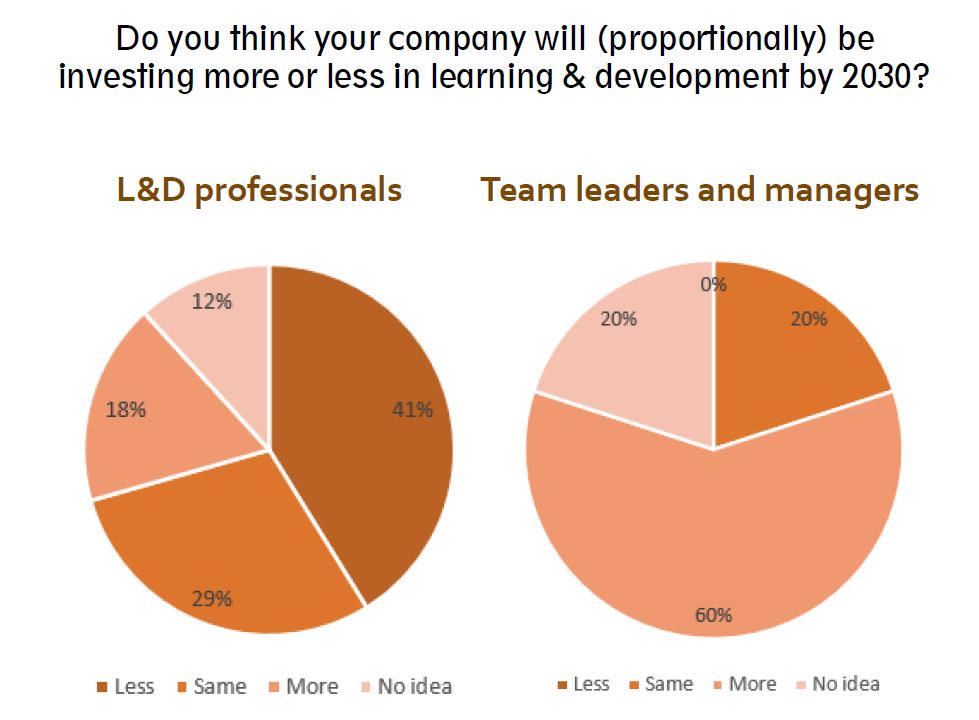
This finding deserves to be explored more. None of the line managers expected to see L&D investment shrink BUT 41% of L&D professionals did. Equally surprising was that 60% of line managers expected to see more money invested in L&D … compared to just 18% of L&D professionals.


Thoughts are divided on the need to develop English language skills in staff

Both L&D managers and line managers are split down the middle on whether companies will need to be investing in Business English training. Our first assumption was that this was connected to the type of industry, the country or even the company size, but we could not find a pattern with the sample size (of 43 L&D professionals and 51 team leaders, managers and senior
managers).


“We will less likely hire staff who don’t have necessary language skills, and if we do we will be looking for a service to bring them up to speed fast so they can perform on the job”. D.F. (Technical Manager)


“I hear a lot from our HR that our new hires can work in English. I don’t think this is accurate. Some of them have spent a year in a foreign country, and many of them have good English listening
skills. But many of them aren’t so called advanced. They don’t have the communication skills we need and the emails they are writing just aren’t professional enough!” C.G. (Senior Manager)


Download the full version

If you are interested to read more about training in 2030, you can download the full version of the survey here.

Business email today takes up a lot of employee time – up 2.6 hours a day according to McKinsey. We are also opening more email than ever before on mobile devices, and out of hours. Therefore, it has become even more important that email messages are clear, precise and understandable.

We recently worked with a global team responsible for managing training inside their organisation. The team were facing challenges in dealing with high amounts of queries about information they had already sent via email. They wanted to know how they could communicate the same information to a wide range of readers in order to reduce follow up emails. We decided to help them explore different communication styles and how to adapt their email communications to them. In this post you will learn what the different styles are, why this matters, and get some tips and strategies for adapting your written communication.

What are the different communication styles?

Did you ever notice that some people are more direct or indirect in how they communicate? This often comes from cultural differences. Two researchers, Edward Hall and Erin Meyer, have categorised these differences as high-context/indirect and low-context/direct. As you read the information below, try to think of colleagues you know who tend to communicate in these different ways.

High-Context/Indirect Low-Context/Direct
Expect to interpret a message

Indirect, nuanced

Higher on background details

Use coded language

Prefer oral communications

State the context before the main point

‘Read between the lines’

Don’t expect the reader to interpret

Direct, to the point. precise

Lower on background details

Less able to read between the lines

Prefer written communications

Get to the main point quickly

‘Say what you mean, mean what you say’

Why does this matter?

Look at this phrase, taken from the final line of a real email.

“Therefore, my role in this is questionable.”

What does the writer mean exactly? Is she saying she doesn’t have a role? Is she saying she doesn’t know what her role is? Is she asking the reader to clarify what her role is? In fact, we don’t know the precise meaning because this is a relatively high-context/indirect message. In fact, this kind of coded language can present problems for all types of readers. Low-context/direct readers will be uncertain what the precise meaning is and how to respond. High-context/indirect readers will read a meaning from the phrase, but it could be the wrong one if they do not share the same assumptions/context as the writer.

As we described at the beginning of this post, the high volume of email communication today means that email needs to be clear, precise and understandable at the first reading. Otherwise we will increase the size of our inboxes with clarifications of old messages.

Understanding these different communication styles can really help to cut down on follow up emails by designing your emails for the type of communicators you are writing to. In the next section you will read tips and strategies for how to adjust to the two communication styles we described above.

How you can adapt your emails to the different styles

Here you will find some practical advise for how to adapt your emails to the different styles. These tips will be especially useful if you are working with people who have a different style to you.

How to work with High-Context/Indirect communicators How to work with Low-Context/Direct communicators
Don’t take words at face value

Ask ‘what do they want to say?’

Ask checking questions to make

sure you understand

Expect questions/clarifications

Find ways to communicate

orally where you can

Keep it short and unambiguous

Don’t search for hidden meanings

Avoid coded language

Don’t take blunt answers

personally

Make sure you include the ‘why’

in communications

Is one style better than the other?

We all have preferences for one style or the other and that’s what makes us who we are. What we are really saying is that a ‘one style fits all’ approach to emailing doesn’t necessarily work. A smarter approach to getting your emails read and cutting down on clarifications is to adapt your style to your reader.

To conclude

The global team we worked with on this topic found it eye-opening to explore their own styles and their assumptions about how to write a good email. They are now experimenting with adapting their styles, with some good results. Of course, this is a work in progress!

For more information

More tips and advice for writing effective emails in these posts:

In this post, we’ll explore each element of the CIA Model—Control, Influence, and Accept—and show how leaders can use it to respond more effectively to challenges, support their teams, and maximise their personal impact.

  • Reading time
  • 5 Minutes
  • Target audience
  • For leaders, managers, and professionals who want to strengthen their ability to navigate uncertainty, influence outcomes, and respond effectively to challenging situations.

One of the challenges of leadership is knowing where to focus your attention and energy. Whether you’re leading organisational change, navigating a difficult conversation, or responding to unexpected challenges, your effectiveness depends on recognising what you can control, where you can influence outcomes, and what you simply need to accept.

A framework that we use in our leadership and communication training is the CIA Model,from The Critically Reflective Practitioner. The model provides a practical way to cut through uncertainty and focus effort where it can have the greatest impact. By helping leaders separate what they can control, what they can influence, and what they need to accept, it enables more effective decision-making, resilience, and purposeful action.

CIA Model

Control InfluenceAccept
identify which elements of the situation you can directly controlidentify the elements that you can’t control, but that you can perhaps influenceidentify the things that you can neither control or influence, and learn to live with them

New Call-to-action

Control

When we deliver training on leadership, change management and influencing skills, we often begin with a simple exercise: asking participants to list the things they can directly control in a challenging situation. The first lists are usually quite short. But as the discussion develops, people begin to realise they have far more control than they first thought.

The first lesson of the CIA Model is that we usually have more control than we think—we just need to know where to look. By focusing our energy on the things we can control, we put ourselves in the best position to influence the things we can’t.

Some of the things that are within our control include:

  • our attitude and mindset
  • how we respond
  • the effort we put in
  • the decisions we make
  • how we communicate with others
  • our knowledge and skills
  • our preparation
  • behaviours and habits

You may notice that our emotions don’t appear on this list. That’s because we can’t always control what we feel in the moment. Emotions are a natural response to our experiences. What we can control is how we respond to those emotions—the choices we make, the words we use, and the actions we take.


“Make the best use of what is in your power, and take the rest as it happens.”

Epictetus


Influence

Once we’ve identified what we can and can’t control, the next step is to consider where we can have influence. This is often where leadership has its greatest impact. While we can’t control every decision, every person or every outcome, we can shape what happens through our actions, relationships and communication.
For example, a leader may not be able to control a change initiative decided by senior leadership, but they can influence how their team understands the change, how concerns are discussed, and how effectively people adapt.

Rather than becoming frustrated by circumstances beyond our control, we identify the areas where we can make a difference through influencing. Influence comes in many forms: building trust, asking thoughtful questions, communicating clearly, sharing expertise, setting a positive example and developing strong relationships. These behaviours don’t guarantee the outcome we want, but they significantly increase the likelihood of achieving it.

Accept

The final part of the CIA Model is often the most challenging: accepting the things we can neither control nor influence. Acceptance isn’t about giving up or lowering our expectations. A cceptance does not mean agreeing with everything that happens or becoming passive. It means acknowledging reality so that we can make better choices about what to do next, rather than wasting energy wishing it were different.
Every leader will encounter setbacks, unexpected change, difficult people and decisions they disagree with. While these situations may be frustrating, dwelling on them rarely improves the outcome. Instead, acceptance allows us to conserve our energy and redirect it towards the things we can control and the people we can influence.

Conclusion

The CIA Model is ultimately about directing our energy wisely. We cannot control every challenge we face, but we can choose where we focus our attention, how we respond, and where we seek to make an impact. For leaders, this shift in perspective can make the difference between feeling overwhelmed by circumstances and responding with clarity, confidence and purpose.

For more information

For more tips and advice on influencing and dealing with change, see these posts:

In Part 1 of this post we shared what trainers can do when dealing with difficult participants, to prevent the training running off track. Even if you take all these steps you may still find that you have some personalities in the training room who are capable of derailing the training for everyone else. In this post you will read some tips and advice for dealing with the most common ‘difficult’ behaviours. In my training career I’ve met all these types (fortunately not all in the same room!) and I’ve observed that they are often unaware of the impact of their behaviour and do not have bad intentions. Nevertheless, it’s useful to have a set of strategies to manage them in order to minimise their impact on the rest of the group.

eBook: The definitive checklist for qualifying training providers

The Talker

There are a few variations of this first type. It could be someone who always has an answer and an opinion to share. Or the participant who talks at length and wanders off the subject. In either case, if you don’t deal with this there is a risk that the talker will dominate the session. In my experience other participants will just let this happen (they expect you to deal with it) and start to withdraw and lose interest. Here are some tips for managing ‘the talker’:

  • Use summarising as a strategy to interrupt, e.g. ‘Thanks, this sounds like an interesting point, so can I just summarise what you’re saying so we are all clear?”
  • Avoid open questions to the group; nominate people by name to answer questions or share thoughts and experiences
  • Break eye contact and turn your body slightly away to signal to the participant that it’s time to stop talking now
  • Give this person a role which encourages him or her to listen, e.g. taking notes on a flipchart of the main points in a discussion

The Quiet One

This could be someone who is innately shy or perhaps uncomfortable in a group setting. In my experience they often have something very relevant and interesting to say when they do eventually contribute, so you need to have a few strategies to make that happen. Here are some of the things I do:

  • Be gentle and encouraging, being aware that you are putting them on the spot, e.g. “I know you have some great experience in this area, we would really like to hear what you think.”
  • Make sure that language is not a barrier and moderate it if it is; all my training is in English with multi-national groups and I always find there is at least one participant who does not have equal ability in English to the others
  • Dividing the class into small groups really helps any quiet participants to come out of their shells and contribute something
  • Use the break time to take the participant to one side and have a private chat to find out why they have joined the training and if there are any specific reasons that you can address to help them participate more

The Challenger

This type wants to disagree or argue with everything you say. It may seem like she or he has something they need to prove to the group and maybe you. While we definitely want participants to critically argue and debate, we want them to do it in a constructive way. If you don’t manage the challenger early on you may find yourself becoming drawn into arguments that take you off what you want to focus on. Here are some tips to manage this type:

  • Acknowledge the participant’s right to have a point of view and remind them of why they are here, e.g. “I don’t need you to agree with everything I say. My intent is to share certain models and theories with you all and ask you to decide how they could be useful in your jobs”.
  • Throw the argument to the group by asking what others think; often a bit of peer pressure will calm the challenger down
  • Ask questions to encourage the challenger to self-reflect on what they are saying, e.g. “That’s an interesting perspective, tell me more” or “Can you tell me why you think that?”
  • As with ‘the talker’, give this participant roles which will encourage them to listen to others, e.g. note-taker, observer, summariser.

The Know-It-All

Similar to ‘the challenger’, this type claims to know much more than you do about the topic and gives the impression that he or she should be leading the training! Their constant attention seeking can take up time and energy. Some tips I have used to manage this type:

  • You can flatter their ego to an extent but be careful not to give them the floor for too long; once they have it you will find it difficult to take it back off them
  • Ask them to tell the group what they know about a topic and then follow up with some probing questions to reveal what they don’t know; this takes a bit of thought but if you can do it well you can succeed in humbling their ego a little
  • Get them to ‘teach’ the others in the group and encourage the group to ask difficult questions, which could show up gaps in their knowledge
  • Take them aside and directly ask why they are here; as with ‘the quiet one’ you may discover information that can help you manage them

The Clown

This type loves to tell jokes, make light of serious issues and distract other participants. ‘Clowns’ usually have some insecurity which they want to mask, but remember your job is not to psycho-analyse participants; it’s to get them working together productively. While this type can supply some needed humour and lighten the atmosphere at useful times, you need to contain their behaviour in order to maintain the focus of your training session. Here are some tips for doing this:

  • Use your body language and eye contact to signal to this person that enough is enough
  • You can also leverage the energy this person supplies at good moments, e.g. to energise people after a hard task or returning from a break
  • As with some of the other types, take them aside for a private chat just to check that they are taking things seriously deep down
  • Get them involved in roles that keep them busy and focused and away from disruptive behaviour

The Complainer

This type seems to have a negative opinion about everyone and everything. You will hear frequent comments like “I can’t do that” or “Person X should be here not me”. The problem with constant negativity is that it can be contagious and quickly spread to the whole group, eventually undermining any productive work. Here are my tips to deal with negative types:

  • Counter negative statements by focusing on reasons behind them and options, e.g. “Tell me why you think it can’t be done” or “So if this won’t work, what else could we try?”
  • You can be a little bit playful and make light of the negativity, which could lift the atmosphere, e.g. “Now I’m sure Participant X will have something to say about this!”
  • Take the person aside for a private chat; sometimes participants don’t realise they are being so negative and raising their awareness of this could help put a stop to it
  • Get group agreement on a limit to the number of negative phrases allowed in the training room and an appropriate punishment for infringement (e.g. the infringer buys cake for everyone at the break!)

The Sceptic

“This is fine in theory, but it will never work here”. As with ‘the challenger’ we want participants to use critical thinking in training, after all the whole point is that they use the training to make changes at work. However, like ‘the complainer’ some participants are overly negative and sceptical and this can impact the rest of the group. Try these tips to manage this type:

  • Acknowledge that scepticism in a necessary thing but only if it leads to new ideas and ways of thinking (a similar tactic to deal with ‘the challenger’)
  • Counter scepticism with positive statements, e.g. “So, you don’t think this would work here. What can we think of that would work?”
  • Use case studies from your own experience to demonstrate how other teams and organisations overcame obstacles using some of the methods you are showing during the training

Sometimes a sceptical participant dismisses ideas on a surface level, so you can introduce some methods of inquiry which are designed to get deeper into complex problems, e.g. root cause analysis or the question funnel

Remember that everyone is someone’s ‘difficult person’ and ‘difficult’ behaviour is not a reason to discount someone. It’s part of our job as trainers to manage personalities and in some ways that’s what makes the job interesting. As I said in Part 1, in over 20 years of training I only remember a handful of these types, but I have learned a few tips and tricks to manage them! We hope you enjoyed reading this post. If you would like to know more about our experience of developing trainers, feel free to contact us.

Training you to succeed globally


This post provides a practial framework for understanding trust and explores the everyday behaviours that increase and weaken it. 

  • Reading time
  • 5 Minutes
  • Target audience
  • Leaders, managers, facilitators, and professionals who want to improve collaboration, strengthen relationships, and build trust within their teams.

Introduction

Trust is one of those things we know is important, but often struggle to define. We know when we don’t have it. A lack of trust is easy to define. Conversations feel guarded, commitments are questioned, and collaboration becomes harder. But when someone asks us “How exactly do you build trust?”, the answer is often surprisingly vague.

In this article, we’ll explore a practical way to understand trust in working relationships: the Trust Equation. Developed by David Maister, Charles Green and Robert Galford, this model breaks trust down into four elements that influence how trustworthy others perceive us to be: credibility, reliability, intimacy and self-orientation.

By understanding these elements, we can move beyond the idea that trust is simply something we “have” or “don’t have” and instead focus on the everyday behaviours that build stronger professional relationships.

Why use it?

For the teams we work with, being able to break down trust into specific and easy-to-understand elements is always a great first step to identifying how to demonstrate behaviours that can build more trust. In short: the Trust Equation helps teams move from “we need more trust” to understanding exactly what behaviours create it, because it:

  1. creates a shared language
  2. shows trust can be developed
  3. improves collaboration
  4. helps leaders understand their impact
  5. diagnoses relationship challenges
  6. supports modern, distributed teams

New Call-to-action

The Trust Equation: Four factors that influence trust 

The Trust Equation is useful in the workplace because it turns something that often feels vague and personal (“I trust this person”) into something we can understand, discuss and improve. Many organisations talk about the importance of trust, but people often mean different things by it. One person might think trust means competence. Another might think it means honesty. Someone else might define it as feeling safe enough to speak openly.

The Trust Equation (David Maister, Charles Green & Robert Galford, 2004, The Trusted Advisor) breaks down trust (T) into an equation of 4 elements:

  • C = Credibility – Do people believe I know what I’m talking about?
  • R = Reliability – Can people count on me?
  • I = Intimacy – Do people feel safe being open with me?
  • S = Self-Orientation – Do people believe I care about their needs, or mainly my own?


For trust to “work” in the workplace, it requires high scores in the first three elements (C, R, I) but a low score in the final one (S). In other words, the Trust Equation tells us that high self-orientation undermines the other elements that are essential for trust.


How to Build (or Lose) Trust in the Workplace

Credibility – “Do people believe I know what I’m talking about?”

Credibility is about the confidence others have in your knowledge, skills and judgement. You don’t need to have all the answers but that you are as competent and honest about your abilities.

You build credibility by:

  • demonstrating your expertise through your work
  • communicating clearly and confidently
  • backing up your opinions with evidence or experience
  • admitting when you don’t know something and finding the answer

You lose credibility by:

  • exaggerating your knowledge
  • making claims you can’t support
  • giving inconsistent information
  • pretending to know more than you do

Reliability – “Can people count on me?”

Reliability is about consistency. People trust colleagues who do what they say they will do. Reliability isn’t about doing everything perfectly or always being available. It’s about being dependable and communicating clearly.

You build reliability by:

  • meeting deadlines
  • following through on commitments
  • preparing for meetings
  • communicating early if plans need to change
  • doing the small things consistently well

You lose reliability by:

  • frequently missing deadlines
  • overpromising and underdelivering
  • forgetting commitments
  • failing to keep people informed

Intimacy – “Do people feel safe being open with me?”

Intimacy in the workplace means creating a sense of psychological safety where people feel comfortable being honest, asking questions or admitting mistakes. People trust those who make them feel respected rather than judged.

You build intimacy by:

  • listening without interrupting
  • showing empathy
  • respecting confidentiality
  • asking genuine questions
  • admitting your own mistakes
  • giving people your full attention

You weaken intimacy by:

  • dismissing concerns
  • interrupting frequently
  • gossiping
  • reacting defensively
  • criticising people rather than ideas

Self-orientation – “Whose interests come first?”

Self-orientation is about where people believe your attention is focused. When people believe you’re primarily interested in helping yourself, trust declines—even if you’re highly competent.

You reduce self-orientation by:

  • asking more questions than you answer
  • being curious about other people’s priorities
  • sharing credit
  • listening before offering solutions
  • making decisions that benefit the team, not just yourself

High self-orientation often looks like:

  • dominating conversations
  • constantly promoting your own ideas
  • taking credit for shared success
  • ignoring other people’s concerns
  • focusing on being right

Final thoughts

Trust is built through hundreds of small, everyday interactions. The Trust Equation reminds us that trust is less about intention and more about experience. People trust us when they see consistent competence, reliability, openness and genuine concern for their interests.

The good news is that every element of the equation can be strengthened through deliberate behaviour. Rather than asking, “How can I get people to trust me?”, a better question is, “Which part of the Trust Equation should I improve today?”

Trusted Advisor offers a free Trust Quotient Assessment which we highly recommend because the results include feedback on which elements are strengths and weaknesses for you.

Knowing that asking for help is probably a viable solution is not always reason enough to ask for help. Asking for help can save time and allow us to practice being courageous, foster social connections, and become healthier people. It also gives everyone involved the chance to boost their overall well-being. The fact of the matter is we are accompanied on our journey through life by an invaluable army of helpers – nurses and doctors, teachers and schoolmates, coaches and teammates, friends and family… not to mention colleagues, mentors and managers. In reality, nobody makes it on their own and nor should we expect to. Then, why is it so difficult sometimes to walk up to a colleague and say “I need your help with something”?

New Call-to-action

The pros and cons of self-reliance

As children, trial and error teaches us we need help, and sometimes we notice that the kids who do really well, are the ones openly asking for help. This is a lesson we sometimes ‘unlearn’ upon reaching adulthood. The quest to become fully-fledged, self-reliant individuals can mean going too far in the opposite direction. We live in an age where user-friendly, DIY solutions are designed to enable and promote our autonomy. And if you don’t know how to do something there are plenty of videos you can watch online without having to actually bother anybody IRL.

We often find that asking people for help is a bit embarrassing, and comes with feelings of vulnerability. Why not just bypass it completely and work things out for yourself? But what’s missing from this picture? In short, the voice of experience, and the immediate feedback you get from trying something out while your helper watches. The timely suggestions, advice on what to avoid and how, the tips and tweaks that save you precious time and effort. Someone maybe even showing you first-hand what you need to do to get the result you want.

Writing this, I’m thinking about the 10 minutes today my colleague spent helping me navigate a new process. It was nothing exciting, but her patient guidance gave me a sense of reassurance that is invaluable. And now I can do something with confidence, that before I was a little nervous about. But still I thought twice before I called her for assistance, worried she might not have time for me.

Research costs time – why not just ask?

The thing is, in the workplace, not asking for help costs time and money, and can hinder us all in learning and in taking action. Being able to move fast may mean the difference between winning or losing a contract. That speed also relates to communication. Second-guessing about getting help slows you down. Typically, as a manager when I frequently set tasks for members of my team. If they have a gap in their knowledge, I expect them to quickly learn what they need to, and get the job done. Why spend valuable time researching when they could just ask a colleague? Knowing all this, why are we collectively still hung up on asking for help?

Here are some theories that I came across while researching this post:

Theory 1: I’m a macho girl in a macho world?

Asking for help means there is a gap in one’s knowledge or competence, a weakness, a flaw, a need, a vulnerability. Feeling vulnerable (and admitting it) feels like a small bird flapping in my rib cage. Who seriously wants to engage with that sensation? If we dig into it though, research shows that not only is it untrue that asking for help makes you appear incompetent, but in some cases asking for help with a difficult task actually results in higher perceived competence. In other words, we are far less likely to be judged negatively for admitting our weaknesses than we think. I know many parents who continually reinforce this to their children, but as adults we perhaps fail to recognise its validity for ourselves. Because feeling vulnerable is difficult, and it’s connected to shame. Shame tells us we are not good enough, and that if others discover this we will simply never recover. Here’s the thing though – for us to connect with other people, we need to be seen (and accepted). And as humans we are hard-wired to connect to others, because on a fundamental level it gives meaning and purpose to our lives.

Brené Brown’s research into vulnerability turned her world upside-down, and in the process she identified a whole cohort of people whom she categorised as ‘wholehearted’. These are people who have a strong sense of love and belonging, and, crucially, who believe they are worthy of love and belonging. In other words, they feel a tremendous connection with others, and are rarely plagued by shame. Maybe you know someone like this, or maybe you are this person. When she delved into what these people all had in common, she discovered 4 attributes they displayed:

  1. Courage (to be imperfect)
  2. Compassion (to be kind to oneself, and thus to others)
  3. Connection (to let go of expectations about who they should be, and to just be who they are)
  4. Vulnerability (asking for help, initiating a relationship, putting yourself out there)

What she discovered is that to become one of these wholehearted people, we have to allow ourselves to be vulnerable at times. In order to reap the benefits that come with belonging and acceptance, we must make space for a little discomfort in our lives. Side note: current research also shows that the impacts of loneliness on one’s health can amount to the equivalent of smoking 15 cigarettes a day. Avoiding connecting with people is really not good for us! So while I might pride myself on being a tough, self-reliant cookie – maybe in truth it’s time to ask myself if I wouldn’t rather be a wholehearted girl, in a wholehearted world?

Theory 2: Rejection hurts – but just ask and you shall receive (in abundance)

The other day I fired off a request for a recommendation for my LinkedIn profile to a colleague I’ve known for about 10 years. As my finger hovered over the ‘send’ button various thoughts passed through my mind: he’s too busy, maybe he doesn’t feel like he knows me well enough, maybe he’ll say no. Guess what – today his recommendation came through. Not only did he have time, and know me well enough to write a few sentences, but what he wrote was amazing, thoughtful, and authentic. This is not the exception; rather this demonstrates the rule.

The fear of rejection is disproportionate to how often rejection actually occurs

Research shows that we regularly underestimate both how willing people are to help us, and how much effort they are prepared to spend. In various studies, participants misjudged both the number of people who would commit to help with a task, and how much help and effort each person would contribute. What this means is that we might not expect it, but people say ‘yes’ far more often than we think. And when they say yes, they really throw themselves into it. Why? There’s a growing amount of science on altruistic benefits, but the long and the short of it seems to show that humans really get a kick out of helping a specific person or people (rather than a general cause), especially when they have a chance to see how their help makes a positive impact. Studies at Harvard found that the emotional benefits of helping are multiplied when they ‘foster social connection’. Universally, doing favours for others boosts our well-being overall. So next time someone helps you out, tell them how it impacted on you and allow them to bask in the warm glow.

In short, asking for help allow us to practice being courageous, foster social connections, become better, healthier, more wholehearted people. It also gives helpers the chance to lift themselves out of a negative mood, boost their overall well-being and enjoy the emotional benefits that come with giving.

Theory 3: You have to say the words. But when you do, be specific, unapologetic, personal, and then share your results

Ever held a crying baby in your arms, overwhelmed by frustration because you can’t figure out what it needs? Of course, the baby can’t articulate the help it needs, but we can… and should. We are often misled by “the illusion of transparency” that others can see right through us, and will know exactly what we need without us having to actually say it. Make it easy for your helper – just tell them. The likelihood is that it’s not immediately obvious to them, and they don’t know what you are thinking and feeling. Research shows that 90 percent of the support that colleagues provide at work is in direct response to specific appeals for help. So get ready to say it out loud: “‘I need your help.”

Tips on asking for help and getting the help you need

  1. Be as clear as possible about the help you need. Half-baked, vague entreaties aren’t very useful. If we don’t really understand what it is that you need, then how can we be sure if we can adequately provide it? Giving useless help is a waste of everybody’s time.
  2. Phrase your request for help in a way that focuses on outcomes, rather than on you or your perceived shortcomings. In business, results really are what count and it’s far easier to provide help towards achieving a concrete goal than to try to support someone who feels crippled by insecurity. It may sound obvious but do share the bigger picture and explain what target this person’s help will support you in reaching.
  3. Don’t apologise or preface your request with a disclaimer about how awkward you feel having to ask for help. The subtext here is ‘I hate asking you for help’ and revealing this makes the whole experience a lot more joyless for everyone than it should be. Helping one another is an inherent part of human relationships, it is the acknowledged currency of caring, and getting hung up about this really doesn’t help!
  4. Having said that, asking for help is more than a transaction. Asking for help via email or text is impersonal and distancing, which, unsurprisingly, means people are less likely to help you than if you ask in person. And though asking by email may feel less uncomfortable, so does saying no! If you really want a yes, ask in person and your request is 30 times more likely to get a positive response.

Finally, and this is the one that came as the biggest revelation to me while researching this: every time you benefit from someone’s support, give them something back by following up with them afterwards. The idea that the act of helping is a reward in itself, is not entirely true. The real reward comes with knowing that your help made a positive difference on a human level. If I have no idea what impact my help had on you, how can I possibly feel good about it?

And on that note, can I ask for a favour? If anything in this article has made an impact on you, let me know in the comments section.


For more information

Here are some of our services that might be of interest to you.

Team challenge 1: There is a new manager in a team who believes that everyone in the team is clear what the other team members’ responsibilities are and yet they aren’t. What should the team do? Team challenge 2: An email/request comes to a shared mailbox or distribution list, and there is confusion in the team who is responsible/who responds? What should be the best practice if there is no clear process in place for this? Team challenge 3: A multi-cultural team may have people who have low or high context preferences.  It can lead to miscommunication at times. How can we be sure responsibilities are clear to everyone?

These are some of the challenges that training groups have shared with us. Aligning people and tasks becomes even more of a challenge if we add in virtual working, cross functional teams and the increasing pressure to be more agile and handle more diverse projects at the same time. In this post we will share a useful tool that can really help address these challenges.

Go to the eBook

The RACI matrix

We have used a tool with teams that helps cut through the complications of these challenges and bring more clarity to complex team setups. The RACI matrix is a simple and frequently used responsibility charting tool to clarify relationships for:

  • Communication or actions required to deliver an acceptable product or service
  • Functional roles or departmental positions (no specific individual staff members’ names)
  • Participation expectations assigned to roles by decisions or actions

The tool assigns roles into 4 categories:

  • Responsible – Those who do the work to achieve the task.
  • Accountable – The one ultimately answerable for the correct completion of the deliverable or task, and the one who delegates the work to those responsible.
  • Consulted – Those whose opinions are sought, typically subject matter experts; and with whom there is two-way communication.
  • Informed – Those who are updated on progress, often only on completion of the task or deliverable; and with whom there is just one-way communication.

A practical example

Let’s look at a simple example to show how RACI works in practice. Imagine a (rather stereotypical) family. The task is to prepare and serve dinner. How does each family member take part in this task? Let’s say mum is responsible (R) and accountable (A) for the meal (A and R is often the same role). Mum can also delegate some of the responsibility, for example asking dad to prepare one element of the meal or the children to lay the table. There can only be one A, but there can be more than one R. Next, the family members need to be informed (I) when the meal will be ready and probably consulted (C) about the ingredients to check they will be able to eat it!

This simple non-business example makes it easy to see how RACI works and can also illustrate how things can go wrong when some of the roles are not defined or followed. For example:

  • Mum and dad share responsibility for preparing the meal but they fail to coordinate when the different elements should be ready.
  • Mum fails to consult the kids on the menu; when she serves the meal she remembers that her son is allergic to one of the ingredients.
  • No one is responsible for laying the table and mum gets angry and stressed that she has to do it in addition to the cooking.
  • The family is not informed when dinner will be ready and is out playing in the park when the meal is served.

How does RACI help us be more agile?

These kinds of misalignments and their results also happen in a business context. Let’s look at some common scenarios which teams often report to us during training, and how to address them using the RACI matrix:

Scenario: Use RACI to:


Work is not getting done because people are not clear about individual responsibilities; some tasks have multiple people working on them, other tasks don’t get touched at all. Decide who is responsible and accountable for different tasks. Breaking up big tasks and delegating responsibilities for them can help. If you are facing this scenario in your team it usually means there are either too many, or not enough ‘R’ roles.
Tasks and projects take a long time to complete because lots of different people give their input and there is a conflict between different views/approaches. Decide who really needs to be consulted in order for the task to be completed. Too many ‘C’ roles can lead to ‘paralysis by analysis’, slowing things down. This often happens in communications, for example when too many people are invited to meetings or copied into emails.
We don’t have visibility on who is doing what and the status of tasks and when they are completed. Sometimes this leads us to duplicate tasks or miss important details. Decide who needs to be informed and consulted for each task. Not enough ‘C’ or ‘I’ roles can lead to poor communication and lack of visibility. If you ask a question and get the answer, “I don’t know, you could try person X” it could be a sign that these roles have not been assigned.

Tips for using the RACI matrix

By now you can probably see how implementing RACI properly can help prevent these problems and address the challenges we described at the start. Remember that RACI defines roles not people; in other words, people can have different roles in different tasks regardless of their job titles. Completing the matrix can also give you a quick overview to check that all roles have been assigned; to the correct people, and that there are not too many/too few roles.

Finally, RACI is flexible and can be easily customised by adding new role types that suit your organisation or projects. Click here [https://en.wikipedia.org/wiki/Responsibility_assignment_matrix] and scroll down for a pretty comprehensive list of how to adapt RACI.

More advice and tips on aligning and communicating in teams

Our Services

Saying yes to a customer request often results in an instant meeting of their expectations. “Yes, I’d be happy to do that for you”, is one of the more powerful statements that conveys that your customer has come to the right place. Hearing yes makes them feel how they want to feel, it will make their life easier, it will give them what they want. Naturally, yes is what we want to say when our customers approach us. Customer satisfaction is almost guaranteed after a yes, hopefully without much additional effort. Saying no to a customer is much more difficult, especially when your no was not what they were expecting to hear. No means “a possible problem”, to them at least. Everybody knows that saying no sometimes makes complete sense, it has to be done. “No, we wouldn’t recommend that”, is also a very powerful statement that conveys that your customer has come to the right place, though in this case, they might not appreciate your (expert) service as much.

There’s a lot to be said about saying no to customers. In this post, we’ll explore how you can turn saying no into a win-win situation with your customer.
DOWNLOAD THE CAN-DO TOOLBOX

Why do you need to say no?

Most customers select a service provider based on knowledge and expertise. Money plays a role, but most customers really do care about working with a service provider who has knowledge and expertise. It’s the balance of this perceived expertise in combination with your fees that led them to choose you. This means it’s important to say no to customers when you think that:

  • the request is based on their lack of understanding or knowledge
  • they are asking you to do something which would not be beneficial to them
  • they are asking you to do something that would not be worth the associated costs to the customer
  • you have a better solution to the challenge they are facing

Be prepared for what comes after the no

As a rule of thumb in customer service, not meeting someone’s expectation requires an explanation and the setting of a new expectation. There’s never a need to say “yes, I can do that because it’s a completely normal request within the limits of our contract”, a simple “yes, sure” is enough. When it’s a no, you’ll need to add the why – in a way that your customer can understand it. Spell it out (nicely): The answer is no because of… Depending on your customer, an explanation is much more than a sentence, it can take two or three conversations for someone to understand why no means no.

The last impression that you DON’T want to leave the customer with is ‘they said no because of a bunch of reasons that I don’t understand’, because accumulated impressions of doubt can damage the long-term relationship quite easily. The last impression that you DO want the customer to have is something along the lines of ‘they said no, but I trust them’. To achieve that, you have to adapt every “no” conversation to their level of knowledge, their expectations, their situation, etc.

“It might be uncomfortable for your customer to hear it, but as soon as they get over the initial shock of the no, most customers will appreciate the fact that you’re applying your experience and judgment.”

What happens when people hear no?

Think about how you have reacted when you heard no instead of yes. Depending on the impact, as the recipient of no, we might question the other party’s ability to understand the request (rejection), or verbally express our unhappiness in no uncertain terms (frustration), before we can accept that no means no.

The SARAH model outlines our typical response to bad news in a linear fashion. For example: after expressing shock at hearing no, somebody will experience anger and/or anxiety which can then become resentment and/or rejection. With your support they will then accept the situation and begin to look for solutions which they hope will mitigate the bad news. The SARAH model is more relevant to most business scenarios and provides a simple, linear framework.

S – shock, surprise
  • “I thought this was covered by the contract”
  • “I just don’t understand – this was obviously important to us”
A – anger, anxiety
  • “I’m not happy”
  • “I’m really frustrated”
  • “This isn’t what I would expect from a business partner”
  • “I’m really worried this is going to set us back at least 2 weeks”
R – resentment, rejection
  • “I don’t think you understand the impact this will have on us”
  • “This might not be a big thing for you, but it is for us”
A – acceptance
  • “I suppose we just need to …”
  • “Well if that’s the way it is, that’s the way it is. I guess we need to …”
H – hope
  • “So what can we do then?”
  • “What kinds of workarounds have other customers used?”

You can use this model to help the customer accept what is happening, by moving them forward during your conversation. Use SARAH to steer the conversation with your customer, now that you know how they typically react to hearing no.

What to do when you need to say no?

When you tell your customer what you think, you’re doing what you’re paid to do – sharing knowledge, expertise and experience. Your expert perspective gives you everything you need to give the customer what they need. The question they asked results from a direct need. Indirectly, your no should address this need. If you successfully uncover their need after your no, you are creating a possible future yes. It can be helpful to see saying no as not just one isolated word but as a six-step process. This process is further explained in our eBook…

1 Prepare them

Indicate you have difficult news. Don’t just drop it on them. “We need to talk about something you won’t want to hear.”

2 Say no

Use clear and straightforward language. Avoid over-softening, hiding. Be aware of cultural differences.

3 Explain why

Inform them why something has happened and, if you don’t understand the reason, be honest (and build credibility). Avoid making excuses.

4 Convey understanding and empathy for their situation

Show that you understand the impact on them (both the business dimension and the human dimension).

5 Explore possible futures

Explore possible impacts. Impacts you’d like to avoid, solutions, workarounds, measures etc.

6 Follow up

Make the effort to follow up with the customer both after you’ve said no and once the solutions or measures have been implemented.

How to say no

You don’t say no to a customer request every day, so make it count. Own your “no”…don’t be fluffy about it by saying things like “well, if it was up to me”, and don’t distance yourself with phrases like “I wish I could but a third party is being difficult”. The message of no has to be clear: “No. I’m very sorry, but that’s just not possible” is the strongest message you can give your customer in their time of need.

Express empathy, apologize if needed but don’t overdo it. If you continue making excuses and apologizing you run the risk of looking indecisive, being open to being convinced otherwise and not owning your no.

In his book “The Power of a Positive No”, William Ury introduced the world of customer service to the “positive no”. The process has 3 basics steps:

Express your yes

There’s a reason you’re saying no, and that’s because you’re actually saying yes to something else (your project plan, your experience, your customers budget limitations). Focus on expressing your commitment to your yes e.g. “We are committed to our system being reliable and secure”.

Add your no in the context of your yes

“We are committed to our system being reliable and secure. This is why we need to say no to the idea of integrating remote access via this 3rd party app. It will be costly, and our experience is that it will create problems neither of us can work with.”

Propose a yes

“We are committed to our system being reliable and secure. This is why we need to say no to the idea of integrating remote access via this 3rd party app. It will be costly, and our experience is that it will create problems neither of us can work with. We can evaluate remote access solutions which will give some of the functionality without the risks. Let’s talk more about what is important to you and how we can help you find the budget.”

Don’t focus on the no

I have done many training sessions on customer service and I never leave the room without saying “if there’s an emotion involved, address it” because it’s the easiest road to customer satisfaction. It’s also, in my experience, one of the most difficult things for people to focus on, when in the midst of a no conversation with a customer. Perhaps it’s comfortable to hide in the business dimension, behind “these are our processes and there’s nothing I can do at this point” and it will help the customer understand your no, sure. However, the impact is much greater if you address the situation in the human dimension with an empathic “You’re frustrated, I can tell”, and give the customer a moment to respond to that.

Our services


In Part 1 of this post we described the three key skills areas needed to develop internal trainers to train virtually. To support them further, we also developed a session planning template that ensured they planned these principles into their sessions. In this post, we’ll answer the question: What are the elements of planning an effective virtual training session? At the end you will be able to download the template for your own use.

New Call-to-action

Designing learning objectives

Just like the physical classroom, learning objectives should focus on the actual needs of the trainees and the outcome of the training, for example: By the end of this session, technicians will be able to communicate the 3 most important features of this new model washing machine to a customer

Unlike the physical classroom, you will have less time in a virtual session to meet this objective, and that includes setting aside time to measure it during the session itself. This means that you should limit yourself to only one or two objectives.

Thinking about your trainees

Thinking about what your trainees know already can save time in your session and help ensure what you plan meets their actual needs. For a virtual session it’s also useful to think about trainees’ previous experience of online learning and their comfort level with technology.

For example, repair technicians who have spend most of their time on the road visiting customers may need more time and practice with getting to grips with online training. You can allow for this with activities where they can have fun and play with the different tools to build their confidence.

Being prepared for problems

Due to technology, there can be more problems in a virtual classroom, and you need to have back-up plans and work-arounds for when people loose connection or can’t hear, etc. At the end of the day there is only so much you can actually do to assist people, but you can plan to address problems that might come up by explaining at the beginning what to do if connection is lost and who trainees should contact for assistance.

If trainees are new to virtual training they will need help and practice in using the tools and for this it is best to set aside time at the start of the session to let them play with the tools in a relaxed way before they use them for more serious activities.

Setting personal goals

Every virtual session is also an opportunity for the trainer to improve. Set yourself personal goals (e.g. speak slower, stick to timing, involve all participants) and then either ask someone to observe the session and give you feedback, or record the session and play it back to yourself.

Creating a detailed session plan

At least when you start virtual training, having a detailed session plan will help you stay on track. A lot is happening during a virtual session, so you don’t need the extra worry of trying to remember what comes next. Your plan will also show you that you are using a range of tools and mixing them up. Your plan will be more micro than normal as in a virtual training session it’s important to very activities in order to keep trainees’ attention; at least a new activity every 5 minutes. One tip we have seen for new trainers is to script what they want to say in the plan; this is a very good way to reduce talking time and be succinct.

You can download the Virtual Training Session Plan here


We hope you enjoyed reading this 2-part post about how to develop internal trainers. You can also find more tips and advice on virtual training in these blog posts:

Our Services

In 2020, many companies have needed to move their internal trainers from classroom to virtual training delivery. Outside of the circumstances and impact of the Covid-19 pandemic, the advantages of virtual training delivery are obvious. With virtual training, you reach more people, training can be deployed faster, more regular training events can be set up, and it costs less. We’ve been delivering virtual training solutions for more than ten years, and we know that the transfer to virtual training delivery can be smooth when the trainer understands the differences between classic face-to-face training and virtual delivery, and is able to adapt and develop him/herself. 

Go to the eBook

We were recently asked about this topic by an in-house training team for a global company who train the company’s technicians on customer service and product updates for their range of consumer household machines. They asked us:

  • What are the new skills that internal trainers need to master in order to train virtually?
  • How quickly can our existing trainers master these skills and how can we help them to do it?
  • How can we train trainers with no experience of virtual training to be confident with it?

Part 1 of this post is about the key facilitation skills for virtual training delivery, which we identified and worked on with our client’s new virtual trainers. In Part 2 you will learn how we designed a session planning template to support them. Part 2 includes a download of the template for your own use.


Essential facilitation skills for virtual training delivery

1. Using your voice effectively

Why this is important? –  You won’t be able to communicate using body language and eye contact in the virtual classroom. You (and your trainees) will rely entirely on your voice. The challenge with listening to someone’s voice is that it’s just more difficult to pay attention, due to lack of visual stimuli. This adaptation is a challenge for trainers new to the virtual training delivery environment because it takes a lot of practice and self-adjustment.

How to develop it – We worked with trainers on adapting 3 voice elements:

  • Clarity – pronounce words more carefully by stressing each syllable, avoid complicated terms, and repeat repeat repeat. After each segment, check in with trainees by asking, “Was that clear?”
  • Speed – you can reduce the strain on listeners by just slowing down. This takes a lot of conscious effort in practice; a technique we suggest is to imagine you are speaking 50% slower and you will probably speak 25% slower (which is an improvement!)
  • Pace – listening to a continuous stream of speech is a strain, so trainers need to practice pausing regularly. This gives listeners a chance to catch up and process what they heard. Try the 3 second rule – pause after each sentence and count to 3 in your head before continuing

2. Ensuring active participation

Why this is important – In a virtual classroom the trainer won’t have much idea who is paying attention, and trainees can easily become distracted by what’s going on around them and other things that pop up on their computer or phone. The only way to overcome this is to keep them engaged because  (unlike the physical classroom) they are not a captive audience.

How to develop it

  • Make sure everyone participates by calling on trainees by name to answer questions or share their thoughts; we recommend making a note each time someone contributes so that you can call on those who haven’t yet contributed. Of course, this is easier in smaller groups; beyond 20 trainees it becomes a challenge, but you can still use the technique.
  • Make the session active by giving participants something to do; this can be a task (e.g. discuss this problem together for 5 minutes and present your solution) or using the tools in your virtual classroom (polls, icons, annotation, etc.) to ensure active participation.
  • Ask questions regularly (as often as every 90 seconds works well) but avoid closed questions (e.g. yes/no questions) and avoid asking questions to the whole group as you will probably be met with silence; instead use the nomination technique described in the first point above.

3. Managing time and attention spans

Why this is important – Technically it is possible to run an entire day of virtual training but in practice this doesn’t work because it’s much more tiring and harder to keep trainee’s attention compared to the physical classroom. GoToWebinar researched the most popular length of sessions in thousands of training sessions and found it is 60 minutes. So, aim to break up longer training into shorter segments. Within sessions there are tips that trainers can follow to manage both time and attention spans, which you can read below.

How to develop it

  • Plan less than you would for a physical training session; we see that trainers who are new to virtual training find that the time just runs away, partly due to technical issues but also because the tips and techniques you have read about in this post just take more time.
  • Break up your session into shorter segments; if you have a longer training segment you can still break it up into chunks. This gives everyone a ‘cognitive’ break, which addresses the increased strain of concentrating in a virtual classroom.
  • Don’t plan anything for the first 10 minutes; allow this time for participants to log on, test their connection and greet each other. We also recommend wrapping up 15 minutes before the finish, to allow for extra time you might have lost during the session, and also take questions. This will all impact the amount of content you can plan for a virtual session, which is the first point you read above.

Part 1 conclusion

We found that identifying and working on these three key skills areas can help internal trainers make the jump to become virtual trainers. In part 2 of this post, you’ll learn more about the elements of planning an effective virtual training session. If you want to continue reading, here are a few recommended posts on the topic of virtual training delivery.

Our Services


Virtual teams have clear advantages, but they also come with a set of unique challenges; building trust and getting people to work together is just not the same in a virtual environment. If you are leading virtual teams you will already be aware of many of these challenges. If you are not, or if you are new to this, or if your teams are not telling you everything; this post is for you! In over ten years of working with virtual teams in global companies we have collected the challenges that they have shared with us. We can now share with you some of the most common challenges we hear time and again, and some suggestions for how to help with them. This post is even more relevant in our current situation, when teams are going virtual out of necessity rather than design. So, we hope that this post will be a valuable resource to you as you adapt to the new normal of virtual working!

New Call-to-action

Challenge 1: Connecting across different time zones

Knowing when to connect with someone halfway across the world is a key challenge that people share with us again and again. Technology allows us to send communications at any time of the day or night. But it does not tell us when we can expect a reply. Delays in response can lead to miscommunication and frustration; not something you want in any team.

How a team leader can help

It really helps to have a whole team discussion about the time zones people are working in. Don’t assume anything; we often find that some virtual teams are completely unaware what time it is for their counterparts! But don’t limit the discussion to just the time of day; in addition, bring in people’s preferred working patterns. We have found that these types of discussions can help people manage their own expectations and tailor their communications more effectively to their remote colleagues.

Challenge 2: Getting to know other team members as individuals

It is much simpler to know our colleagues’ working styles and flex to them in a co-located space because we can see how they work. In a virtual team these things are more hidden. Virtual teams who don’t know each other are more likely to fall into conflict and work to separate agendas.

How a team leader can help

The secret to building intimacy in virtual teams is to do more of it and be explicit about it. Explain why the team needs to make extra efforts to get to know each other and the benefits of doing it. Plan time at the start of meetings for personal check-ins, encourage people to reveal non-work related things about each other. Host a ‘virtual’ breakfast or coffee meeting for people to socialise. One team we worked with devised a set of 20 questions for new teams to break the ice; simple, non-threatening questions like ‘Do you prefer coffee or tea?’ can start things going and encourage people to open up. The time you create for personal bonding will pay rewards later. But the key is to realise it doesn’t happen naturally in virtual teams.

Challenge 3: Holding each other accountable and giving feedback

This is even more critical in a virtual team because we simply can’t see what other people are doing. Distance can too easily undermine the things we do more naturally in co-located teams such as giving feedback and holding each other accountable.

How a team leader can help

Ensure that the same processes and standards are applied for giving honest and timely feedback and holding each other accountable. DEEP and DESC are two approaches that work extremely well. In the office you may stipulate that feedback and performance conversations happen face to face. In a virtual team this means video calls; don’t let email take over just because it’s more convenient.

See the next challenge for a technique that can help drive team accountability.

Challenge 4: Keeping focused and engaged

Individuals will need to work more independently and with less supervision in a virtual environment but will also become more easily distracted and may lose focus due to competing work/life priorities.

How a team leader can help

Borrow a very effective technique from the iterative, agile approach; ‘Stand Up’ meetings are a short daily meeting to check-in and align with each other. In the meeting, team members are asked to share what they will be working on today and what obstacles they may face. For a team leader this provides valuable insights into problems that you will need to work on that day. For team members this is a routine event than can help them focus and energise.

Challenge 5: Making it more personal

Technology has introduced many more personal features today but teams that we work with still say that having a screen between them can make virtual teams feel impersonal.

How a team leader can help

Virtual hugs or pats on the back, telling jokes and playing games can all help to make things more personal. But the number one thing that creates the biggest impact is to turn on the webcam! As humans we connect to faces instantly and, according to the Mehrabian studies, our body language accounts for 55% of how we express emotion and attitude. It still surprises us how many virtual teams do not switch on their cameras. It’s a small step that makes a very big impact.

Challenge 6: Scheduling too many (and too long) meetings

Meetings can be draining in a physical environment. For virtual teams they can feel even longer due to the lack of physical interaction and interruption from technical problems. So, it’s important to manage meetings a bit differently in a virtual environment.

How a team leader can help

Acknowledge that virtual meetings are more of a strain and mitigate this by making them shorter and more frequent. Ensure that meetings are timetabled with people’s time zone and schedule considered; remember that these things are not as visible as they are in a co-located space. Use the tools you have in meeting software to involve everyone and keep people attentive and engaged; for example, hand raising, emoticons, breakout rooms. Check out the links below for specific posts on meetings.

Challenge 7: Knowing how much to communicate

When we are not working physically together it’s difficult to know what is too much, or too little communication. If we get it wrong we risk over-burdening our team mates, or feeling isolated.

How a team leader can help

Finding that ‘Goldilocks moment’ of just the right amount of communication means agreeing together when and what to communicate. It’s also worth thinking about which tools to use for which kinds of communication and the differences between synchronous (real time e.g. video calls) and asynchronous (delayed e.g. email). Successful virtual teams we have worked with use some simple techniques to manage their team communications, e.g. asking before interrupting, having agreed communications ‘black out’ times, and simply sharing their preferences.


More information on this topic

For more advice and tips on virtual teams, see these posts:

If you are interested in our training programmes on managing virtual teams, click on the links to learn more.


Virtual teams work across time, space, and organizational boundaries—and they are becoming increasingly common. As these virtual teams interact through technology and only occasionally meet face-to-face, it is important to rethink and sharpen the way we collaborate and communicate . In this short video Scott Levey, a director at Target Training outlines 3 simple steps you can follow to make sure your virtual team makes an impact.


Storytelling is a topic of great interest in the business communications world.  Conferences and speakers around the world are praising the power of storytelling and attracting audiences. Why? Humans have told stories since our earliest beginnings. We all tell stories. It was part of our survival and development. Stories are all around us, from campfires to multimillion dollar movies, so why do we have to make a case for it in a business environment? Why do people want training on something that comes naturally? In a business context, perhaps we don’t want reveal too much of ourselves, show too much emotion or not be taken seriously at work. Our storytelling seminar gives participants the skills and determination to tell more stories and better stories in the workplace. This post shares five lessons learned about storytelling in business.

Lesson 1 – What does your listener want?

What attracts audiences to the telling of a story? We identified three things:

  1. emotion

  2. energy

  3. authenticity

Children will demand expressions of the energy of the characters, the emotion of the plot and telling the story “like you mean it”. Telling bedtime stories to children is a practical example of the standards adults have for stories as well, though many may not say it. Adults need the same things to be engaged.

Lesson 2 –  What makes a good story good?

As Aristotle observed, a good story starts with a character in trouble. The character is one the audience can identify with–not too good to be in trouble and not too bad to deserve the trouble to come.  The story progresses with the development and deepening of the trouble to create a sense of fear in the audience so the resolution of the problems leaves the audience with a sense of relief.
Aristotle referred to the stages as pity, fear, and catharsis. Stories from Greek tragedy to Toy Story follow this model in one way or another.

In the workplace we can tell stories about problems, consequences and solutions to reflect Aristotle’s model.


“Storytelling comes naturally to humans, but since we live in an unnatural world, we sometimes need a little help doing what we’d naturally do.”

 Dan Harmon


Lesson 3 – Crafting stories that fit

The STAR Model is a basic and effective format for telling stories in a business environment. The model fits the needs of business audiences as it sets the scene, describes the action in it and talks about what happened to resolve the situation. This model is very effective in behavioral interviewing, answering questions about past performance and offering a status update.

  • Situation – clearly explain the facts and assumptions that make up the context of the action.
  • Task – detail the task to be completed or the goal to be reached.
  • Actions taken – describe all relevant actions taken to complete the task.
  • Results achieved – describe the immediate outputs and eventual outcomes of the actions taken.

Lesson 4 – Courage to connect

If work for you is simply an exchange of power, storytelling and other enhanced communication tools are not important.  Others will translate what you say into orders if you are in a power position just as you may interpret orders from your superiors. If you want your workplace to be a place where people build something together instead of following the orders of the few, storytelling is an active strategy to humanize the workplace for you and your co-workers. It provides opportunities for meaningful connections that inspire trust.

Lesson 5 – From stories to action

A good story can set the stage in a business environment and yet we often need to make the purpose clear once it is complete. We can achieve that Socratically through a debriefing method or by simply telling the listeners what we had in mind directly.

A clear explanation of the purpose of the story provides a natural, logical connection to the observation of what the teller and the listeners need to accomplish in a business environment. When listeners can connect the story to their current situation, they become involved in the process of identifying what to do and why it needs to be done—without having to be told.


Related training services

For more information about what we can do to help you succeed globally, here are some of our leadership solutions


I often find myself in the business section of the book store and I’m always struck by how cleverly these books position themselves. Titles like “How to Have A Good Day” or “The Art of Thinking Clearly” seem to speak directly to me and this is the reason I pick them up and sometimes even buy them. If you are involved in writing offers and proposals (RFQ’s, tender responses) you are looking to create a similar impact – you want the reader’s attention and interest from the moment they pick up the document. The secret to doing this, just as with business books, is to make them ‘reader-oriented’. Over the years we have worked with many companies that have great products and services but sometimes find it challenging to write commercial offers which appeal to readers. In this post we will explain exactly what ‘reader-oriented’ means and how to achieve it.

New Call-to-action

What do readers want to read about in an offer?

Think for a minute; if someone sends you a proposal for a product or service they want you to buy, what do you want to read in it?

Now read this quote: “Don’t come into my office and tell me about the perfect solution you have. Instead, tell me how you can solve my business problem and then I’m all ears!” Max Bittner, CEO Lazarda

Every proposal or offer exists to solve a problem, which your client is unable to solve on their own. So, as Max says, make sure your client’s problem or challenge is front and centre in your proposal. This means starting with a detailed and accurate description of the problem. You want your reader to think “This organisation understands my business and its challenges” because this will establish your credibility to solve their problem right from the start. It sounds obvious I know…and yet when running proposal writing workshops I am almost always asked “But where do I write about us and what we do? Normally we start with this!”

Key Learning Point 1

If you want to get your proposal read, start by talking about them not you.

What will they actively read?

Proposals have many different elements and different stakeholders will focus on different parts; legal will study your T&C, finance will look at your figures, procurement will study your value statement. But the three most important elements, and probably the ones that will be read by the decision maker, are:

1. The title

A good title can create a great first impression and get your proposal higher in the pile of many proposals. And the trick is to make the title speak to the reader. Compare these 2 different titles for the same proposal and ask yourself – which proposal would you read first?:

  • Proposal from Company X for Internet Connectivity Services.
  • Creating Opportunities for Company Y’s Customers by Connecting Remote Islands in the Western Pacific.

An effective title will contain 3 things; name the client, include a verb (to indicate what the proposal will do) and an outcome (which of course is focused on the client’s business).

2. Contents page

The contents page is there for a reason. At a quick glance, a reader can assess what’s in your proposal, whether it is worth reading, and where to start. Spending time on the contents page will also help you to:

  • Plan the proposal before you start writing it
  • Check that nothing is missing
  • Order the sections of your report so they are logical and connected
  • Craft headings for each section

Again, it’s all about the language. Compare “Context and Background” to “What Problem is Company Y Trying to Solve?”. The second heading is more specific and engaging, and it uses a question which is a good way of getting readers’ attention. You probably noticed that this post uses questions for each section.

3. Executive summary

The Executive Summary is critical – it may be the only part of the proposal read by a decision maker, before she or he passes it to specialist teams with their comments and recommendations. Think of the Summary as the text you read on the back of a book; it should tell you what’s in the book and encourage you to read it.

Executive Summaries should be short (I would recommend no more than 1 page) and written in clear and simple language; avoid technical or specialist language as your reader could be more of a generalist if they are a C-level decision maker. Giving it to someone else to read is a great way to get feedback and make improvements.

The next section in this post will give you ideas on how to craft the content of your Executive Summary. You can also find help and advice on writing in clear and simple English and editing your writing in these two posts:

Key Learning Point 2

Focus on the 3 elements of the proposal that will make the biggest impression. Craft them to grab your reader’s attention with how your product or service will benefit their business.

Is there a winning structure for offers?

Yes there is! There is a structure that we recommend and organisations we have worked with tell us it works. N.O.S.E. can be a powerful structure to engage and persuade your reader because it starts with answering the question “Why should I read this proposal?” just as Max Bittner explained in the quote your read earlier. In fact, it would be a great structure for your Executive Summary!

Here’s the structure, described from two perspectives; what you write about and what your client is looking for:

NEEDS

  • You: What problems/needs does the client have?
  • Client: I want to see that you understand my problem

OUTCOMES

  • You: If the problems/needs are addressed, what would be the positive result for the client’s business?
  • Client: I want to know how this will benefit my business

SOLUTIONS

  • You: What is the product/service will provide this outcome?
  • Client: I want to believe you can solve my problem

EVIDENCE

  • You: How will you deliver the solution on time, to budget and with quality?
  • Client: I want to trust that you can do what you say

Key Learning Point 3

Use a structure that persuades by starting with the client’s needs before you explain your solution.


More writing skills


This week’s Secret L&D manager is Hungarian and is a Learning & Development Specialist for a global chemical company. In this post, he talks about the journey and the challenges of building and encouraging a learning culture in a large organization.

Go to the eBook

You were the first L&D manager in the organization. What sort of training budget were you expecting to have to work with when you joined?

Before I came here, I was working in a huge worldwide corporation where learning and development had a lot of money working –  close to about €400,000 per year. Looking back, we were definitely spoiled, and I was expecting something similar when I came here. That was my expectation. When I arrived, I was given a  budget of €10,000 and most of this was already allocated to translation work!

I wanted to be able to build a learning culture (see this post for more information). One of the things I have been doing (and haven’t yet finished) is to build a large library of free learning. This does take time but there are a lot of free, good quality things on the internet. You just need to be able to invest the time to find and assess them. I used our skills and competency models as the basis to build this and then I just matched these skills and competencies with an index of releavnt e-learnings, learning nuggets, MOOCS, e-books and podcasts.

I have also created internal webinars. My first step was to establish subject matter expert groups within our company and then we started to create something like internal TED Talks. People could learn about and from the different groups and different fields within the company. For example we would have one subject expert talking about dealing with difficult customers. It was a 1 ½  hour session and it was advertised, and people could join via Zoom.

How did you raise awareness of these learning opportunities and events?

Here I used 2 types of advertising; one is definitely the usual and very boring e-mail communication. I’m not sure it was very helpful but people did join as a result of this kind of communication channel. The other was creating and printing leaflets and brochures and placing them around the corridors and also in the canteen. This was definitely more helpful and effective. I based them on a silly cartoon that was going around on Facebook a couple of years ago.

These initiatives have helped to prove the worth of learning. Now I’ve got the management to actually spend and dedicate a real budget for learning this year, although with the coronavirus crisis who knows what will happen? But I’m pretty sure that this time I will be able to spend more and I’ve very concrete ideas of what I want to do. So for example I want to still further develop these internal webinars and I also want to continue with e-learning creation and creating the content internally.

The other thing that I’ve been planning on doing for a long time is implementing virtual learning and actually this is also a very timely thing. As you know  I have been in talks with you regarding implementing this.  When you think of the flu symptoms and all the sickness that are going around the world right now I think one of the best tools, let’s call it a tool not a method, is to use e-learning and virtual learning. Virtual learning, and it is not to be confused with e-learning, is when you go for an interactive training session but you don’t have to go anywhere. You can do it from your home or you can do it from your office.  It fits our company and the situation.


More secret L&D Managers

Who is the secret L&D manager?

The “secret L&D manager” is actually a group of L&D managers. They are real people who would prefer not to mention their name or company – but do want to write anonymously so they can openly and directly share their ideas and experience with their peers.


Popular training topics

A Global Customer Services Director recently came to us with a challenge: We have customer service teams spread all over the world, helping our telecommunications customers with technical troubleshooting. Some of them are really excellent, experienced agents, others are relatively new and still learning the ropes. Some are good with the technical side, others better at working with people. The question is – how do we get them all working to the same standard?

We proposed the RATER model, a five-point framework which describes how customers evaluate the service they receive. We have found RATER is a tool which everyone can learn from and improve, whatever their level of experience. In a previous post we introduced the framework. In this post we will add some information and provide tips on how to put it into practice, based on real experience we’ve had working with clients like the one above.

DOWNLOAD THE CAN-DO TOOLBOX

Reliability

Is your organisation able to deliver services consistently, accurately and on time? Of course, sometimes things go wrong. If you work on a customer helpline, ‘reliability’ becomes the measure of how quickly and effectively you can put things right.

  • Manage customer expectations by explaining honestly what can and cannot be done. Being open and transparent is the foundation of reliability.
  • Never feel pressured to promise something you are not 100% sure you can deliver. Declining customer requests is not pleasant, but it will build trust in the long term because your customers will value your honesty.
  • Being pro-active by identifying and communicating problems before they happen is another great way to help your customers see you as reliable.

Assurance

How much do your customers trust you? If a customer is buying a service from you this is particularly important because the transaction is built on the customer’s future expectation that you will deliver what you say you will.

  • Find out what your customers’ real needs are and show that you are focused on the benefits and outcomes for them.
  • Build your credibility by demonstrating your specific skills and expertise; customers expect you to be an expert in the product or service your organisation offers.
  • Ensure that you are giving consistent information to all customers. If customers hear different things from different people in your organisation, they will not be assured that they can trust your answer.

Tangibles

Tangibles are the way the customer interacts with your organisation; through physical spaces as well as your web site, apps, phone lines and email. If you are a customer service agent, some of these things will be beyond your control but there is still a lot you can do to make the customer journey a good experience.

  • Consider the steps the customer went through to get in touch with you and how that can impact their mood and expectations. For example, apologising for waiting time is a respectful thing to do.
  • Smile, be friendly and interested, show respect. These are all tangible elements that contribute to a customer’s impression of your service.
  • If you have different customer communication channels, find out which ones different customers prefer and use them to personalise your communication approach.

Empathy

Do you customers feel that you care about them as individuals? And importantly, how do you show them that you care?

  • Empathy means putting the customer at the centre of communication; you will achieve this by talking less, listening more, and asking effective questions to ensure you understand.
  • Avoid phrases like “I understand how you feel” and “I apologise for the inconvenience” which are over-used and sound scripted and unnatural.
  • Listen to the customer’s emotions and acknowledge them; a phrase like “I can hear that you are feeling upset” shows the customer you are paying attention to their feelings and they have a right to feel that way.

Responsiveness

The whole reason for having customer service is to respond to customer questions and problems. So, customers will judge you on how quickly and effectively you do this.

  • Don’t wait until you have the full solution before re-contacting a customer; giving updates on progress and steps you have taken will assure customers they have not been forgotten and are still a priority.
  • Provide customers with specific deadlines and timelines but always make sure these are realistic and do-able, otherwise you will undermine their trust in you.
  • Manage communications across multiple channels (if your organisation has them) to make sure you pick up and deal with customer communications quickly.

The RATER model in action

When we used the RATER framework with this team, participants reported that they found it extremely useful to have a model to draw on – not just for planning customer interactions but also to reflect on which of the RATER dimensions was important for a specific customer and how the agent addressed this during the interaction. RATER became a common language which this team could use to support and debrief each other.

If you would like to know more about our experience of working with global companies on developing their customer service communication, or the RATER model, feel free to contact us.


Customer service training solutions

Click on the links below for more details.