Hybrid blog articles

Originally published on 08.07.2013

A common problem

We often hear how writing emails in English can cost just too much time. One solution that works for many people is to begin building a “toolbox” of useful phrases.  A toolbox is a simple idea – you just start keeping a list of common and useful expressions – perhaps on your desktop or in a notebook next to your keyboard? There’s nothing wrong with reusing some standard phrases if it helps save you time and communicate clearly. You probably already have 2 or 3 sentences you reuse again and again. But sometimes the tone just isn’t right, is it?  To help you find the right words when you need them here are 20 great expressions for closing an email.  As you read through them ask yourself two simple questions:

1. When would I use this?

2. When will I use this?

Expressions for thanking                                                                                                     

  1. Thank you for your help. / time / assistance / support
  2. I really appreciate the help. / time / assistance / support you’ve given me.
  3. Thank you once more for your help in this matter.


Writing emails that people read: Free eBook download
Expressions with a future focus

  1. I look forward to hearing from you soon / meeting you next Tuesday.
  2. I look forward to seeing you soon.
  3. I’m looking forward to your reply.
  4. We hope that we may continue to rely on your valued custom.
  5. We look forward to a successful working relationship in the future.
  6. Please advise as necessary.
  7. I would appreciate your immediate attention to this matter.

Expressions for showing them you want to help

  1. If I can be of assistance, please do not hesitate to contact me.
  2. If you require any further information, feel free to contact me.
  3. If you require any further information, let me know.
  4. Please feel free to contact me if you need any further information.
  5. Please let me know if you have any questions.
  6. I hope the above is useful to you.
  7. Should you need any further information, please do not hesitate to contact me.
  8. Please contact me if there are any problems.
  9. Let me know if you need anything else
  10. Drop me a line if I can do anything else for you.

You can check out more ways to improve your writing at work here.  Don’t hesitate to comment below if you have any questions or additional phrases you’ve used that work.

FOR MORE INFORMATION

If you’re looking for phrases, tips and tricks and useful downloads related to this topic, start here. In a range of topics, here are some more links for you:

Do you ever feel your meetings have gone off track?

You’re in a meeting to talk about one thing, but someone is talking about something completely different, someone else is discussing an unimportant point, and others are debating something completely irrelevant – the whole meeting has gone off track! When this happens, it’s hard to get back on track and return to your meeting agenda. In international meetings with foreign colleagues, this can be much harder as you don’t want to seem rude or too forceful about sticking to the schedule.  You could watch the clock and give warnings when people are talking too much or are going over their allotted time, but again this could be misinterpreted as impolite and bad-mannered.

To avoid damaging delicate business relationships, here are some common ways and phrases for getting the meeting back on track in a professional an polite manner.

Be the moderator

  • Sorry, but we’re getting off topic and need to move back to …
  • Let’s return to the main point of today’s meeting.
  • We seem to be talking outside of the scope of the meeting.

Consider the value of the current discussion

  • Do we need to add this topic to the agenda?
  • Maybe we can get back on topic and postpone this to later?
  • Is everyone happy if we discuss this later?

Focus on the schedule / time

  • We’re running short on time, so can we move back to…
  • I’m afraid we’re running out of time.
  • I’m afraid I can only give you another minute.

Talk about briefness

  • Please keep to the point everyone.
  • Please make your comments brief.
  • Please keep your remarks short.

More on meetings?

Our blog authors have plenty to share!

We also have a number of seminars that might be of interest to you.
Originally published on 25.03.2013

I know enough people at my company.  I have enough friends.  I’m not comfortable speaking and reaching out to people I don’t know.  I’m not a salesperson. 

The list of excuses on why not to engage in professional networking can go on and on.  As undesirable as it can seem, networking successfully can lead to improved performance in your current job, as well as opportunities for future career development.

5 quick tips on making networking easy

Network with a purpose

Set a specific goal (improving inter-department relationships, growing sales in the logistics industry, discovering opportunities to work abroad in your company, etc).  The more focused your networking is, the faster the desired results will be.

Share useful information

It is always easier to reach out to someone when you know you have something they can use.  Think of something that has helped you in your job (a process, document, tip, etc) and pass it along.  If you help someone first, they are more willing to help you when you may need it in the future.

Use the other person’s ego

You don’t want to contact someone and ask them for a job.  Instead, contact them and ask for an informational interview if you are looking for a job.  Tell them you have some questions that you feel their experience will help answer.  You will get some insight and a good networking contact, and they get to feel like an expert and helpful.  It’s a win-win situation.

Follow up

If you say you are going to send something, send it.  If you say you are going to check on something, do it.  Following up on what you say you will do shows respect and professionalism, and helps build trust with the contact.  Also, make sure to follow up regularly with contacts even when you don’t need something as there will be a time when you will; and no one likes that friend who only calls when they need something.

Use good etiquette

The same skills you have used to become a successful professional are the ones you will use to build and maintain a good network of contacts.  Here are some good reminders on what to do/not to do when networking online and face-to-face.

There are many other ideas on networking successfully.  Check out Target Training’s seminar on networking for professionals here.  Tell us in the comments area below what have you done to build your network.

If you are nervous about presenting in English, making an effective introduction is especially important. An effective introduction will help your audience know what to expect and it will help you feel confident.  Once you’ve started well it is easier to keep going – and don’t forget that your audience is there to listen to what you have to say and not your English!

eBook: The definitive checklist for qualifying training providers

Effective introductions for beginners – the 3 Ps

This simple technique always works. When you are presenting in English (or in any language) your introduction needs to answer three questions:

  1. Why are you standing there presenting? What is the purpose of your presentation?
  2. What are the steps in your presentation? What is the process you will follow?
  3. Why should your audience listen to you?  What is their payoff?

It doesn’t matter if you are introducing your team, presenting a process or giving an update on a project – the structure is the same. The 3Ps help you remember this structure, and if it helps you when you are nervous, why not use the three keywords?

Presenting in English – an example of the 3Ps in action

“Good afternoon and thank you for coming.  The purpose of my presentation today is to update you on the factory acceptance test.  The process I will follow is to first review the agreed schedule, then talk about the tools we are using and finally we will look at two problems we have found and how we will solve them.  This will take me 10 minutes. Why should you listen?  Well, your payoff is that you will be confident that we can complete the FAT on schedule and that everything is under control.”

Simple, clear and effective

If you follow this structure, your introduction will be simple, clear and effective.  Most importantly you can concentrate on what you want to say, and stop worrying about the English.

Good luck, and why not let me know how it works for you?

At the time of Elvis’ death there were an estimated 170 Elvis impersonators in the world. Today there are at least 85,000 Elvis’s around the world. At this rate of growth, “statistically speaking”, one in three of the world’s population will be an Elvis impersonator by 2019.

I share this for two reasons. Firstly, I’m always suspicious of how statistics can be used to make a point – in this case an absurd, if humorous, one. Secondly, statistics can help us understand what is happening around us. There are a lot more Elvis impersonators in the world than there used to be, and the number keeps on rising.

Virtual team statistics

“So what does this have to do with virtual teams?”, I hear you say. Spend 10 minutes surfing the internet, and you can find numerous statistics on virtual teams. Here’s a sample…

  • 66% of multinational companies make extensive use of virtual teams i.e. project teams, management teams, service teams
  • 7 out of 10 managers believe virtual teams will become increasingly prevalent in the future
  • Between 49% and 52 % feel that time differences impact the team’s success –   with the standard solution being people are working much longer hours to ensure their availability for team meetings.
  • 15%-28% of team members feel that a lack of awareness regarding other team members ‘workloads is a recurring problem. Virtual team leaders feel the problem is greater.
  • Somewhere between 51% – 79% of virtual team members feel that the lack of personal relationships within the team cause problems
  • Ineffective leadership styles negatively impact a virtual team’s performance (25 % to 71%)
  • 55% to 73 % of virtual team leaders feel that decision making is too slow
  • 71% of teams feel that there is a lack of active participation amongst team members
  • Between 10% and 47% of international virtual teams feel that inadequate English language skills negatively impact the teams results
  • Differences in cultural norms also present challenges in communication, decision making and building relationships within the virtual team (26 % -49%)
  • 81% feel that poor communication and inappropriate information sharing (too much or too little) between team members impacts team’s success
  • Not knowing how to effectively use the technology available is an issue for at least 1 in 5 virtual teams
  • Only 16% of teams have had any training on working in virtual teams

What does this really mean?

Returning to the two reasons I mentioned earlier – yes, we’re using statistics to make a point about virtual teams. We’re a training company, and yes, we’d like you to invest in training. However the statistics above do help us to see what is happening. Just as there are way more Elvis impersonators today than there were in 1977, it’s clear that virtual teams are here to stay, that the challenges are known, and that we need to begin addressing and overcoming these barriers if we’re going to become truly effective when working virtually.


Obviously, no training program can remove the issue of working across time zones, but practical hands-on training does have a part to play in many of the other challenges facing virtual teams. Task-specific business English training can alleviate the basic problems caused by language barriers, and if you integrate a cross-cultural element into your training you can raise awareness of the impact culture can play on business relationships and communication. Soft skills training can make virtual team leaders much more comfortable and effective when managing virtually. This in turn will address challenges such as slow decision making, dealing with undercurrents and conflict, and driving active team participation. Finally, the technology isn’t that demanding. It’s more a case of learning to use your tools effectively and adapting your communication and team dynamics accordingly.

An upfront investment in training can and will bring your virtual teams tangible long-term benefits. Now take a look around you and imagine who’d be wearing that rhinestone jumpsuit. Lord almighty, do you feel your temperature rising?


Free downloads

THE ULTIMATE BOOK OF VIRTUAL TEAMS CHECKLISTSVTchecklists

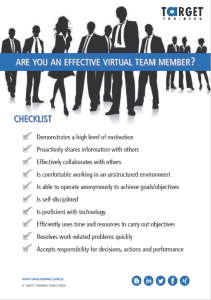
CHECKLIST – ARE YOU AN EFFECTIVE VIRTUAL TEAM MEMBER?

Not your typical phone call

Teleconferences are a great way to connect to people around the world. They’re less expensive than face-to-face meetings, often take less time, and solve problems more efficiently than emails do. Conducting a teleconference should be easy. All you have to do is connect everyone on the phone and make decisions as if you were all in person, right? Unfortunately, it’s not that easy. A teleconference is not your average phone call. It is a meeting and needs to be prepared for as such. Below are some key points to help you remember that a teleconference isn’t your typical phone call.

3THINGS TO KEEP IN MIND FOR A TELECONFERENCE

Teleconferences aren’t difficult to carry out, but many people are not mentally prepared when joining. Having the awareness, through the 3 main points below, that your telecon is not just a normal call is a great start.

1. Plan

  • Send out an agenda beforehand with objectives, time(length) of call, participants, and specific results you want to achieve.
  • Identify roles: moderator, minute taker, etc. Remember, ideally the moderator and minute taker will be two separate people. Also, just because someone sent out the Outlook invitation, doesn’t mean they are automatically the moderator. Make it clear before the call.

2. Moderate

  • The moderator should ensure that the call starts on time, not too much time is spent on certain topics, and the call allows for everything to be covered within the designated time
  • The moderator should also open and close the call in an official way. Open: state the objectives and goals and introduce people if needed. Close: review the action items identified and what the next steps are.
  • The moderator should make an effort to include everyone on the call as best they can with pointed, open questions directed at specific people. This will encourage and facilitate participation.

3. Participate

  • Everyone should participate by being prepared to say something for each item. (You may not say something for each point, but you should be prepared to do so.)
  • Ask questions if you are not sure of something
  • Speak naturally in the direction of the microphone
  • Identify yourself when speaking (if necessary)
  • Pause occasionally so others may make comments
  • Try not to talk over others and interrupt by using polite phrases

More tips on teleconferences?

You might enjoy reading Chad Phillip’s post: Teleconference tips and phrases. The simple and practical checklists in our latest Ebook: The ultimate book of virtual teams checklists may also be of interest to you.

THE ULTIMATE BOOK OF VIRTUAL TEAMS CHECKLISTSVTchecklists

How effective is your virtual team?


Ensure your virtual meetings are productive

Virtual meetings can be tricky at times. Are they more like a telephone call or a face-to-face meeting? Well, they are a combination of both and should be treated differently. Here are some quick and easy “Dos” and “Donts” for virtual meetings.

New Call-to-action hbspt.cta.load(455190, ‘0455f399-a600-43a9-848f-986da3f8ea8e’, {});

Virtual Meeting “Dos”

  • Ensure all stakeholders essential to achieving the meeting’s goals can attend—Otherwise, reschedule it
  • Consider rotating the meeting time to accommodate those participants in different time zones
  • Prepare an agenda that outlines the meeting goals
  • Ensure meeting items/priorities/times align with meeting goals
  • Cancel a regularly scheduled meeting if you feel time could be better spent elsewhere
  • Send a meeting reminder with the agenda, needed materials, and information on the technology to be used at least three days before the meeting
  • Ask team members who are not speaking to put their phones on mute
  • Ensure everyone participates
  • Eliminate distractions—Ask people to turn off all smartphones, and to avoid email and instant messaging during the meeting
  • Side bar and report to make necessary side conversations part of the official function of the meeting
  • Document decisions and next steps


Virtual Meeting “Donts”

  • Hold a meeting if you can’t clearly answer the question “What is the purpose and expected outcome?”
  • Let meetings become “habit”
  • Attempt to cover more than five specific items per meeting
  • Allow side issues, “experts”, or native speakers to dominate the meeting
  • Hold a meeting even if any stakeholders essential to the meeting objectives cannot participate
  • Assume team members are clear about their roles and the meeting objectives
  • Continuously hold “marathon” meetings without any small-group brainstorming or breaks
  • Tackle critical topics at the start of the meeting
  • Let the meeting get off track by discussing the details of an action item that aren’t relevant to the meetings goals
  • Start late

More tips on virtual teams?

These dos and donts are only a small sample of the tips in our latest Ebook: The ultimate book of Virtual Teams checklists. Make sure you download a copy if you’re interested in maximizing your virtual team’s impact. Enjoy the read and… let us know what works for your virtual team!

Professional email communication is essential in business situations. However, people sometimes let their emotions get the best of them and send an email they later regret. Multiple punctuation marks, all-capital letters along with a rude and unprofessional tone are often used to show how upset the sender is. We have all received them at one time or another. You may have been guilty of sending one, as well.

A quick reaction to receiving such an email would be to immediately send a response even angrier than the original, but what would that solve? Answering with your own angry and emotional email would only lead to more problems later. The important thing to remember when receiving such an email is to remain calm. There is no reason to maintain the angry dialogue by responding in the same manner, but simply ignoring the email won’t make the issue go away either.

Writing emails that people read: Free eBook download

3 Tips on what to do to avoid emotional replies

Don’t write your response immediately. If you do, some of your own lingering emotions may show in your writing. Put the email aside until later in the day.

1.  After some time:

  • Take a deep breath
  • Try to see the situation from the sender’s position

2.  Ask yourself:

  • Why are they upset?
  • Is the issue a legitimate complaint, or has the sender lost sight of the big picture?
  • How can I help solve the issue?

3.  When writing your response:

  • Stay professional, diplomatic and objective
  • Stick to the facts
  • Do not respond to any of the original email’s unprofessional language or personal attacks

Emotional emails are often written to get a reaction and to bring awareness to a particular issue. Make sure you acknowledge this issue, but don’t try to pass the blame on to somebody else. By remaining professional, the sender will often realize how unnecessary their tone and language was.

Helpful phrases to help avoid emotional emails

Intro sentences:

  • “Thank you very much for taking the time to write me today.”
  • “I hope my email finds you well.”
  • “I have just read your email concerning…”

Addressing the issue:

  • “I understand your concern about…”
  • “With reference to your inquiry about…”
  • “Thank you for bringing … to my attention.”

Closing sentences:

  • “I appreciate your continued professionalism and patience as we resolve this issue.”
  • “Working together, I believe we can find a reasonable solution to this issue.”
  • “Your email has helped bring attention to this important issue.”

By keeping your email clear, concise and diplomatic, you open the door to a more efficient dialogue while also strengthening your professional relationships. Always avoid using language that you wouldn’t use if speaking to somebody face-to-face. If you have any phrases you like to use in these situations, please let us know below.  Also, check out our seminar on reader-oriented writing in English to improve your overall email communication.

What are the challenges in your virtual team?

Each virtual team has their own unique challenges, but there are always a few that seem to be consistently present.  In this short video, Scott Levey, Director of Operations, focuses on two of the most commons challenges we see when training virtual teams.  Having awareness of these, and other issues that may arise, will help your virtual team increase its effectiveness.


Want to improve your virtual team’s performance?  Make sure to download our eBook of Virtual Team Checklists and check out our Working Effectively in Virtual Teams seminar.

Do you ever give feedback virtually?

Do you give your suppliers, your clients and your co-workers effective feedback – both positive and constructive (negative)? Giving good, timely, constructive and actionable feedback is something that most of us have to put a lot of effort into. Do we praise theVTchecklists right things? When we give constructive feedback, do we make positive suggestions? Do we always remember to address the issue, not the person?

Giving feedback well is not easy. But, giving feedback well in a business world that is becoming increasingly virtual can be a real challenge. When we add a few of the complexities that come from interacting virtually, we have an even harder job. Some of these challenges include timing, reading reactions, specificity and tone. When giving feedback virtually, for example via email, here are a few suggestions and tips below to help you do a better job.

Free eBook
download

5 Tips for giving feedback virtually

1.  Make sure that the timing is appropriate – especially if your feedback is negative. Think about raising a child or a pet; you don’t tell them they did something wrong three days later!

2.  Make sure that the reader understands immediately what the email is about:

  • Use a subject line like: “Feedback on your proposal”
  • Tell them in the first sentence why you are emailing: “I’m writing to you with some feedback regarding the proposal you sent me on January 4.”
  • Tell them what feedback is included: “I have some feedback regarding the pricing and the payment process.”

3.  Break your feedback up. If you told them you had feedback about the pricing and the payment process, these should be two completely separate paragraphs. Give them headings if you wish.

4.  Try to be specific and give justification. For example:

  • “We liked your proposal. Especially the second page where you mentioned that the training would focus on our corporate values. This really fits to our company philosophy.”
  • “Unfortunately, we cannot agree to point 3 in section 2, relating to the payment options. This is not in accordance with our compliance policy.”

5.  When rejecting a suggestion, try to make a counter suggestion. For example:

  • “We cannot agree to point 3 in section 2. However, we could agree if the payment period was extended to 60 days.”
  • “I do not like the way you formatted the report. Next time, try to base it on the attached example or come and see me to discuss my expectations in more detail.”

Of course, there are many other things which can help to make giving feedback virtually more effective. Please feel free to add your extra ideas in the comments section below. Also, make sure to check out our seminar on Working Effectively in Virtual Teams to help improve your virtual team’s performance.


How are your Virtual Team meetings?

More and more meetings are being held virtually. Virtual team meetings are a trend that is bound to continue as it is far cheaper than getting everyone together. But it isn’t the same, is it? Unless you use webcams, you can’t pick up on any nonverbal communication going on. You can’t see people’s faces. You can’t see what they are thinking. To be honest, you don’t know what they’re actually even doing. You also, and this point bothers me the most, can’t have that cup of coffee together at the beginning where you exchange a few words often unrelated to business.

Why is the social aspect so important?

You completely miss out on the opportunity to establish any empathy or rapport with the people you are working with. Imagine for example that you are having a virtual team meeting to discuss solving a problem you have. If you don’t have any form of relationship with these people, how can you expect them to help? Isn’t it easier to request help from someone you know a little about? If you don’t know them at all, how can you choose the right way of talking to them to win them over? Of course, the need for empathy building will vary from culture to culture. Some will take an order as an order and just do it, but not that many. And what happens if you have a multi-cultural team?

What can you do to establish virtual empathy and rapport?

It is doubtful as to whether empathy can actually be taught. But there are techniques which help to develop it. Here are a few:

  • Begin the webmeeting on time, with a quick round of self introductions. It is important to hear everyone’s voice and know who is present. Remind participants that each time they speak, they should identify themselves again.
  • Log in early and encourage small talk while waiting for everyone to join in and at the beginning of the meeting itself – have that cup of coffee virtually. This will help to make a connection between people and give them a bit of character. In a remote meeting you often feel distant from each other, and this can make it difficult to interact. This feeling of distance happens, because the participants are in different places and often can’t see each other. Small talk helps to ‘bridge the distances’. Small talk also helps you to get to know each other and each other’s voices, so you know who is speaking and when. This will help communication later on in the meeting.VTchecklists

What can you talk about and what should you say?

Small talk can also give you valuable information about the other participants which could be important to the success of the meeting. What mood are they in? Are they having computer problems? Are they calling from a quiet location? Here are some topics we recommend using and some language to get you started. There are literally hundreds of things you could say, but it can be helpful to have a few prepared. You’ll see that some of these are particular to virtual meetings:

Location

  • Q: Where are you speaking from?
  • A: I’m at my desk.  How about you?

Weather

  • Q: What’s the weather like where you are? We’re clouded over!
  • A: We’ve got blue skies and sunshine.  Hope it gets to you soon!

Logging-in

  • Q: How did you find logging in?  I had a few problems.
  • A: It was fine.  What problems did you have?

Sound quality

  • Q: Can you hear me OK?
  • A: No sorry, you are a bit faint.  Can you please speak up?

Performance

  • Q: I am getting serious lag here.  How are you doing?
  • A: I am doing fine.  Maybe it is your internet connection.

Work

  • Q: How are things going in Marketing at the moment?
  • A: Oh, you know, busy as usual.  How are things in your department?

If you give lots of information in your answers, it makes it easier for the other person to ask more questions and keep the conversation going. If you just say ‘yes’ or ‘no’, it will stop the conversation. If you’re asking questions, remember to use open questions so that they can’t be answered with “yes” or “no”.

More on this topic can be found in our Using Collaborative Technologies Seminar. Do you have any tips you’d like to share on how to build empathy and rapport in your virtual team meetings? Let us know in the comments area below.


Is giving advice the same in every culture?

Giving advice to someone is not as simple as just telling them what to do, especially in an intercultural situation where more sensitivity needs to be applied.  The problem is that if the advice you give is too direct it can come across as a command. What if you haven’t understood the situation correctly or completely, and your advice is no good? The person seeking your advice needs ‘an out’ – a way that they can reject your advice, or reformulate their request for advice without losing face – or causing you to lose face!

Below you can see some typical phrases for giving advice across cultures in the form of tips which can help you ensure nobody loses face. They offer your conversation partner plenty of flexibility to take your advice or not, as they see fit. If you are able to offer advice in an objective, neutral, sensitive and respectful way when people come to you, then the risk of accidentally damaging a good working relationship will be reduced.

Language for giving advice across cultures


Tip: Clarify the limits of the question
Phrase: If I were you, I’d make sure you understand the limits of the question.

Tip: Ask how your advice sounds
Phrase: Asking how your advice sounds might help.

Tip: Be confident not arrogant
Phrase: If you ask me, be confident but not arrogant when giving advice across cultures.

Tip: Beware of giving unsolicited advice
Phrase: Bear in mind the difference between solicited and unsolicited advice.

Tip: Give the recipient an “out”.
Phrase: You could try giving the recipient an “out.”

Tip: Ask for follow-up
Phrase: In your situation I would make sure to ask for follow-up.

3 Benefits of using suitable language when giving advice

By ensuring the language you use to frame your advice is culturally sensitive you can:

  1. address your conversation partner respectfully
  2. avoid damaging relationships
  3. help establish trust and open channels of communication

If you are interested in learning more about doing business across cultures check out our seminar details. And for more details on intercultural communication take a look at our selection of blog posts.


How do you disagree with colleagues in meetings?
You’re in an international meeting with people from all over the world and it’s time for you to agree or disagree with the solutions being offered. Unfortunately, you can only agree on one solution – so you have to disagree with someone.

However, disagreeing with a colleague at work can be problematic. If they believe you’re being too direct – or even rude or aggressive, it could have serious consequences for your business.

If this has happened to you, you may be working with a different business culture, one that expects disagreement to be softened or said indirectly to save face and maintain good working relationships.

Here are some common diplomatic and polite ways of saying “no” which you can use in meetings to disagree politely and diplomatically.

Go to the eBook

Meeting phrases for disagreeing politely and diplomatically

1.  The partial agree

  • I agree with you to a point, but…
  • I understand what you are saying, however…
  • I see what you’re saying, but…

2.  Using words or phrases to soften your disagreement

  • I’m afraid, I don’t agree.
  • I’m sorry, but I just can’t agree.
  • Sorry, but I really can’t agree to that.

3.  Disagreeing using general doubt

  • Hmm, I wonder if it’s true that….
  • Hmm, I’m not sure it can work like that.
  • Hmm, I’m not sure whether it’s possible.

4.  Avoiding the negative

  • I don’t think that’s such a good idea. (NOT It’s a bad idea.)
  • I don’t think I can agree with you. (NOT I disagree with you.)
  • I’m not sure it’s the best idea. (NOT it’s the worst idea!)

Following these simple examples will help you maintain good business relationships when working with other business cultures and keep things positive and diplomatic in international meetings.  Want more ways to improve your meetings? Check out our seminar on facilitating meetings for more info on how.

FOR MORE INFORMATION

What is your CEFR level?

In Europe everyone talks about their language skills in terms of being somewhere between A1 and C2.

But what does this really mean? How do you really know what level you are? Does the next person have the same understanding of what that level really means? Do you even know what CEFR stands for?

In 273 pages the Council of Europe explain the whole concept and what each level of the Common European Framework of Reference for Languages (CEFR) mean.

The only problem is that I don’t actually know of anyone – language trainer, L&D professional, or client purchasing the training – who has read the whole thing. I’ll be the first to admit that I haven’t.

There are though a number of more succinct explanations available on the internet. And most training institutions, Target Training GmbH included, have their own documents which explain it in the way they think is most accessible to their clients.

What are the advantages of using the CEFR for business language training?

  • It is based on can-do statements which is far more useful than just having , for example, a grammatical syllabus
  • The can-do statements are largely practical
  • Provided levels are assessed correctly, and participants are not put up a level purely because they have finished a course and the training institution wants a happy client,  a certain level of standardization is offered

What are the disadvantages?

  • Put a group of experienced language trainers in the room to discuss a participant’s level. There will always be some discussion as to what the level is. One person focuses more on grammatical errors, another only listens for fluency, another for the use of interesting language, etc
  • The CEFR is of limited use when assessing corporate language training. The broad bands mean that the time needed to move up a level is too great to be assessed on anything less than a 12 month basis (100 hours to progress from an A1 to and A2, up to 400 hours to progress from a C1 to a C2)
  • Lack of relevance. The CEFR was not designed with the corporate environment in mind. The can-do statements are very general

Is what really counts being measured with CEFR?

At Target Training, we aim to improve participants’ performance at work in English in a short time.  Progress is generally shown in terms of being able to participate better in a meeting (and for someone else to notice), being able to write emails quicker and better than they could before the training, etc.   Such progress is difficult to assess using the CEFR levels.

If you don’t agree, have a look at the can-do statements in the document mentioned above and the suggested language points in the British Council /EAQUALs Core Inventory.

They are wonderful for the general English classroom, but need adapting to the world of business. And we really need to consider whether versions adapted for the business world are really the best way of assessing levels and progress. Most of us who carry out level placement tests notice that there is a clear difference in an individual’s general and business level. There isn’t a difference in the CEFR levels, and as the can-do statements are general, the level assigned will be general. This might not be accurate for the corporate environment. Let us know what you think in the comments area below. Also, check out our methods and tools that we use to ensure high quality training at the workplace.

Are you using too many presentation fillers when presenting?

Have you ever given a presentation and started using words like ‘umm’, ‘erm’, ‘well’, ‘I’m not sure’, ‘maybe’, ‘how can I put this’, etc. because you didn’t know what to say or how to answer someone’s question? Have you thought about the effect this has on your listeners? You want your listener to think that you know your topic very well, that you are well-prepared and that your English language skills are very good. Unfortunately, words and phrases like the ones above (which are called fillers) can leave your listener asking themselves why they should listen to you if you don’t really have anything important to say. Even worse, your audience might start focusing on these words instead of the topic of your presentation. That’s why it is important to know how to act when giving a presentation. Here are some tips for you to remember so your audience doesn’t get distracted by your words instead of hearing and remembering your intended message.

4 Tips to help decrease presentation fillers

1.  Know your material. This includes your slides, but also the English words you use on them, other jargon (or specific language) which is important to explain your product or strategy as well as verbs to make your presentation active. Using all of these correctly will reduce the need to use fillers because you are knowledgeable about your subject.

2.  Anticipate questions. Think about possible questions the audience might ask and the answers you might give before the day of the presentation. You might think this is a waste of time, but if you can anticipate the ideas and the vocabulary you might need in advance, you won’t need to use a filler phrase to gain time.

3.  Practice your presentation in advance.  While you might not need to memorize the presentation, you should go through it at least once before giving the presentation, (the more often, the better, however). Practicing the presentation means that you have said what you want to say out loud, that you have thought about your introduction and conclusion and that you have practiced using the visual aids, (slides, props, flipchart etc.) while speaking. This is not always as easy as it looks, especially while doing everything in another language! (For those of you who have a Target Incorporate Trainer in your company, you can ask them to help you with this).Contact us now

4.  Be comfortable with silence. Perhaps this sounds silly to you, but some people use fillers simply because they don’t like silence. In today’s world of constant sounds, it is an easy trap to fall into. This doesn’t mean, however, that saying something without content is better for your audience than saying nothing at all. Everyone, including your audience, needs a chance to think and organize their thoughts before responding to or asking a question. Allow them to do this without interruptions!


Finally, some words of advice. Don’t worry if you still use presentation fillers occasionally. Even native speakers sometimes use them. What’s most important is not to overuse them. Let us know if you have any comments below and good luck on your next presentation!  Also, check out our seminar on Presenting with IMPACT to get better results with your presentations.

How are you at giving constructive criticism?

Giving praise to someone, for example on a job well done, is easy and direct: “Well done!” – but what about doing the opposite, giving constructive criticism when someone’s performance is unsatisfactory?

The problem is that if the constructive criticism you give is too negative or direct, you might risk destroying a good working relationship with a valued member of your team.  Working  internationally means you also have to consider cultural factors when delivering constructive criticism, and it is very important to handle this with sensitivity.

Below are some standard phrases for giving both praise and constructive criticism, as well as some tips which can be used in a variety of cross-cultural situations to help you make your point sensitively and ensure that you get a positive outcome. After all, the reason for giving the criticism is to improve things in the future, right?

Writing emails that people read: Free eBook download hbspt.cta.load(455190, ‘aaa71860-e705-4a7e-b8e5-ab6e16849d2e’, {});

Phrases for giving constructive criticism


Praise:  This team works very well together.
Constructive criticismI’ve noticed that the team has some problems communicating.

Praise: The performance of the database is excellent.
Constructive criticism: The database performance needs to be improved so that

Praise: That sounds like a good idea.
Constructive criticism: I’m not sure that idea would work because

Praise: I love this application.
Constructive criticism: I can see some difficulties with this application, it could be improved.

Praise: You are very well-trained in ABAP.
Constructive criticism: How about getting some training in ABAP?

Praise: The project was a great success.
Constructive criticism: What do you think is the reason we had problems with this project?


5 Tips for giving constructive criticism

  1. Where possible, give concrete examples for your criticism. This helps the other person to really grasp what you are saying.
  2. Give the other person a chance to explain and to fix things if possible, make sure this is a two-way conversation.
  3. Say what you would like in future – and why. Let the other person see the bigger picture and get an understanding of your perspective.
  4. When discussing lessons learned, make sure you get input from the other person i.e., the expert, on how to solve the problems.
  5. Agree on specific targets and timelines. That way, the person receiving criticism walks away with a concrete guide on how to move forward.

By making sure your criticism is truly constructive and culturally sensitive you can have more meaningful discussions and avoid damaging relationships. Just remember, in most cultures you can be more direct when complimenting people than when giving constructive criticism. Let us know if you have any other tips that have worked for you in the comments areas below.  Do you want to improve your ability in communicating difficult news?  Click here to learn more.

Do you ever have someone using the meeting rooms that you booked?

Have you experienced conflicts with the meeting rooms in your company? Imagine this situation: you’ve done hours of preparation for a meeting with your customer. Your slides, documents and ideas are in perfect order and you’re feeling confident. You meet your client in the lobby of the building and direct him upstairs to the meeting room you booked months ago, especially for this meeting. When you arrive, you feel a rush of panic: the door is closed and you can hear the sounds of a meeting in progress. You open the door. What should you do and say? It is important to knock on the door, enter slowly, excuse yourself and politely clarify the issue. Here are some phrases to help your issues with meeting rooms.

Phrases to use when discussing meeting room conflicts


  • Excuse me for interrupting. Do you have a booking? / Did you book this room?
  • I’m sorry to interrupt. Do you have a reservation? / Did you reserve this room?

The verb ‘to book’ is helpful when we need meeting rooms. We can also use the verb ‘to reserve’.

  • Sorry for interrupting, but I have a booking here. / I booked this room. / I reserved this room.

If you checked and you know you’re in the right place at the right time, it can help to be assertive and confident.

  • Hello. Sorry to interrupt your meeting, but I have a booking at 12:00.

If it’s close to 12:00, this can be a friendly way to suggest the person already in the room needs to finish his or her meeting in progress.

  • Hi. Sorry to interrupt your teleconference, but I think I have a reservation here at this time. Can we check the calendar?

It might be necessary to look together and see how the conflict happened.


While these phrases can help in the uncomfortable situation that two people have booked the same room, this doesn’t really solve the problem. Employees around the world complain about meeting rooms in their office. Bookings are changed, rooms are double-booked and appointments are modified at the last minute. Do you have any tips for how to manage this sticky situation? It would be great to hear your thoughts in the comments section below. Want to improve your meetings overall? Click here for more information.

Do you send polite emails?  Each day at work we send and receive many emails.  The longer you spend writing and replying to emails, the less time you have for other important tasks.  Why should you waste time trying to be polite in emails when all you need is some quick information from someone or to give them a quick answer?  The answer is simple: relationships.  Building lasting relationships is key in business, and how you write your emails can help.  Taking a few extra seconds to show professional and personal respect can go a long way.  One easy way is by keeping in mind the ‘Hamburger Approach’ when writing your emails.  You may have heard of this method for giving feedback as a manager.  A hamburger has three main parts: the top bun, the meat, and the bottom bun.  Here is how you can use these parts to create polite emails.

3 Parts of the Hamburger Approach for polite emails

1.  Polite introduction (top bun)

The goal here is to start off your email in a positive way.  This is especially helpful if you are delivering unpleasant news to your recipient.  Jumping right into your subject can be read as being very direct and abrupt.

  • I hope all is well today.
  • Thanks for your email Tim. (when replying to an email)
  • I hope you had a good holiday/weekend/business trip.

2.  Information/Request/Update (meat)

This is where you discuss the main point of your email.  It could be a quick answer, a request, etc.

  • Regarding the management meeting on Tuesday…
  • That proposal sounds good.  Let’s meet…
  • I am writing about the changes to our…

3.  Polite close (bottom bun)

The last part finishes the email in a positive way.  Without a phrase, like the ones below, your email will seem incomplete and unfinished.  This could lead to a negative impression for the recipient.

  • Thanks for your time and have a good day.
  • Feel free to contact me with any further questions.
  • I am looking forward to seeing you next week at the meeting.

Example of a polite email using the Hamburger Approach


Bill,

I hope all is well today and you had a good weekend.  I am writing about the change in the meeting agenda for our conference next week.  Could you please inform the others about the new schedule before the end of the week?  This is important to make sure everyone is prepared.  Thanks for your help.  I’m looking forward to seeing you next week in Boston.

Robert


You don’t have to use this approach with every email.  If you are emailing back and forth all day on a topic, this isn’t necessary.  It is important for the first or second email in an email exchange.  Keep this Hamburger Approach in mind and it will help you write polite emails.  Let us know if you have any other suggestions in the comments area below.  Want more help with polite emails or to improve your writing overall at work?  Click here for information.

Every presentation is different. Or is it? In this short video, Chris Slattery, Managing Director and training enthusiast, outlines the three elements all presenters need to keep in mind to make sure their presentations runs well. By keeping the key elements of head, hand and heart in mind even the most inexperienced presenter can deliver a clear and memorable message.

Discover more about how we integrate the Head, Hand and Heart model into our seminars here.