Elvis, Statistiken und virtuelle Teams

Zum Zeitpunkt von Elvis’ Tod gab es schätzungsweise 170 Elvis-Imitatoren in der Welt. Heute gibt es mindestens 85.000 Elvis auf der ganzen Welt. Bei dieser Wachstumsrate wird “statistisch gesehen” jeder Dritte der Weltbevölkerung bis 2019 ein Elvis-Imitator sein.

Ich teile dies aus zwei Gründen. Erstens bin ich immer misstrauisch, wie man mit Hilfe von Statistiken eine Aussage machen kann – in diesem Fall eine absurde, wenn auch humorvolle. Zweitens können uns Statistiken helfen zu verstehen, was um uns herum geschieht. Es gibt viel mehr Elvis-Imitatoren auf der Welt als früher, und die Zahl steigt weiter an.

Virtuelle Teamstatistiken

“”Was hat das mit virtuellen Teams zu tun?”, höre ich Sie sagen. Verbringen Sie 10 Minuten im Internet, und Sie können zahlreiche Statistiken über virtuelle Teams finden. Hier ist eine Auswahl…

  • 66% der multinationalen Unternehmen nutzen in großem Umfang virtuelle Teams, d.h. Projektteams, Managementteams, Serviceteams
  • 7 von 10 Managern glauben, dass sich virtuelle Teams in Zukunft immer mehr durchsetzen werden.
  • Zwischen 49% und 52% sind der Meinung, dass Zeitunterschiede den Erfolg des Teams beeinflussen – wobei die Standardlösung darin besteht, dass die Mitarbeiter viel länger arbeiten, um ihre Verfügbarkeit für Teambesprechungen sicherzustellen.
  • 15%-28% der Teammitglieder sind der Meinung, dass ein Mangel an Bewusstsein über die Arbeitsbelastung anderer Teammitglieder ein wiederkehrendes Problem ist. Virtuelle Teamleiter empfinden das Problem als größer.
  • Irgendwo zwischen 51% – 79% der virtuellen Teammitglieder glauben, dass der Mangel an persönlichen Beziehungen innerhalb des Teams Probleme verursacht
  • Ineffektive Führungsstile wirken sich negativ auf die Leistung eines virtuellen Teams aus (25 % bis 71 %).
  • 55% bis 73% der virtuellen Teamleiter glauben, dass die Entscheidungsfindung zu langsam ist.
  • 71% der Teams sind der Meinung, dass es an aktiver Teilnahme unter den Teammitgliedern mangelt.
  • Zwischen 10% und 47% der internationalen virtuellen Teams sind der Meinung, dass unzureichende Englischkenntnisse die Ergebnisse des Teams negativ beeinflussen.
  • Unterschiede in den kulturellen Normen stellen auch Herausforderungen an die Kommunikation, Entscheidungsfindung und den Aufbau von Beziehungen innerhalb des virtuellen Teams dar (26 % -49 %).
  • 81% sind der Meinung, dass schlechte Kommunikation und unangemessener Informationsaustausch (zu viel oder zu wenig) zwischen den Teammitgliedern den Erfolg des Teams beeinflussen.
  • Nicht zu wissen, wie man die vorhandene Technologie effektiv nutzt, ist ein Problem für mindestens 1 von 5 virtuellen Teams.
  • Nur 16% der Teams haben ein Training zur Arbeit in virtuellen Teams absolviert.

Was hat das zu bedeuten?

Zurück zu den beiden oben genannten Gründen – ja, wir verwenden Statistiken, um einen Punkt über virtuelle Teams zu machen. Wir sind ein Ausbildungsbetrieb, und ja, wir möchten, dass Sie in das Training investieren. Die obigen Statistiken helfen uns jedoch zu sehen, was passiert. So wie es heute weit mehr Elvis-Imitatoren gibt als 1977, ist es klar, dass virtuelle Teams da sind, um zu bleiben, dass die Herausforderungen bekannt sind und dass wir anfangen müssen, diese Barrieren anzugehen und zu überwinden, wenn wir wirklich effektiv arbeiten wollen.

Natürlich kann kein Trainingsprogramm das Problem des zeitzonenübergreifenden Arbeitens lösen, aber praktisches Training spielt bei vielen anderen Herausforderungen, mit denen virtuelle Teams konfrontiert sind, eine Rolle. Ein aufgabenspezifisches Business-Englisch-Training kann die durch Sprachbarrieren verursachten Grundprobleme verringern, und wenn Sie ein interkulturelles Element in Ihr Training integrieren, können Sie das Bewusstsein für die Auswirkungen der Kultur auf Geschäftsbeziehungen und Kommunikation schärfen. Soft Skills Training kann virtuelle Teamleiter viel entspannter und effektiver machen, wenn sie Teams führen. Dies wiederum wird Herausforderungen wie langsame Entscheidungsfindung, Umgang mit Konflikten und aktive Teambeteiligung ansprechen. Und was die Technologie betrifft: sie ist nicht so anspruchsvoll. Es geht vielmehr darum, Ihre Werkzeuge effektiv einzusetzen und Ihre Kommunikation und Teamdynamik entsprechend anzupassen.

Eine Vorab-Investition in Trainingseinheiten kann und wird Ihren virtuellen Teams langfristig greifbare Vorteile bringen. Aber jetzt genug davon: Strassanzug und Perücke anziehen und los singen.


Free downloads

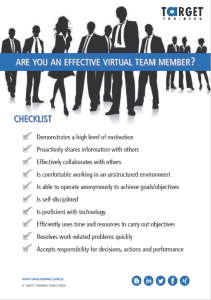
THE ULTIMATE BOOK OF VIRTUAL TEAMS CHECKLISTSVTchecklists

CHECKLIST – ARE YOU AN EFFECTIVE VIRTUAL TEAM MEMBER?

Buchbesprechung: 5 tolle Bücher zur Leistungssteigerung Ihrer virtuellen Teams

Wie wir von vielen unserer Teilnehmer in unseren virtuellen Teamseminaren gehört haben, sind die Herausforderungen von virtuellen Teams ähnlich wie die von Face-to-Face-Teams, nur  nochmal vergrößert. Hinzu kommen neue Herausforderungen, wie z.B. die Auswirkungen des fehlenden sozialen Kontakts, der die Teams zusammenhält, oder die Anpassung der richtigen Technologie an die richtige Aufgabe. Die unten aufgeführten Quellen helfen uns weiterhin, uns auf praktische Lösungen für die realen Probleme und Möglichkeiten virtueller Teams zu konzentrieren. Wir hoffen, dass sie Ihnen auch in einer virtuellen Umgebung zum Erfolg verhelfen.

VTchecklists

Free eBook download

Virtual Team Success

von Darleen Derosa & Richard Lepsinger

Dieses forschungsbasierte Buch ist eine Zusammenstellung von praktischen Ansätzen für virtuelles Teaming. Das Buch enthält eine Reihe hilfreicher Checklisten und Best Practices, die als Leitfaden für virtuelle Teamleiter und Teilnehmer dienen können. Der Verhaltensfokus von Virtual Team Success wird Ihnen helfen, Probleme zu überwinden, bevor sie auftreten, und zwar mit einer sachlichen Beratung, die auf echtem Erfolg basiert. Wenn Sie die Investition von Zeit, Energie und Ressourcen zur Verbesserung Ihrer virtuellen Teams rechtfertigen müssen, hilft Ihnen dieses Buch dabei. Die Prozesse zur Lösung gemeinsamer Probleme in virtuellen Teams sind ein Highlight.

Mastering Virtual Teams: Strategies Tools and Techniques that Succeed

von Deborah Duarte & Nancy Snyder

Die Autoren von Mastering Virtual Teams haben Best Practices, Tools und Techniken aus der Teamtheorie und dem Informations- und Wissensmanagement auf die Herausforderungen virtueller Teams angewandt. Sie haben die Informationen in drei leicht verständliche Bereiche gegliedert: Virtuelle Teams verstehen, erstellen und beherrschen. Ihre große praktische Erfahrung als Professoren, Berater und Wirtschaftsführer prägen den “how to”-Ansatz des Buches. Das Buch bietet ein Toolkit für Teilnehmer, Führungskräfte und Manager virtueller Teams. Praktische Werkzeuge, Übungen, Einsichten und Beispiele aus der Praxis helfen Ihnen, die Dynamik der virtuellen Teambeteiligung mit Richtlinien, Strategien und Best Practices für interkulturelles und funktionsübergreifendes Arbeiten zu meistern. Statt einfach nur “Vertrauen aufbauen” zu sagen, geben uns die Autoren beispielsweise drei allgemeine Richtlinien für den Aufbau von Vertrauen in einer virtuellen Umgebung an. Kein Wunder, dass diese Faktoren auch in zusammengesetzten Teams funktionieren. Sie haben eine CD-Rom mit der dritten Ausgabe beigefügt – eine einfache Möglichkeit, die Checklisten und hilfreichen Dokumente aus dem Buch auszudrucken.

Where in the World is My Team: Making a Success of Your Virtual Global Workplace

von Terrence Brake

Where in the World is My Team: Making a Success of Your Virtual Global Workplace folgt den Heldentaten von Will Williams, der seinen Weg in einen virtuellen Arbeitsplatz und das Leben eines jungen Berufstätigen in London geht. Als Erzählung, die die Best Practices virtueller Organisationen und Teams verwebt, hilft das Buch dem Leser, Schritt für Schritte, Seite für Seite mitzugehen und Where in the World is My Team: Making a Success of Your Virtual Global Workplace nicht nur als Ressourcendokument zu verwenden. Das Buch ist weit mehr als nur ein unterhaltsamer Blick auf das digitale Leben. Der sehr detaillierte Anhang des Buches bietet recherchierte Unterstützung für die in der Geschichte hervorgehobenen virtuellen Strukturen und Werkzeuge. Die 6 C’s der globalen Zusammenarbeit von Brake bieten einen logischen Rahmen für die Bedürfnisse effektiver virtueller Teams.

Leading Virtual Teams

Harvard Business School Publishing

Leading Virtual Teams ist eine schnelle und einfache Anleitung für diejenigen, die nicht überzeugt werden müssen, ihre virtuellen Teams zu verbessern, sonder lediglich Tipps dafür brauchen. Das Buch behandelt die Grundlagen für diejenigen, die ihre ersten Erfahrungen mit führenden virtuellen Teams machen. Es gibt Hinweise auf verwandte Harvard Business Publikationen, eine Erwähnung des Harvard Erweiterungskurses zum Thema Managing Virtual Teams, der virtuell unterrichtet wird, und einen kurzen Test als Check-on-Learning.

The Big Book of Virtual Team Building Games

von Mary Scannell & Michael Abrams

The Big Book of Virtual Team Building Games füllt einen aktuellen Entwicklungsbedarf für viele virtuelle Teams mit Spielen, die den Aufbau von Beziehungen, die Lösung von Problemen und Teamfähigkeiten fördern. Die Spiele sind so konzipiert, dass sie mit verschiedenen virtuellen Teamplattformen gespielt werden können und sind geschickt nach Tuckmans Stadien der Teamentwicklung – forming, storming, norming, performing, sowie dem zusätzlichen Stadium transforming – angeordnet. Jedes Spiel wird ausführlich mit der ungefähren Zeit für die Fertigstellung beschrieben. Beachten Sie, dass Teams mit Mitgliedern, die eine Nicht-Muttersprache verwenden, etwas länger dauern können, als vorhergesagt.


Warum, statistisch gesehen, Ihre E-Mails nicht so klar sind, wie Sie glauben.

Zum Zeitpunkt der Erstellung dieses Blogs werden schätzungsweise 269 Milliarden Mails pro Tag verschickt. Sobald wir alle Spam-Mails (sagen wir 50%) entfernt haben, ist das immer noch eine Menge Kommunikation. Doch wie effektiv ist E-Mail als Kommunikationsmittel wirklich? Einfach ausgedrückt – es kommt darauf an. Wenn eine Mail gut geschrieben ist, zum Beispiel mit dem SUGAR-Ansatz, kann E-Mail ein effektiver Weg sein, um Informationen zu kommunizieren und Ideen auszutauschen. Allerdings, wo E-Mail beginnt zu straucheln ist, wenn sie Emotionen enthält oder vermittelt. Und wir sprechen hier nicht über GROSSE EMOTIONEN – die meisten von uns wissen, dass es keine gute Idee ist, E-Mails zu verschicken, wenn sie müde, verärgert, wütend usw. sind. E-Mail-Kommunikation hat allerdings auch Probleme, wenn wir versuchen, viel subtilere Emotionen zu vermitteln – Ironie, Sarkasmus, Zufriedenheit etc.

Writing emails that people read: Free eBook download

Warum haben wir Probleme damit, Emotionen per E-Mail zu kommunizieren?

In unseren Gesprächen vermitteln wir Emotionen sowohl durch Worte als auch durch paralinguistische Hinweise (Körpersprache, Gesichtsbewegungen, Ausdrücke, Gesten, Ton, Intonation usw.). In der Tat wird es sogar komplizierter, da manchmal das Fehlen eines erwarteten paralinguistischen Stichwortes die Emotion oder einen gemeinsamen Kontext vermittelt, zum Beispiel beim Ausdrücken von Ironie oder Sarkasmus.

Wenn es um E-Mail geht, versuchen wir, Emotionen durch Wortwahl, Satzstrukturen und – ob man sie nun mag oder nicht – Visuals wie Emojis zu vermitteln (ja, sie sind mittlerweile auch im Geschäftsleben üblich).  Wissenschaftliche Untersuchungen zeigen jedoch, dass wir unsere Fähigkeiten beim Schreiben von E-Mails immer wieder überschätzen.


Warum das Schreiben einer E-Mail anders ist

Schriftliche Kommunikation ist nicht neu – aber die Allgegenwart und Verbreitung von E-Mail ist es!  Das Schreiben und Briefe verschicken bedeutete, dass wir in größerem Maße planten und überlegten, was wir schrieben und wie wir es schrieben. Niemand hat einen 3-zeiligen Brief geschrieben.  Heutzutage bedeutet die Geschwindigkeit und Bequemlichkeit von E-Mails, dass wir zu oft nur tippen und senden. Dies bringt eine ganze Reihe neuer Verhaltensweisen mit sich, und weil es so sehr Teil der modernen Kommunikation ist, nehmen wir uns keine Zeit, um zu beurteilen, wie wir die E-Mail verwenden oder unsere Schreibfähigkeiten zu schärfen.

Forschung zeigt: unsere Kommunikation per E-Mail ist nicht so gut, wie wir denken.

Es gibt viel Forschung von Sozialpsychologen darüber, wie wir per E-Mail kommunizieren. Eine interessante Studie zeigt, dass die Grenzen von E-Mail oft unterschätzt werden, wenn es darum geht, eine beabsichtigte Emotion zu kommunizieren – und dass wir beim Schreiben einer E-Mail immer wieder überschätzen, wie gut unser Leser verstehen, was wir sagen.

Veröffentlicht im Journal of Personality and Social Psychology, führten Kruger, Epley, Parker und Zhi-Wen Ng eine Reihe von Studien durch, in denen sie verglichen, wie gut ein E-Mail-Autor seine E-Mails gegenüber dem Leser bewertet hat.

  • In einer Studie erwarteten 97% der Autoren, dass die ernsten und halbsarkastischen Sätze in ihrer E-Mail korrekt entschlüsselt werden. Die Leser haben nur 84% erfolgreich entschlüsselt.
  • Eine andere Studie verglich das übersteigerte Selbstvertrauen bei der sprachlichen Kommunikation mit dem übersteigerten Selbstvertrauen bei der Kommunikation per E-Mail. Bei der Kommunikation mit der Stimme glaubten 77,9%, dass ihr Ton verstanden werden würde – während es in Wirklichkeit 73,1% waren. Eine spürbare Lücke ABER deutlich besser als die E-Mail-Ergebnisse, wo 78% glauben, dass ihr Ton verstanden würde, während es eigentlich nur 56% waren!
  • Aber es ist anders, wenn Sie einem Kollegen schreiben, der Sie gut kennt, oder? Möglicherweise nicht – eine dritte Studie betrachtete übersteigertes Selbstvertrauen, wenn sie mit Fremden oder mit Freunden kommunizierten. Überraschenderweise deuteten die Ergebnisse darauf hin, dass Vertrautheit nicht in Kommunikationsgenauigkeit übersetzt werden kann.
  • Und schließlich hat eine weitere Studie gezeigt, dass E-Mail-Autoren in ihrer Fähigkeit, in einer E-Mail lustig zu sein, sich stets selbst überschätzt haben!

Warum sind wir so überzeugt, dass unsere E-Mails leicht zu entschlüsseln sind?

Es ist einfach, den Lesern die Schuld zu geben. Vielleicht haben sie die Mail zu schnell gelesen, oder sie haben sie am Handy überflogen, als sie zu ihrem nächsten Meeting gingen. Vielleicht sind ihre Sprachkenntnisse nicht stark genug und sie müssen ihr Geschäftsenglisch verbessern. Oder – wagen wir es zu sagen – vielleicht sind sie einfach zu “blöd”, um unsere gut geschriebenen E-Mails zu verstehen!

Tatsächlich liegt es oft daran, dass wir egozentrisch sind. Studien wie Elizabeth Newtons “Tapping-Studie” – in der die Teilnehmer gebeten wurden, den Rhythmus eines bekannten Liedes, das sie hörten, zu klopfen  und dann abzuschätzen, ob ein anderer Zuhörer das Lied anhand ihres (überaus geschickten) Klopfens erraten würde (50% vs. 3%) – zeigen, wie leicht wir uns selbst davon überzeugen können, dass unsere Realität offensichtlich ist. Die Studien beleuchten auch, wie schwierig es ist, sich die Perspektive eines anderen vorzustellen (z.B. “Ich meinte es ganz klar ironisch – wie konnten sie das nicht verstehen?!)

Was können Sie also tun, damit Ihre Leser Ihre E-Mails richtig interpretieren können?

Hier sind drei Dinge, die Sie sich für die Zukunft merken können:

  • Bevor Sie auf Senden klicken, lesen Sie Ihre E-Mail mit Ihrem “Mehrdeutigkeits-Radar” erneut durch. Wenn etwas anders verstanden werden könnte, dann schreiben Sie es neu, erklären Sie es – oder löschen Sie es einfach.
  • Wenn die Mail eine emotionale Komponente hat, lassen Sie sie dreißig Minuten lang in Ruhe und lesen Sie sie dann erneut.
  • Wenn etwas ein Witz ist, benutzen Sie Emojis.

Und schließlich, wenn Sie nicht sicher sind, benutzen Sie das Telefon


Effektive E-Mail-Etikette für virtuelle Teams

E-Mail ist nach wie vor eines der häufigsten Kommunikationskanäle in virtuellen Teams – und das kann durchaus zu Spannungen führen.  Die proaktive Bewältigung potenzieller Probleme ist der Schlüssel zum erfolgreichen Start eines virtuellen Teams – deshalb diskutieren wir in unseren Präsenz- und Online-Seminaren mit virtuellen Teamleitern die Erwartungen.  Natürlich kommt dabei die Kommunikation ins Spiel und die Zeit, die für die Erstellung eines Kommunikationsplans aufgewendet wird, ist immer gut investiert. Wie Jochen, ein deutscher Projektleiter, sagte: “Es klingt so offensichtlich, dass wir nicht daran gedacht haben, es zu tun – und jetzt, wo wir es haben, kann ich schon sagen, dass wir einige echte Hindernisse gelöst haben”.

Erstellung eines Kommunikationsplans beim Start Ihres virtuellen Teams

Ein Kommunikationsplan beschreibt, welche Kommunikationsmittel Sie verwenden werden und wie Sie diese nutzen werden.  Zum Beispiel “wir benutzen Webex für Brainstorming und Problemlösung, wir benutzen Hipster zum Chatten und Teilen von Links und wir benutzen Email für….”

Bei der Erstellung des Plans geht es darum, Ansätze und Erwartungen zu diskutieren – und durch das Durchsprechen dieser Erwartungen können Sie verschiedene Einstellungen aufdecken und mit ihnen umgehen.  Ein Beispiel, auf das wir oft stoßen, wenn wir mit multikulturellen virtuellen Teams arbeiten, ist, dass ein Teammitglied erwartet, dass die Leute ein höfliches “Danke für die Nachricht” zurückschreiben, ein anderes kann dies jedoch als Zeitverschwendung – und sogar als lästig! – empfinden. Und weil E-Mail immer noch so allgegenwärtig ist, haben wir gesehen, dass die meisten Frustrationen von der Art und Weise herrühren, wie Menschen E-Mails nutzen (oder nicht nutzen). Damit Sie mit Ihrer Planung beginnen können, teilen wir Ihnen hier eine Liste von E-Mail-Verpflichtungen mit, denen einer unserer Kunden zugestimmt hat (natürlich mit deren Erlaubnis).

E-Mail-Verpflichtungen eines Software-Entwicklungsteams, das virtuell in 3 Ländern arbeitet

  1. Wir werden unsere E-Mails mindestens alle 3 Stunden überprüfen.
  2. Wir checken keine E-Mails, wenn wir in Meetings sind.
  3. Wir benutzen das Telefon und hinterlassen eine Nachricht, wenn etwas wirklich zeitkritisch ist.
  4. Wir schreiben E-Mail-Betreffzeilen, die sofort erklären, worum es in der E-Mail geht.
  5. Wir werden Schlüsselwörter wie “Erledigen bis zum XX” oder “zu Ihrer Information” in den Titeln verwenden.
  6. Wir gehen davon aus, dass jemand, der in eine E-Mail kopiert wird (cc), nicht antworten muss.
  7. Wir werden es vermeiden, “Antwort an alle” zu verwenden, wenn nicht jeder die Informationen unbedingt benötigt.
  8. Wir benutzen das Telefon, wenn 3 E-Mails zu einem Thema geschickt wurden.
  9. Wir akzeptieren, dass E-Mails, die von Handys gesendet werden, gelegentlich Tippfehler enthalten.
  10. Wir erwarten, dass größere E-Mails gut geschrieben sind.
  11. Wir verwenden keine BLOCKSCHRIFT (CAPITALS) und wir benutzen normalerweise keine Farben, es sei denn, etwas ist kritisch und wichtig.
  12. Wir verwenden fett, um dabei zu helfen, nach wichtigen Informationen zu scannen.
  13. Wir schenken den Personen im Zweifel immer das Vertrauen, wenn etwas auf zwei Arten verstanden werden kann.
  14. Wenn wir eine E-Mail in einem emotionalen Zustand schreiben, sind wir uns alle einig, dass wir sie speichern werden – und am nächsten Tag darauf zurückkommen. Und trotzdem wird ein Anruf von allen bevorzugt.
  15. Wenn wir zwischenmenschliche Probleme haben, verwenden wir keine E-Mails – wir benutzen das Telefon oder nutzen Skype für Unternehmen.
  16. Wir werden diese Liste jedes 4. Skype-Meeting überprüfen. Halten wir uns noch alle daran?

Die obige Liste ist klar und übersichtlich. Sie wurde in einer 30-minütigen Diskussion aufgebaut und sie funktioniert. Wir werben nicht dafür, dass Ihr sie wörtlich nehmt – aber warum nicht als Sprungbrett nutzen, um das Verhalten Ihres eigenen Teams zu diskutieren? Der Aufbau eines gemeinsamen Verständnisses im Vorfeld hilft Ihrem virtuellen Team, reibungslos und sicher zu kommunizieren.

Und wenn Sie mehr lesen wollen

Hier ist ein nützliches Dokument (auf Englisch) mit Tipps und Redewendungen für eine effektive Kommunikation zwischen verschiedene Kulturen.

Virtuelle Teams: Aufgaben vor dem Meeting

Was machen Sie vor Ihren virtuellen Teambesprechungen?

Die Vorbereitung auf ein Meeting ist wichtig, insbesondere für virtuelle Meetings via Telefonkonferenz oder Netmeetings. Es ist schwierig, in virtuellen Teams zu arbeiten, da man die anderen Teammitglieder nicht oft von Angesicht zu Angesicht sieht. Versuchen Sie also ein paar kleine Dinge vor Ihren Meetings anzupacken, um sich nicht weiter zu benachteiligen. Hier sind fünf einfache Dinge, die Sie vor Ihren virtuellen Teambesprechungen tun können, um sie produktiver zu machen.

5 Aufgaben vor dem virtuellen Meeting

1.  Teammitglieder identifizieren

Führen Sie die Entscheidungsträger, Fachexperten und Meinungsführer vor dem Treffen auf und ermitteln Sie ihr mögliches Interesse am Ausgang des Treffens.

Resultate:

  • Wissen, wen man wann ansprechen muss
  • Wissen, wer bestimmte technische Fragen beantworten kann
  • Informationen auf die Interessen der Entscheidungsträger fokussieren

2.  Grundregeln festlegen

Das Team entscheidet vor Beginn der Sitzung über ein akzeptables Meeting-Verhalten und hält sich gegenseitig für die Regeln verantwortlich; z.B. keine Unterbrechungen, Meinungsumfragen, immer eine Tagesordnung usw…

Resultate:

  • Förderung von Verhaltensweisen, die die Interaktion in der Gruppe verbessern.
  • Kein einziger “Vollstrecker” notwendig
  • Verantwortlichkeit durch Erinnern

3.  Veröffentlichung einer Agenda (Ziele)

Die Veröffentlichung einer Agenda sollte ein “Muss” sein, aber es passiert nicht immer oder nicht rechtzeitig, damit sich die Teilnehmer darauf vorbereiten können. Ein weiteres wichtiges Merkmal einer Agenda ist eine Absichtserklärung oder ein Ziel. Was wollen Sie mit dem Treffen erreichen? Wie sieht ein gutes Meeting aus? Die Beantwortung dieser Fragen wird Ihnen und Ihren Teilnehmern das Gefühl geben, etwas erreicht zu haben, wenn das Meeting vorbei ist.

Resultate:

  • Klare Richtung für das Treffen
  • Verbesserung der Vorbereitung der Teilnehmer
  • Art und Weise, wie die Teilnehmer sich auf das Thema konzentrieren können.
  • Das Gefühl verspüren, etwas erreicht zu haben, wenn es vorbei ist.

4.  Beziehungen aufbauen

Nehmen Sie sich vor dem Meeting Zeit, um die Teammitglieder persönlich kennenzulernen. Es ist wirklich wichtig, eine Beziehung und eine Verpflichtung zum virtuellen Team aufzubauen.

Resultate:

  • Lernen, woran andere, über die Arbeit des Treffens hinaus, interessiert sind
  • Mehr Informationen helfen dem besseren Verständnis
  • Helfen Sie, Metaphern und Geschichten zu entwerfen, um die wichtigsten Punkte zu illustrieren.
  • Erhöhung des Engagements für das virtuelle Team

5.  Beherrschen Sie die Technik, die Sie in Ihrem Meeting verwenden

Das Verstehen Ihrer technologischen Tools, was schief gehen kann und wie man es im Vorfeld des Meetings beheben kann, ist entscheidend. Seien Sie informiert darüber, welche Werkzeuge Ihren Teilnehmern zur Verfügung stehen und seien Sie bereit, den Teilnehmern bei Problemen zu helfen. Haben Sie immer einen Notfallplan in der Rückhand!

Resultate:

  • Technische Probleme vermeiden, bevor sie auftreten
  • Zeitersparnis bei der Lösung technischer Probleme während der Besprechung
  • Andere Teilnahmemöglichkeiten parat haben

Sie können sicherstellen, dass Ihre virtuellen Teambesprechungen reibungsloser ablaufen, indem Sie sich ein paar Minuten Zeit nehmen und die oben genannten fünf Dinge tun. Was haben Sie noch getan, das gut funktioniert hat? Lassen Sie es uns im Kommentarfeld unten wissen. Wenn Sie Ihre Teilnahme an virtuellen Teams insgesamt verbessern möchten, können Sie unser eBook mit Checklisten herunterladen und unser Seminar “Effektiv in virtuellen Teams arbeiten” besuchen, indem Sie hier klicken.

Virtuell Feedback geben

Müssen Sie manchmal Ihr Feedback virtuell geben?

Geben Sie Ihren Lieferanten, Kunden und Mitarbeitern effektives Feedback – sowohl positiv als auch konstruktiv (negativ)? Gutes, rechtzeitiges, konstruktives und umsetzbares Feedback zu geben, ist etwas, wofür die meisten von uns viel Arbeit investieren müssen. Loben wir die richtigen Dinge? Wenn wir konstruktives Feedback geben, machen wir dann positive Vorschläge? Denken wir immer daran, das Thema anzusprechen, nicht die Person?VTchecklists

Feedback zu geben allein ist schon nicht einfach. Aber in einer immer virtueller werdenden Geschäftswelt gutes Feedback zu geben, kann eine echte Herausforderung sein. Wenn wir ein paar der Komplexitäten hinzufügen, die sich aus der virtuellen Interaktion ergeben, müssen wir eine noch schwierigere Aufgabe bewältigen. Einige dieser Herausforderungen sind Timing, Lesereaktionen, Spezifität und Ton. Wenn Sie virtuell, z.B. per E-Mail, Feedback geben, finden Sie hier einige Vorschläge und Tipps, die Ihnen helfen sollen, Ihre Arbeit besser zu machen.

Free eBook download

5 Tipps für das virtuelle Feedback

 1.  Stellen Sie sicher, dass das Timing stimmt – vor allem, wenn Ihr Feedback negativ ist. Denken Sie daran, wie ein Kind oder ein Haustier aufgezogen wird: Ihnen drei Tage später zu sagen, dass sie etwas falsch gemacht haben, ist kontraproduktiv!

2.  Sorgen Sie dafür, dass der Leser sofort versteht, worum es in der E-Mail geht:

  • Verwenden Sie eine Betreffzeile wie: “Feedback zu Ihrem Vorschlag”
  • Sagen Sie im ersten Satz, warum Sie eine E-Mail schreiben: “Ich schreibe Ihnen ein Feedback zu dem Vorschlag, den Sie mir am 4. Januar geschickt haben.”
  • Sagen Sie, welches Feedback enthalten ist: “Ich habe einige Rückmeldungen bezüglich der Preisgestaltung und des Zahlungsprozesses.”

3.  Brechen Sie Ihr Feedback auf. Wenn Sie gesagt haben, dass Sie eine Rückmeldung über den Preis und den Zahlungsprozess haben, sollten dies zwei völlig getrennte Absätze sein. Geben Sie ihnen Überschriften, wenn Sie wollen.

4.  Versuchen Sie konkret zu sein und begründen Sie Ihre Aussagen. Zum Beispiel:

  • “Wir mochten Ihren Vorschlag.” Vor allem die zweite Seite, auf der Sie erwähnt haben, dass sich das Training auf unsere Unternehmenswerte konzentrieren würde. Das passt wirklich zu unserer Firmenphilosophie.”
  • “Leider können wir dem Punkt 3 in Abschnitt 2, der sich auf die Zahlungsmöglichkeiten bezieht, nicht zustimmen. Das steht nicht im Einklang mit unseren Compliance-Richtlinien.”

5.  Wenn Sie einen Vorschlag ablehnen, versuchen Sie, einen Gegenvorschlag zu machen. Zum Beispiel:

  • “Wir können Punkt 3 in Abschnitt 2 nicht zustimmen. Aber wir könnten uns einigen, wenn die Zahlungsfrist auf 60 Tage verlängert würde.”
  • “Mir gefällt es nicht, wie Sie den Bericht formatiert haben. Könnten Sie es nächstes Mal anhand des beigefügten Beispiels versuchen oder kommen Sie einfach zu mir, um meine Anforderungen genauer zu besprechen.”

Natürlich gibt es noch viele andere Dinge, die helfen können, das virtuelles Feedback effektiver zu gestalten. Bitte zögern Sie nicht, Ihre zusätzlichen Ideen in den Kommentaren unten einzutragen. Besuchen Sie auch unser Seminar “Effektiv in virtuellen Teams arbeiten“, um die Leistung Ihres virtuellen Teams zu verbessern.


What should I do with my hands during a presentation?

Whether you are presenting, telling a story or just talking, how you use hands (or don’t use them) is important. An analysis of TED talks found that the most popular TED talkers were using 465 hand gestures over 18 minutes – compared to the least popular using just 272. Other research shows that gestures – more than actions themselves – impact our understanding of meaning. Put simply, you need to unleash the power of gestures when you present.

New Call-to-action

Your hands give you away (4 things not to do)

We have all seen somebody standing in front of a large group of people, trying to remain calm and hide their nervousness, and their hands giving them away. We can see they’re nervous and uncomfortable. When presenting, don’t:

  1. Keep them in your pockets. This will usually come across to your audience as too casual and is often perceived by people at as you trying to hide your hands because of nervousness. Like it or not, it is best to keep your hands out in the open for the world to see.
  2. Keep them in behind you. Hiding them behind your back can this makes you look distant and reserved or even uninterested in the people you are talking to.
  3. Place them on your hips. A stance with both hands on the hips will, more than likely, seem aggressive or authoritarian and definitely will not win you any friends in your audience.
  4. Hold them together. You’ll look as if you are defending yourself and come across as unconfident and vulnerable. Crossing them can achieve the same result too.

4 Things to do with your hands when presenting

When you are presenting, the focus should be on you. Therefore, use everything in your arsenal to ensure your audience is interested and informed. By using your body to help emphasize your words, your presentation becomes more dynamic, and your audience is more likely to remember your message. Use your hands and arms; don’t leave them at your sides. Be aware of your body and how it can help you.

Open up

If you maintain a closed stance, the audience may suspect you are hiding something and won’t trust you. Remember not to cross your arms or to keep them too close together. You are not a T-Rex, so don’t keep your elbows glued to your ribs. Claim the space and show your hands.

Use broad gestures

These should fit with what you are saying and not be used randomly. You know what you are going to say, so now decide how you are going to say it. Your body is an extension of your voice, so it is important to use confident gestures while you are practicing your presentation. With practice, the gestures will become more natural and a part of your dynamic speaking style. Use your hands to emphasize, to contrast or even to convey emotions in your story.

Show an open palm

By keeping your hands open and showing the audience your open palms, you are showing you have nothing to hide. The audience are more likely to feel they can trust you, and that you are sincere in your message.

The Palm Sideways

This is like holding your hand as though you were going to shake another person’s hand. This gesture is used to impress upon the audience the point you are making. You are opening up your message and showing them what is inside. You can also use this to point … without using your finger.

Videos

And keep in mind that you don’t necessarily need to be flamboyant and bounce around. You just need to be authentically you! This Target Training video from James Culver on storytelling  is a great example of how smaller and gentle movements can be natural and still reinforce the message.

What to do with your hands when you’re presenting

Two excellent and short video displaying tips and tricks.


4 essential tips

From the 2014 Toastmasters International world champion of public speaking Dananjaya Hettiarachchi.  You may feel that Hettiarachchi is a little theatrical for a business scenario, but the 4 tips are directly transferable!

Body language

This video is longer (just under 14 minutes) but comprehensive.  It covers all areas of body language when presenting and is definitely worth watching.

If you’d like more tips on presenting in general…

We have 37 blog posts related to presenting on our blog. Two further eBooks on presentations are available to download in the sidebar: “Presentation Models” and “Presenting with IMPACT.” Or, one of our seminars on this topic might be just what you need:


Watch, listen and learn: 3 great TEDx talks on listening

Many of our communication skills seminars involve practical listening activities, and occasionally we get requests solely for listening skills. But it’s arguably wrong to see listening as one of many “communication skills” – listening is so much more fundamental than that. Listening builds trust, strengthens relationships, and resolves conflicts. It’s fundamental in everything we do. In a HBR article “the discipline of listening”, Ram Charan shared what many of us already know: Not every manager is a great listener. Charan’s own “knowledge of corporate leaders’ 360-degree feedback indicates that one out of four leaders has a listening deficit, “the effects of which can paralyze cross-unit collaboration, sink careers, and if it’s the CEO with the deficit, derail the company.” Good managers need to know how to listen – and great managers know how to listen well. And because we know you’re busy we’ve taken the time to find 3 TEDx talks for you listen to.

New Call-to-actionThe power of listening with William Ury

William Ury is the co-author of “Getting to Yes”, the bestselling negotiation book in the world. This is a great video exploring what genuine listening really is, why it’s so important and how to take our first steps to improving our listening.  He explains why he feels that listening is “the golden key to opening doors to human relationships” and why the skill of listening needs to be actively practiced every day. Ury uses stories of conversations with presidents and business leaders to show the simple power of listening: how it helps us understand the other person, how it helps us connect and build rapport and trust, and how it makes it more likely that you’ll be listened to too.


The Power of Deliberate Listening with Ronnie Polaneczky

Grabbing our attention with the shocking story of an angry reader, journalist Ronnie Polaneczky expands on why we need to consciously and actively practice our “listening muscle”. By practicing deliberate listening and putting aside our own judgements we can discover things we don’t know that we don’t know.  She moves beyond the obvious “techniques” (e.g. look them in the eye, nod your head and repeat back what you’ve heard) and challenges us to think about letting go of positions (e.g. “I want to be right”) and embracing learning – letting go of our need to judge. She closes with the personal impact listening has – it doesn’t just change the person being listened to – it changes the listener.

A Case for Active Listening with Jason Chare

You may find this talk far removed from a business environment, but active listening skills are essential for those managers wanting to build a coaching approach. Jason Chare, a professional counselor, shares his experiences with an audience of teachers.  The second half (around the ninth minute) begins to look at specific strategies and attitudes – especially the importance of unconditional positive regard and listening with empathy.  Check out this article on “Three ways leaders can listen with more empathy” too!

More listening resources for you …

And if you’d like to know more about how you can further develop your or your team’s listening skills then please don’t hesitate to contact us. We’d love to listen to you.

Making sure managers understand the importance of their role in developing our staff

This month’s Secret L&D manager is Australian, based in Germany and works for an American corporation which produces machine vision systems and software.  He has worked in training and development for over 18 years – as an L&D manager, an in-house trainer and as an external training provider.

New Call-to-actionWhat are your challenges as an L&D manager?

One of the things that’s burning at the moment is helping the managers I work with see the role they play in developing people.  This is not a question of lack of willingness on their side – just a lack of awareness of the role they can and should play. For example, most of the time if they know that Dieter needs to improve his presentation skills, they send him on one of the 2-day presentation courses we run. When Dieter gets back, they expect that they can tick a box and say, “Well, Dieter can present now.” This is a start, but it isn’t good enough. It is not enough for them to assume that the training department or the training provider is going to solve everything alone. I need to help them see their role in developing their staff’s skills.

How do you see the manager’s role in developing their staff?

If we look at the 70-20-10 model, just 10% of the change will come from the training itself. 20% is when Dieter is learning from his colleagues, sharing ideas and giving each other tips and feedback. BUT, the other 70% will come from just getting up there and doing it (best of course, if supplemented with feedback and guidance where required). If the manager wants somebody to get better at a skill, they need to make sure there is plenty of opportunity for that person to actually use that skill, give them support and guidance and let them use what they are learning. This is clearly in the manager’s hands.  I want our managers to be realistic in their expectations and see the role that they play in the developmental process. We work together.

How do you see your role in this?

I have a number of roles. I work to identify current and future training needs. I then organize practical training with training providers who are going to deliver what we need and challenge the participants to really improve.  I also need to help our managers understand their role in developing our staff and encourage them to see training as a collaborative effort between them, the employee, us in L&D, and the training providers.  And of course, the person getting the training needs to take some responsibility and ownership for their own development – and I can offer advice and support here too, both before and after the “formal” training. Our experts need to be present in the training and they need to actively look to use what they have learned and practiced after the training too. And again, this is where their manager plays an important role.

Who is the secret L&D manager?

The “secret L&D manager” is actually a group of L&D managers. They are real people who would prefer not to mention their name or company – but do want to write anonymously so they can openly and directly share their ideas and experience with peers.

You can meet more of our secret L&D managers here …

And if you’d like to share your thoughts and experiences without sharing your name or company then please get in touch.

50 ways to start a conversation in English at work

Socializing and networking doesn’t come naturally to everyone. Whether it be a language issue  or a question of skills and behaviors, many professionals struggle when networking and socializing with new people. How do you start a conversation when you walk into a meeting room and there are a lot of people you don’t know? Introducing yourself is the obvious first step: “Hi, my name’s Renate and I’m a member of the purchasing team.” … Easy… but what comes next?  If you are shy this can be awkward in your own language –  AND doing it in a foreign language can be really challenging!  Our InCorporate Trainers often find that seemingly small challenges such as this can cause an unnecessary amount of pressure. A few trainers have come up with 50 phrases to help you break the ice and start a conversation. Many of the phrases can be used in any context – but some are only used in certain situations. You don’t need to remember them all just pick the ones you feel comfortable with and can say naturally.
New Call-to-action

Collecting someone from reception

  1. Did you have any problems finding us?
  2. Did you find the parking area ok?
  3. How are things going?
  4. I like your laptop bag. Where did you get it?
  5. Do you know…?
  6. What are you hoping to get out of today?
  7. How was your weekend?
  8. Did you hear that…?
  9. What have you been up to lately?
  10. Are many of your colleagues coming today?

Waiting for the presentation/meeting to start

  1. Is it OK if I sit here?
  2. I don’t think we’ve met before. My name is…
  3. Where are you from?
  4. I think you were at the XXX meeting last month, weren’t you?
  5. Do you know what the Wi-Fi code is?
  6. When did you arrive?
  7. What brings you here today?
  8. How was your journey?
  9. Nice weather / terrible weather, isn’t it?
  10. I could really use a coffee. Do you know where the machine is?

During the coffee break

  1. Do you mind if I join you?
  2. How’s the coffee?
  3. Can I pour you a coffee?
  4. What do you think of it so far?
  5. I was a bit late this morning; did I miss anything in the first 10 minutes?
  6. Which department are you in?
  7. Don’t you work with…?
  8. I can’t believe how many people are here today.
  9. Do you find it hot in here?
  10. I found it interesting that XX said …?

During lunch

  1. Is this seat taken?
  2. So, what do you think of this morning?
  3. Have you eaten here before?
  4. How’s your steak / fish etc.?
  5. Have you had a good day so far?
  6. Do you know many people here?
  7. Do you know what the program is for this afternoon?
  8. How did you get into this business?
  9. What do you do?
  10. Did you travel in today or come last night?

After a presentation/meeting

  1. What did you think of today?
  2. What’s been the highlight of the day for you?
  3. What have you learned today?
  4. I liked what xxx said about yyy.
  5. How’s today been for you?
  6. What do you think about…?
  7. What are you working on at the moment?
  8. How long have you been working here?
  9. Are you taking a taxi to the hotel/ train station / airport ?
  10. Do you have any plans for the weekend?

Even more resources

You’ve now got 50 practical phrases and of course there are  many, many more. Here are 5 more tips for you.

The power of putting yourself in their shoes when influencing people


When we run seminars on influencing skills we typically start off by exploring a couple of fundamental questions – one of them being how do people feel about the idea of influencing others and being influenced?  Over the years we’ve had a surprising range of responses including “If I’m the manager why must I influence -people should just do what I say” to “influencing is manipulating” to “I’m open to new ideas and approaches – but our colleagues in the order management department aren’t!”. As a trainer these are always great places to start – opinions are on the table and we can openly discuss them. When we dig deeper these opinions often link into personal experiences of how people have influenced (or not). So how do people influence each other?

Download it here hbspt.cta.load(455190, ‘9441b6d6-bb99-4122-9bfe-b037ddc918af’, {});

The two influencing styles – pushing and pulling

Broadly speaking there are two approaches to influencing people – to push and to pull. When we “push” we are directive. We know what we want to see happen, where we want to go, what needs to be different etc. And when we “pull” we are looking for a joint agreement, for collaboration, discussion, commitment.  There are different pushing styles and pulling styles, plus strategies, tactics and skills to learn BUT neither approach is inherently wrong. Influencing and manipulating draw on the same skills but with different intents.  They both have pros and cons– and neither approach work without considering other key factors too.

Factors to consider when seeking to influence somebody

When we try to influence somebody it helps to take a step back and reflect on what we know.  What is the environment, the situation, the relationship and most importantly – what do you know about who you are trying to influence? How successful you’ll be always depends upon what you know about the other person. Examples of practical questions to ask yourself when trying to influence somebody include:

  • how do they see things?
  • what is their context?
  • how they communicate?
  • how do they like to be communicated with?
  • how do they take in information and make decisions?
  • what are their experiences – with me, with change, with the theme I’m talking about
  • what turns then on? What turns them off??
  • what do they want to happen, not want to happen and why?
  • what are their hopes and fears?
  • Who else has an influence upon them? and does this influence help or hinder?
  • What is in it for them? their colleagues? Their organization?

First seek to understand the other person – a transcultural truth

The more you understand the person you are seeking to influence the more effectively you can influence them. As dale Carnegie said in How to win friends and influence people “I love strawberries. But whenever I go fishing I bait my hook with worms. This is because fish like worms – not strawberries.”

In English we have expression like put yourself in their shoes, put yourself in their place, see the world through their eyes and walk a mile in their shoes.  And of course the idea of putting yourself in somebody else’s shoes is transcultural!  Germans say eine Meile in seinen Schuhen gehen, Italians mettersi nei miei panni, French se mettre à la place de quelqu’un … All cultures- whether it be Europe, the Americas, Africa or Asia and the Pacific have similar expressions.

Put simply, if you want to influence somebody then seek to understand where they are and who they are.  Start by understanding their situation, use your emotional and social intelligence and then adapt.

And if, like me, you’ve got the song “Walk a mile in my shoes” going around in your head now .. here it is.


The importance of asking investigative questions in negotiations – and how to do this in English

There are times in negotiations when we can be too focused on our own position. If we want to get the best outcome then we need to find out why the other side asks what it asks, offers what it offers, and wants what it wants. One of the most effective ways of doing this is by adopting an “investigative mindset” – and then actively listening to what is (or is not) said. Harvard Business School Professors Deepak Malhotra and Max Bazerman set out 5 key principles that underpin this method. This post provides a simple overview of the 5 principles, offers useful phrases for those looking to further improve their business English, and closes with some great suggestions for further reading.

The big (free) eBook of negotiations language


Find out what your counterparts want – and why they want it

Asking questions to uncover needs and priorities is essential in any negotiation.  The sooner you can find out what your counterparts wants AND WHY they want it, the sooner you can build solutions. Malhotra and Bazerman give the example of an US pharmaceutical company  negotiating exclusive rights for an ingredient from a small European supplier. Despite the pharma company’s best offers, the supplier refused to agree to exclusivity. It was clear the smaller company had no chance of securing such a large order from any other customer – so what was going on?

With the negotiation in deadlock the American negotiator decided to ask a simple question “Why wouldn’t they grant exclusivity?” The reason was equally simple – the supplier was selling a small amount of the ingredient to a family member who needed it to manufacture a product sold locally. A new offer was made and quickly accepted – the European firm would provide exclusivity except for a small annual amount for the supplier’s cousin.

Discover your counterparts’ constraints – and then help them relieve them

Whenever we go into a negotiation we always have limits. In fact having your BATNA clear up front is a must if you don’t want to leave the negotiation with regrets. These limits are influenced and/or restricted by external forces – pricing, strategy, risk, relationships etc. And just as you have limits, so does your counterpart.  When your counterpart’s limits seem to be unreasonable or rigid, ask investigative questions to better understand what is behind the scenes. What is going on? Why is somebody responding like that? How can you help them remove their constraints or concerns?

Understand what is behind a demand – and then look to interpret them as opportunities

When our negotiating partner makes “excessive demands” we feel attacked and can become defensive. We then focus on either avoiding, mitigating, or even combatting this demand. The response of an investigative negotiator is to understand what is behind the demand and what they can actually learn from it. How can they reframe the demand from a threat to an opportunity? Malhotra and Bazerman article illustrates this nicely with the story of a construction company closing a major deal. Just before the deal was closed the property developer introduced a game-changing penalty clause for late completion.  In this case, reframing looked like “why was this penalty clause so important?” which led to “ timely completion was hugely important” which then led to “was the developer interested in completion ahead of schedule?“ . The negotiation concluded with the construction company agreeing to pay higher penalties than proposed and with a sizable bonus for early completion.

Look to create common ground

Despite the pervasive mantras of “partnership” and “win-win”, too often when we are in a negotiation it we end up with “”sides”. My side and your side, you are my competitor etc …This means that we miss out on opportunities to create value. Investigative negotiators focus on genuinely exploring areas of mutual interest to find real common ground.  This can be especially important when negotiating across cultures.

When things don’t work out keep on investigating

Even after rejection, there is nothing to be lost, and actually much to be gained, by asking “What would it have taken for us to reach agreement?” or “Can you explain to me why we lost this business? … as I’d like to learn for next time”.  It is much easier to get unguarded information when there is no deal to be done. If you don’t know what went wrong, how can you improve your approach in similar future negotiations? And of course there is always a chance of actually reopening negotiations based on the new insight.

Useful language and further reading for negotiators

 As Deepak Malhotra wrote “In the end, negotiation is an information game. Those who know how to obtain information perform better than those who stick with what they know.”

Using investigative questions

  • What is important to you?
  • Why is this important?
  • What is it you need?
  • Which part of my suggestion can you accept? Not accept?  And why?
  • Why can/can’t you ?

Building and practising active listening skills

Active listening (as the name suggests) is when you actively and fully concentrate on what is being said, rather than just passively hearing the words. Communication theory breaks what is being said into two elements – the content and the context. Content is the what – the data, the facts, the information etc. Context refers to everything else that is going on when somebody speaks with you – the relationship, the background, the situation, the emotions etc. Active listening involves paying close attention to the content being shared AND the contextual components between the listener (the receiver) and the speaker (the sender). Skilled active listeners can hear the what PLUS interest, emotion, concern, energy and other contextual factors from the speaker’s perspective. And they can hear what isn’t being said.

How good are your listening skills?

Books on negotiations

  • Negotiation Genius: How to Overcome Obstacles and Achieve Brilliant Results at the Bargaining Table and Beyond (Malhotra and Bazerman)
  • Never Split the Difference: Negotiating as if Your Life Depended on It (Chris Voss)
  • Getting Past No: Negotiating in Difficult Situations: Negotiating with Difficult People (Ury)
  • and the sequel Getting to Yes: Negotiating an agreement without giving in (Fisher and Ury)

Finally, as a training company, you just know we’re going to suggest organizing negotiation training for yourself or your team.

6 reasons why silence is golden in presentations

I recently delivered a two-day Presenting with IMPACT course for a group of highly-talented professionals, all of whom came from different countries and had different job functions.  Their levels of English varied slightly, as did their age, work experience and confidence.  The one thing this highly diverse group did have in common was their tendency to talk too much during their presentations. Why is that a problem you ask?  Aren’t we supposed to talk when presenting…isn’t that the point?  Of course it is, but there is a time when silence, or a nicely timed pause, works in your favor as the presenter.  We spent a lot of time working on the usage of pauses and silence in their presentations with great results.  So, I’d like to share with you 6 practical ways that silence can improve your presentations:

New Call-to-action

It slows you down

Many people struggle with speaking too quickly when they are presenting.  This can be due to nerves, having a lot to cover in a short period of time, etc.  Building planned pauses into your presentation allows you to slow things down, collect yourself and focus on enunciating your message to the audience.

It helps your audience absorb and retain your message

Using a strategic pause after stating your walk away message can allow it to better ‘sink in.’  I’d suggest doing this more than one time throughout your presentation at it will reinforce what you want the audience to do/think/feel after listening to your presentation.

It helps non-native speakers ‘catch up’

Many of our clients present in their second language, English, to an audience who are receiving the message in their second or third language.  Regardless of how talented someone may be in a second or third language, they still need more time to process things compared to their native language.  Using pauses can give the audience ‘space to breath’ and make sure they fully comprehend what you are saying.


“Silence is one of the great arts of conversation.”

Marcus Tullius Cicero

It shows willingness to listen and take questions

When a speaker is ‘speed-talking’ through their points, an audience can feel that things are rushed and there is no time for questions.  Fielding and asking questions in a presentation can work in the speaker’s favor if handled correctly.  It involves the audience and gives the presenter a chance to reinforce their walk away message in a context that matters to the audience.

It emphasizes important points

Silence is an effective tool to emphasize important points, build positive suspense and highlight things that need to be clarified.  Mark Twain once said, “The right word may be effective, but no word was ever as effective as a rightly timed pause.”

It shows confidence, control and poise

Most of us get nervous and experience stress when speaking in public.  The important thing is not show it when presenting if possible.  Using pauses and silence throughout your presentation will give you the breaks you need to collect yourself and refocus if need be.

Try it for yourself…

Using pauses and silence when speaking doesn’t come natural for a lot of people.  It takes practice and being open to feedback from colleagues or friends.  One quick and easy activity to practice using pauses is as follows:

  1. Write down 2 sentences on what you will do after work today. For example: I will finish work at 6pm and head to the supermarket. After shopping, I will go home and cook dinner for my family.
  2. Read the 2 sentences out loud as you normally would.
  3. Now, read the 2 sentences again out loud, but this time with a 3 second pause in between them. (count to 3 in your head between the sentences)

It sounds like a simple exercise, but many people have a hard time waiting the full three seconds to start the second sentence.  Try this with a colleague at work over lunch.  Ask each other how it sounds and how you feel.  Try it a few more times and then try using it at least once the next time you speak in front of people.

We have all heard the phrase ‘Silence is golden’.  Whether you agree with this or not, try to use a little bit of it in your next presentation.  I think you will be pleased with the results, and your audience will be too.

Does the Peter Principle still hold true? (And what you can do to develop your managers.)

Nearly half a century ago Laurence J. Peter published his seminal work on selection and promotion, “The Peter Principle”.  In this satirical look at why things go wrong in businesses, he argued that the selection of a candidate for a position is based on the candidate’s performance in their current role, rather than on abilities relevant to the intended role. Thus, employees only stop being promoted once they can no longer perform effectively, and “managers rise to the level of their incompetence.” His theory is so convincing that you feel it must be one of those natural laws that is just simply true, and indeed the Peter Principle is based on the behavioural observation that there is a strong temptation for people to use what has worked before, even when this might not be appropriate for the new situation.

eBook: The definitive checklist for qualifying training providers

Over the last couple of decades I have had the impression that the Peter principle is either out of fashion or no longer as relevant. Management training is now so widespread that all managers are now allegedly agile, change agents, ace communicators and inspirational. Yet intuitively I have always felt the Peter Principle in its elegant simplicity must still hold true, so you can imagine my relief when I came across an article in the Times by Alexandra Frean entitled, “Rise of the accidental manager lies behind UK’s low productivity”. She uses the term ‘accidental managers’ and explains “they have excelled in their role and are rewarded with promotion to a management position that is entirely different from the job they have been doing, only to flounder when they get there.” Does this sound familiar? The focus of her article is that accidental managers are more prevalent in the UK and account for the UK’s poor productivity. According to Ann Francke, head of the Chartered Management Institute (CMI), four out of five bosses in Britain are accidental managers; so 2.4 million managers are probably not delivering to full capability. And international comparisons indicate UK managers perform 30% below the benchmarked countries of Germany and Scandinavia. Francke does not agree that good managers are born not made and makes an impassioned plea for more and better training.

Which neatly brings us on to the question: What does effective management training look like? Here are four thoughts to consider:

Invest early

Building skills, knowledge and behaviors in young managers can provide spectacular results for years to come! Simply teaching and training simple skills for managing the task, the team and the individuals, does yield real returns. More investment at the beginning is a must especially training solutions for when they first move into management  .

Show the managers that their managers care about the training

Research consistently shows that when a training participant’s manager shows interest and involvement this is the single most important factor in transferring the training to the workplace. Involvement starts with explaining the purpose of the training and linking it to values, strategy and concrete business needs. It finishes with senior managers who are committed to delivering results through developing performance. And keep this human!

Fewer models

There are hundreds of management, communication, team, interpersonal dynamics, and strategy models. Good management training understands that models can be useful BUT they need to be simple to grasp, easy to remember and actionable. And be aware of trying to bend a model out of shape just to fulfil a trainer’s desire to show how everything fits. Managers can deal with complexity too!

Skill drills beat bullet points

It’s not what you know it’s what you do as a manager that counts. Discussing the role of feedback, exploring SCARF, sharing horror stories can be useful BUT the most important things is to get managers practicing, practicing and practicing.  Skill drills change behaviors and build confidence.  Yes, role-plays aren’t real but they give you an opportunity to experiment and practice! And my experience is that investing in business actors always add value too. This is why Target’s own leadership and management programs focus on doing (again and again).


Making a difference in meetings – 6 approaches for introverts to be heard

You’re too quiet”, “you need to be more involved in our meetings and discussions” and “people who matter are getting the wrong impression of you because you aren’t forward enough “.  This is the feedback Sven, a high-potential from a German automotive company, shared with me during a management training program. Sven was clearly able and bright – but he was a classic “introvert”. The idea of extraversion–introversion is a core dimension in most personality trait models, including the Meyers-Briggs Type Indicator. Sven is reflective rather than outgoing, and prefers working alone to working in groups.  Sven wanted to think before he talked, as opposed to talking to think. However, his natural introversion was getting in the way of his career opportunities.  Sven wanted to know “What can I do to be more involved in meetings … without having to be a different person?”
Go to the eBook

Always prepare before the meeting

If you don’t have the agenda then get hold of one. If the organizer hasn’t prepared an agenda then ask them what they want to get from the meeting and which questions do they want to discuss Who is going to be there? Why have they been invited? Who will assume which roles? Get your thoughts together ahead of time. Write down questions, concerns and points you want to share. Turn up with a couple of clear points you want to contribute. This preparation means that you can …

Speak up early on

If you know what the meeting is about you can and should get actively involved as quickly as possible. Get your thoughts on the table as quickly as you can. This means that you will feel part of the meeting from the start, others will see you as involved and you’ll notice people connecting, challenging, or building on your contributions. And if your meeting quickly goes into an unexpected direction …

Take control if you aren’t ready to speak

When somebody wants to pull you in to the meeting and you feel you aren’t ready then actively control this. You have the right to take a little more time. Try expressions like:

  • “I’d like to think this through fully first before I answer”
  • “I’m thinking this through and would like a little more time”
  • “I’d like to let this settle and think it over. Can I get back to you this afternoon?”

Be aware that there is a danger of over-thinking too, and you may find the meeting has moved on too fast. With this in mind …

Accept that sometimes you need to just speak

If you aren’t fully ready to speak but feel you can’t ask for time try expressions like …

  • “I’m just thinking out loud now …”
  • “My first thought is …”
  • “This isn’t a fully-formed suggestion but how about …”
  • “Ideally I’d like to think this over some more , but my initial impression is ..”

And you don’t always need to have original ideas. If you’re not at your best try to …

Play to your strengths and leverage your listening skills

Many introverts are considered good listeners. You haven’t been talking that much and you’ve probably heard things that others haven’t (as they’ve been busy talking). This means you can …

  • “If I can just reflect back what I’ve heard so far …”
  • “What I’ve heard is … “
  • “I heard Olaf mention XXX, but then everybody kept moving on. I’d like to go back and ask …”
  • “I think we’ve missed something here ..”
  • “There seems to be a lot of focus on XX, but nobody has thought about YYY”
  • “If I can play devil’s advocate for a moment ..”

Accept and embrace that you can’t be perfect (all the time)

Nobody wants to come across as stupid or incompetent. But if you aren’t visible be aware that people may quickly see you as “the assistant”, or “the doer but not the thinker”.  Everybody has said things that have been wrong, incomplete, or poorly thought through. And vulnerability is  important for building trust. We trust people who are human and fallible. Be open to risking sharing ideas and thoughts and try expressions like …

  • “This idea isn’t fully formed but maybe you can help me …”
  • “I’m concerned I’ve got the wrong end of the stick here so let me just check ..”
  • “I know I’m missing something but here’s where I am so far ..”

And finally…

If the English is an issue then consider getting some targeted training. By doing the above you’ll quickly begin to be seen as playing an active role, and be viewed as a contributor. You can also expect to grow in confidence over time as you see strategies working and people reacting to you differently.


Negotiations in English – tips and phrases (for beginners)

Working within a central purchasing and logistics business unit, negotiation is a word that one cannot escape. Most of my participants have dealings with suppliers within Germany, though some negotiate with suppliers worldwide. Negotiation skills are a key part of the on-the-job training and support that I deliver. In this post, I’ve collected some basic negotiating “musts” that I use in my training.

The big (free) eBook of negotiations language

Prepare

Preparation is the first key factor for all negotiations. In order for you negotiation meeting to be a success you must have clear goals in mind, acceptable alternatives and possible solutions, what you’re willing to trade, and finally what your bottom line is- where you are not prepared to budge. In “negotiations-speak”: You need to know your BATNA.

Start positive

Highlight all the positive goals both parties want to achieve for the day to reduce any tense atmosphere and break the ice with some healthy small talk.

  • Our aim today is to agree on a fair price that suits both parties.
  • I’d like to outline our aims and objectives…
  • How do our objectives compare to yours?

Effective questioning

Ask open ended questions in order to establish what the other party wants. Use questions to dig deeper, to uncover needs, to reveal alternative options, etc.

  • Could you be more specific?
  • How far are you willing to compromise?
  • Where does your information come from?

Agreeing

When your counterpart makes an acceptable suggestion or proposal you can agree to show enthusiasm and highlight how you are mutually benefiting from something. Revealing your stance will also help come to a favourable negotiation.

  • That seems like a fair suggestion.
  • I couldn’t agree more.
  • I’m happy with that.

Disagreeing

Disagreements are a normal and positive part of building a relationship and coming to an agreement, they show transparency. It is always a good idea to anticipate possible disagreements before going into a negotiation meeting.  However, disagreements should not come across threatening but instead should be mitigated and polite.

  • I take your point, however…
  • I’m afraid we have some reservation on that point…
  • I would prefer …

Clarifying

In order to avoid any misunderstandings especially in an environment where English is the lingua franca, it is fundamental to be clear about your goals but also ask for clarification when something isn’t clear to you.

  • If I understand correctly, what you’re saying is …
  • I’m not sure I understand your position on…
  • What do you mean by … ?

Compromising

Compromising is often required at times during a negotiation, and the way you do it is often an indicator of the importance of some of the negotiation terms. Remember, when you do compromise consider getting something for giving.

  • In exchange for….would you agree on..?
  • We might be able to work on…
  • We are ready to accept your offer; however, there would be one condition.

Bargaining

This is the moment to debate price, conditions or a transaction where one must be firm, ambitious and ready to justify their offers.  In this stage you can employ hard ball tactics or a softly softly approach, either way being prepared with a strategy will take you to the winning road.

  • I’m afraid we can only go as low as…
  • From where we stand an acceptable price would be…
  • Our absolute bottom line is …

Summarising

There are key moments when summarising will take place during a negotiation; concluding discussion points, rounds of bargaining and the final commitment.  This stage is also the moment of agreeing on the next steps and it is vital not to leave anything unsaid.

  • Let’s look at the points we agree on…
  • Shall we sum up the main points?
  • This is where we currently stand …

Of course…

There’s a lot more to negotiating. Sometimes not saying anything is a valuable approach, while creating and claiming value is also a must. Feel free to contact us if you’re interested in learning more about what we can do for you/your team. Or keep an eye on this blog, for more negotiation tips and phrases.

I’ll leave you with another great piece of free content: 1001 Meetings phrases.

Go to the eBook

Losing my mind on a deserted island: My challenges of working virtually

No, I don’t think I am really losing my mind, but some days I feel like it.  As Head of Sales for Target Training I work virtually each day. This means that I am working at clients’ offices, on a train or at home in my office.  I am constantly emailing, messaging, phoning and videoconferencing with my colleagues.  There are weeks where I don’t see any of my colleagues in person. I love the flexibility and autonomy of working virtually. There are a lot of advantages and it fits my lifestyle.  This way of working is becoming the norm for many professionals and with it come challenges. The key is to make sure you address the challenges before they start to affect your, and your team’s productivity.

New Call-to-action hbspt.cta.load(455190, ‘0455f399-a600-43a9-848f-986da3f8ea8e’, {});

I was in a client meeting a few weeks back discussing a virtual teams training project with a department leader.  We were looking into his team’s struggles in an effort to customize our training approach.  During our talk, he used the phrase ‘…with everyone working on their own little deserted island..’  when he was discussing his virtual team spread over 5 countries.  It struck me as a great analogy and got me thinking about my team.

So, I took a few minutes and wrote down the biggest challenges I personally face when working virtually.  I recommend doing the same as the exercise helped me raise awareness of what is happening and what I can do to improve things.  I had quite a long list after 10 minutes, but here are the three main struggles I thought I’d share:

1. Trust

Trusting the people that you work with is essential.  Without trust; conflict, misunderstanding and communication breakdowns occur.  In my opinion, trust is something that comes from two people investing in their working relationship.  This can be purely professional or a mix of personal and professional.  Trust can mean different things to different people, but I think most people would agree that it is easier to build when you see someone face to face on a regular basis.  You don’t always have that luxury when working in dispersed teams.  Building trust takes more effort and work.  What can you do to build trust in your virtual teams?

2. Email etiquette

Love them or hate them, emails aren’t going anywhere no matter what you might have heard or read. Emails can be a great way to quickly distribute information all over the world to a number of people.  They can also easily offend, frustrate and demotivate colleagues due to the smallest word, phrase or omission of something.  When you don’t have the ability to see someone face to face when communicating, you need to make sure your message and tone reflect what you are trying to say.  Even then, the reader may interpret things differently based what is happening on their ‘deserted island’ that particular day.  What should you do?  Use the phone when in doubt and establish some email rules for your virtual teams. 

3. Unnecessary virtual meetings/calls

There are different opinions out there on whether to have weekly catch up meetings scheduled or not, regardless of urgent discussion points. In my opinion, the fewer the calls the better.  My schedule changes quickly and needs to flexible to accommodate client demands.  So, when I see a weekly call on my calendar I look at it as a barrier to productivity, unless it is about something to move a project forward.  What can your team do instead of the weekly teleconferences?


As a kid, I used to fantasize about being on my own deserted island and doing what I wanted, the way I wanted, every day. That is my current reality, minus the beach. Working virtually is reality for most us and taking a few steps to improve our communication and relationships goes a long way. Give a few of the tips included in the links above a try and see how it goes!


FOR MORE INFORMATION

Read more on virtual teams on our blog. Or download our popular eBook below.

Writing emails that people read: Free eBook download


Linking and building to successfully influence others

In today’s business world of cross-functional initiatives, matrix structures and virtual teams, the ability to influence others is becoming even more essential if you want to succeed. And no matter what your influencing style is, to effectively influence somebody you need to connect with them. If you’re trying to influence somebody it means that you have differing opinions and ideas. One of the simplest ways to influence somebody is by “linking and building”: Find and focus on the agreement … and then build on this. Most people are open to sharing and discussing their opinions and ideas – and most of us are aware that our ideas are not the only ones valid. What we want is to be taken seriously and feel listened to.  This is where “linking” comes in – if you link your ideas to their ideas it clearly shows you have listened to and understood their thoughts and feelings.  And when you build on somebody’s ideas it means you are validating their contributions.  This builds rapport and relationships WHICH then makes the process of influencing so much easier...
The big (free) eBook of negotiations language


 5 things to keep in mind

1. Is the link already there?

Do you just need to draw their attention to it? Or will you need to build the link step by step? If so you need to find some common ground – this could be a shared goal, a previous experience or perhaps the two of you are seeing the same current challenges?  Open questions like “Where do you think we need to go?” or “What are your thoughts?” work well here …

2. When you find your “link”, be explicit about what you like / share about their views, opinion, drives etc.

For example. “It’s clear to me that we both want to make sure any changes we make don’t cost people more time” or “What I really like about your approach is that you’re considering the end-user first. I feel the same way”

3. Focus on positives and use positive language.

Most people are very rarely completely wrong, just as you are very rarely completely right.  Understanding this means that it is always possible to approach something by looking for the “right” ideas e.g. “What I like about your suggestion is …” thereby creating a positive spiral and rapport – as opposed to focusing on what you don’t like e.g. “ I can’t imagine this working” thereby creating a downwards negative spiral (source – George Prince – The Practice of Creativity).

4. There are going to be differences.

If there weren’t you wouldn’t be trying to influence each other! But make an effort to delay focusing on differences until some bridges have been built. When you turn to them, link back to the shared elements you’ve found and be explicit about your reasons. “It seems that we agree on the causes of the problem and we have different ideas about what needs doing. Why do you think this is?” Don’t assume the everything is obvious!

5. As you progress do continually clarify.

Use language like “So what you’re saying is …” and “Let me just check I’m understanding you … “. This shows your understanding of their views, ideas and thoughts AND actually ensures you do actually understand. Build your bridge on concrete foundations.

Linking and building is just one of many practical techniques from our influencing seminars that can help you successfully influence others. And it starts with getting all parties to face in the same direction. Please contact if you’d like to know more.


Meetings in English are fine but the coffee breaks are terrifying

Martin, an IT Project Manager, was getting ready for a meeting with his European counterparts to review his bank’s IT security. As ever he was very well prepared so I was a little surprised when he confessed to being nervous. However, it was not the meeting itself that was worrying him – it was the coffee and lunch breaks. His nerves were due to having to “small talk”. Small talk is an essential element of building relationships.  Yes, the meeting is all about dealing with business and discussing the items on the agenda but it’s in the breaks in between where the relationships are forged.
Go to the eBook

Why do some people find small talk so hard?

When we run seminars on small talk and socializing in English we hear many reasons why people struggle when they have to make small talk. Some people don’t know what to say, some are afraid of saying the wrong thing, some don’t know how to start a conversation, some are scared that people will think they are boring, some people find small talk a waste of time…and the list goes on. All of these objections, and fears are magnified when we know we are going to have to do it in a foreign language.

You prepare for the meeting so prepare for the small talk!

If you are nervous or uncertain about what to say during the breaks – prepare for them. First of all identify topics that are safe and suitable for the event and the people attending.  Depending upon the culture you are speaking with “safe topics” may be different but in general you are on safe ground with the following:

  • The weather – The forecast says it’s going to rain for the next 2 days. What’s the weather like at this time of year in Cape Town?
  • The event itself – I particularly enjoyed this morning’s presentation on big data analytics. What did you think of it?
  • The venue – This is one of the best conference centres I’ve been to. What do you think of it?
  • Jobs – How long have you been working in data security?
  • Current affairs, but NOT politics – I see they’ve just started the latest trials on driverless cars. I’m not sure I’d want to travel in one. How do you feel about them?

Opening a conversations and keeping it flowing

If you are going to ask questions, when possible, ask open questions. An open question begins with a question word – what, why, where, when, how etc. and the person will have to answer with more than a simple yes/no answer. Open question elicits more information and helps the conversation to develop. Similarly if you are asked a question (closed or open), give additional information and finish with a question. This will keep the conversation flowing.

7 phrases for typical small talk situations

  • Hi, I don’t think we’ve met before. I’m Helena Weber from IT support in Ludwigsburg.
  • I’m ready for a cup of coffee. Can I pour you one?
  • I believe the restaurant here is excellent. Have you eaten here before?
  • What did you do before you joined the product management team?
  • Where are you from?
  • Did you see the story on the news about…?
  • It’s a while since I last saw you. What’s new?

Don’t forget

Your counterparts may well be as nervous as you are and will welcome your initiative in starting and joining in conversation with them.  You could be taking the first steps in developing new personal and business relationships